
For Obama, Boehner's Retirement Alters Little
Published Sept. 26, 2015 • Read time: 7m
Join the Conversation
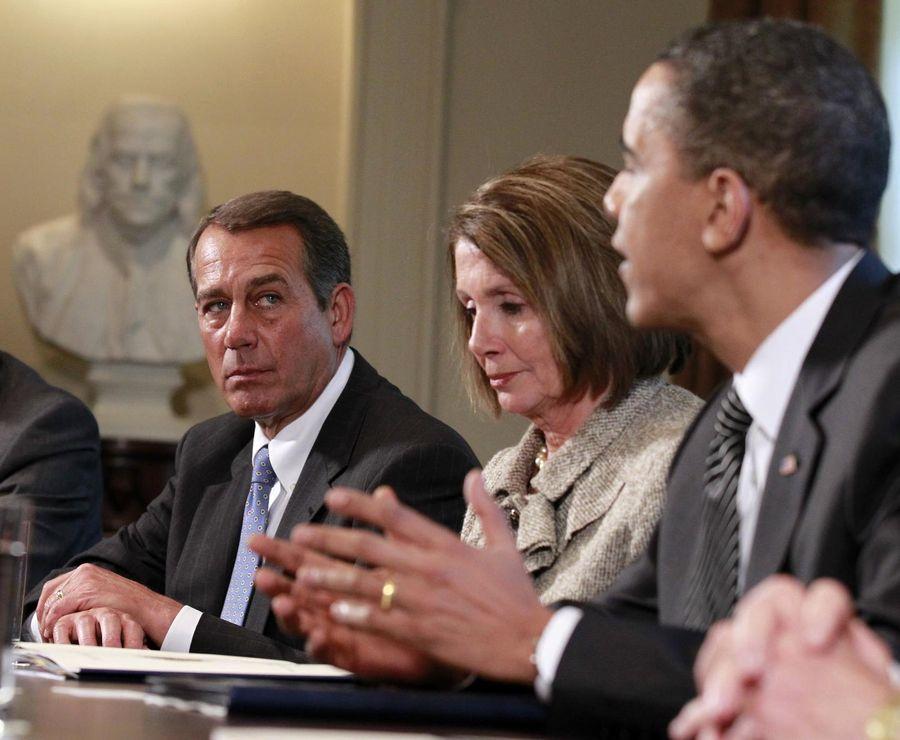
0President Obama has long viewed the House Republican conference as an ungovernable tribe and Speaker John Boehner as a closet pragmatist perpetually shackled by his colleagues’ firebrand disunion.
On Friday, surprised by the news that the speaker would retire in October, Obama praised Boehner as “a good man” and “a patriot” who understood that in governance “you don’t get 100 percent of what you want but you have to work with people who you disagree with, sometimes strongly, in order to do the people's business.”
Obama, who telephoned Boehner immediately after learning of his plans, pledged to reach out to the next speaker, and said he did not “prejudge” who that might be. There is scant optimism in the White House that a moderate, or more commanding, Republican will get the job.
Obama, in his second term, had to change how he’s governed in divided government because of the raw lessons he learned about Boehner’s conservative conference and the speaker’s reluctance to buck the Tea Party and social conservatives in his caucus. The president abandoned ambitions for accords on immigration, gun safety, a “grand bargain” budget accord, and sweeping climate change legislation, turning instead to executive powers that navigated around Congress. Obama amped up his megaphone to reach the American people, and he turned to the Senate when he needed to block House conservatives’ momentum.
His two significant legislative achievements this year – fast-track trade authority and blocking congressional disapproval of the Iran nuclear deal – were possible because the president learned to patiently build distinct coalitions of Democrats or Republicans around issues they cared about, with pressure from outside surrogates and advocates, the American people, and respected lawmakers.
Boehner’s colleagues – some motivated by ideology and others by politics – have sued Obama, tried more than 50 times to repeal his signature health care law, investigated agency missteps and policymaking, and challenged the president personally, often in harsh, partisan language. Boehner, heeding his caucus, invited Prime Minister Benjamin Netanyahu to address a joint session of Congress to oppose the nuclear deal with Iran last spring -- before an agreement was fully negotiated. The invitation to another head of state, without coordination with the White House, infuriated the president and his top aides.
Unless Boehner abandons his colleagues in dramatic fashion to forge a budget deal with moderates and Democrats in the next month, the president believes the speaker’s retirement amounts to a stark example of a Republican Party at war with itself.
“It's not as if there's been a multitude of areas where the House Republican caucus has sought cooperation previously,” Obama said during a Rose Garden news conference alongside China’s President Xi Jinping. “I don't necessarily think that there's going to be a big shift.”
Obama and Boehner sounded realistic about what might actually change when the speaker hands his gavel to a successor, although both invoked Pope Francis’s calls for unity and compassion while also professing some optimism.
“Hope spring eternal,” Boehner replied during a Capitol Hill news conference when asked how the House caucus might stabilize.
“Hopefully, they’ve learned some lessons from 2011,” Obama said, referring to the bitter battles that summer over the elusive “grand bargain” on deficit reduction and fiscal compromise. It eluded negotiators on both sides of the aisle. The budget impasses and GOP antipathy toward the Affordable Care Act later drifted toward a “fiscal cliff,” then new fights over approving Treasury borrowing to pay obligations, and eventually into a 16-day government shutdown in 2013. Along the way, the guillotine known as sequestration, which neither party wanted, became the blunt-force budget enforcement weapon to reduce federal spending.
“As I recall it wasn't particularly good for the reputation of the Republican Party,” Obama said of the perpetual fiscal divisions that began in 2011 and continue today. “Hopefully some lessons will be drawn there. I expect we'll continue to have significant fights around issues like Planned Parenthood and significant fights around issues like immigration,” he added.
That will surely be the case, but keeping the government funded and averting a shutdown next week may be easier after Boehner’s decision to retire. Still, tougher decisions will be kicked down the road for his conference. There are no guarantees that a reasonable accord on raising the nation’s debt ceiling or funding transportation, or alleviating the pressure of sequestration can be smoothed out in the fall.
“In the near term, there is no way that what is left of the sane part of the House Republican caucus is going to allow the Continuing Resolution to go down next week,” said Jim Manley, a longtime Democratic aide in the Senate and observer of the House GOP. Funding for the government runs out Sept. 30.
“But beyond that, the quiet expectation of many, including some in the administration, that a deal on spending, tax and debt limit issues could be reached later on in the year has been seriously damaged,” he added. “It takes two to tango, and no president in his right mind will be able to trust the new speaker under these circumstances to be able to deliver votes.”
Boehner’s preference to follow the House GOP conference and its most restive members rather than try to dictate to them forced Obama to trim his ambitions and rely on executive and regulatory authority to make strides. Those orders, including deportation enforcement waivers through the Department of Homeland Security, can be undone by the judicial branch, or by his successor when he’s out of office.
“I think the president had already internalized a pessimistic view of Boehner having the strength to negotiate big things with him, and it’s already impacted his second term. That pessimism clearly shaped much of his second-term strategy,” former Obama economic adviser Gene Sperling, who witnessed many of the fiscal battles with Boehner and his colleagues, told RealClearPolitics.
Speaking before hearing the president’s remarks, Sperling also sought to commend Boehner for good intentions. “I give the speaker real credit for always having personally wanted to do bigger and more constructive things than his caucus was ever willing to allow,” he added.
Some pointed to immigration as the test that displayed Boehner’s strengths and weaknesses. He believes immigration reform is important for his party to achieve politically if it seeks to be a national party. But in 2013, after a Senate bipartisan bill attracted 68 votes, House Republicans declined to take the bill up. The window closed for immigration reform to occur before the next president is inaugurated.
Obama said divided government has somehow made cooperation and compromise seem like betrayal to many Republicans in the House, and he has often been the target of their wrath. In the end, the president and Boehner, who have little in common besides a shared love of golf, have kept their distance in public, but conferred politely by phone when necessary, agreeing not to discuss those private calls for fear of inflaming their respective bases and undercutting what might be possible.
One Democratic source familiar with the Obama White House and the House speaker said Boehner has “an opportunity” to represent Ohio, his party and his country with some final, significant achievements before stepping down.
“There’s a chance for a lot of good things to get done if Boehner wants to do it,” he said. “But he hasn’t wanted to do that in the past.”




RCP Today
Top stories on RealClearPolitics
The Takeaway
Polling intelligence and analysis delivered to your inbox
World News
Featuring the latest world news
Policy
Featuring the latest policy news
Support Our Mission
As part of RealClearPolitics, authors aim to provide balanced, non-partisan analysis by presenting top reporting and commentary from all sides of the political spectrum.
Trusted by policymakers and citizens alike since 2000