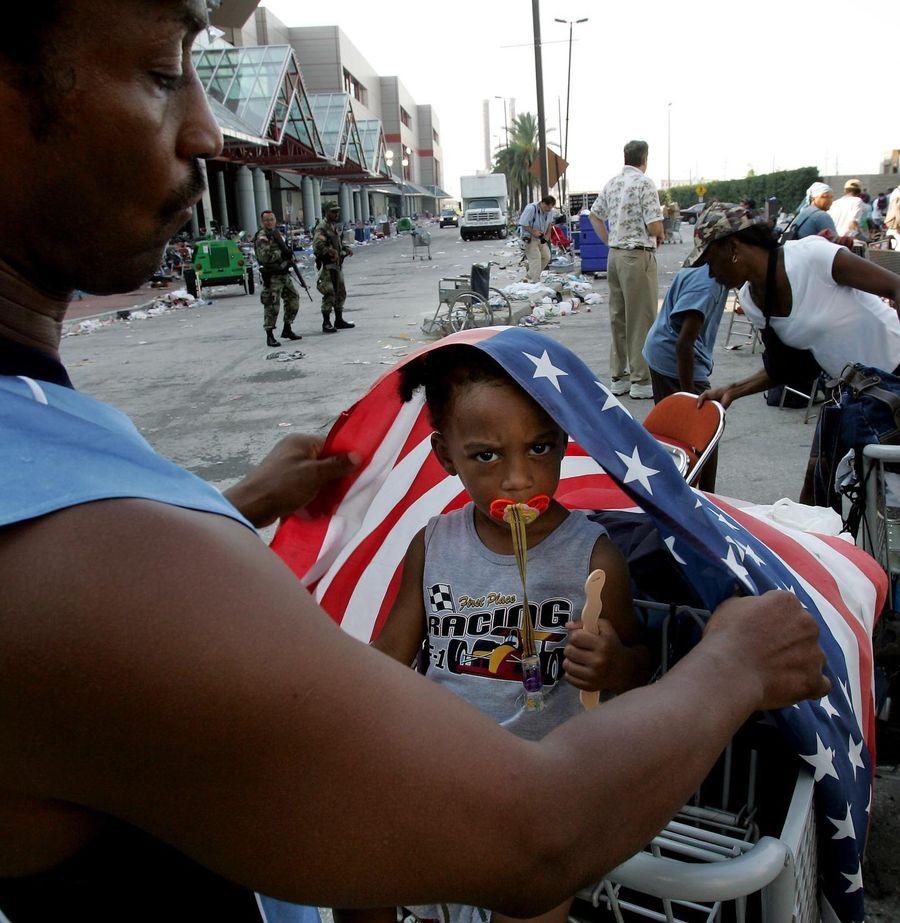
Ten Years On, Devastation From Katrina Remains
Published Aug. 11, 2015 • Read time: 7m
LOOKING out of her front window down Clouet Street, in the 9th ward of New Orleans, Clothilde Mack, who will turn 99 next month, reflected on how she might have died.
Two doors down from the clapboard house where the widow has lived since 1959, two young women and two children aged seven and four had been shot dead in 2010 by a 22-year-old man in an argument about money.
She had twice spotted the young man visiting the house. “If he’d seen me sitting out on my porch he probably would have killed me, too,” she said, recalling the tragedy.
“He just slaughtered that family. I used to see those two sweet kids at the bus stop in the morning.”
Ten years ago this month Mack had been even closer to death. After stubbornly opting to stay behind to look after her three cats, she was then trapped in her home in the upper 9th ward after Hurricane Katrina struck.
Some 1,833 people were killed by Katrina, most of them black and nearly half of them elderly. But despite high- profile restoration projects and rising property prices in the historic French Quarter, the poorer black areas of New Orleans have never recovered.
The city’s population has dropped by 25% and large parts of the 9th ward were returned to nature when the flood waters receded.
After an initial drop in crime, murders increased sharply in the past year. With 92 homicides in the first half of 2015, the murder rate is on track to equal that of 2004, the last year before Katrina when New Orleans was the undisputed murder capital of America.
Kids' Lives Matter Too
In a Corner of Ohio, Lessons of 2016
2016 Presidential Election Could Decide State Legislative Races
McCaskill Says No to Run for Missouri Governor
As the waters rose in August 2005, Mack told a 911 operator: “I know I am going to die here.” But she did not die. She survived on two tins of green beans and a few bottles of water, keeping a diary that recorded the rising and ebbing water levels and imparting details of her will and where her cats might be found.
Ten days later, as a reporter covering the disaster, I helped guide a boat through the fetid, chest-high water to 2006 Clouet Street as a helicopter hovered overhead. "Thank the Lord for you all!" Mack exclaimed as members of the Oregon National Guard opened the door.
She was evacuated to Tennessee but was adamant she would not live with any of her relatives or in a care home, stubbornly insisting she return to her house.
Three months after the storm, she returned to New Orleans, spending a year living in a FEMA trailer before moving back to the Clouet Street house, which was repaired and cleaned by Catholic Charities USA, in the autumn of 2006.
Mack had led a full life. Married three times to two men, she worked for the navy in Washington and, according to her family, as a nanny to the American football players and brothers Peyton and Eli Manning.
Originally from Pearlington, Mississippi, Mack never had any children. Part Choctaw Indian, she came from hardy stock. Her mother Mary Slocomb McGee, a diminutive woman known as “Big Momma”, was 95 when she died.
Now she is almost deaf and blind and it has been a year since she left the house to be taken to the casino, where she used to enjoy playing the slot machines.
Her Chevrolet car remains outside the house because, her grand-niece Cheryl Keith said, “she thinks that one of these days she goes to get in and drive it again.
Keith believes that it’s being in the house that keeps Mack alive. “If she had a gun, she’d shoot us if we told her she couldn’t live there.”
Clouet Street is also a shadow of its former self. There are overgrown vacant plots and abandoned homes. Some properties still bear the markings sprayed on them by the emergency services after Katrina.
One empty home is daubed with messages “RIP Geoff” and “RIP Daddy”, commemorating the wheelchair-bound man who drowned there during the flood.
“Before the storm, you knew all your neighbours,” said Rhonda Morton, 62, standing on the porch of the house in which she was born. She fled her home when the water “came down the street like the Mississippi” and spent the next two days in her sister’s attic.
“I came back but most didn’t. Old properties torn down and vacant lots just breed crime.”
Across the street James McNeil, 62, and Kevin Snowton, 59, were drinking cans of Busch beer outside a Katrina-damaged house they were fixing up.
In 2005 McNeil spent four days stranded on Claiborne Avenue Bridge before being lifted off by a helicopter. He came back to the Big Easy two years later but now regrets it.
“It seems like there’s a murder every night. Nobody down here has got a damn thing, but there’s car-jackings and burglaries and everything. I’m ready to go but I haven’t got enough money to leave,” McNeil said.
Snowton said thieves had stripped the copper from the air-conditioning systems of three churches in the surrounding streets. The wheels of his battered jeep had been stolen as he slept.
“Back in the day we used to fight and then shake hands,” he said. “Now these thugs smoke dope and have their boom box music on and if you look at them wrong they’ll try something stupid.”
He warned: “You might get shot down the street there. That’s just how a day goes.”
Tammy Hollins, 46, a school bus driver, said families had disintegrated after Katrina: “I look at people and I don’t know who is who. I think: is you the grandma or is you the mamma? I don’t know if it’s lack of jobs, lack of education, parents in jail, the way they was raised.”
Morale among the police is low. Officer Kevin Boswell shot dead Terrence Harold in the 9th ward after the 15-year-old pulled a gun on the policeman and shot him in the elbow and ankle. It was December 2006 and Boswell had not seen Harold because of the darkness — electricity still had not been restored to the street lamps after Katrina.
“The statistics don’t lie,” Boswell said, intimating that political corruption was endemic.
“Things are bad here. They are putting blindfolds and handcuffs and shackles on police officers and then they’re giving you a gun and a radio and a badge and saying: go do police work. When your hands are tied, it’s really hard to do.”
In the lower 9th ward, the most devastated part of the city, many roads have not been rebuilt and the area is a sprawling wasteland.
Dozens of solar-panelled futuristic homes built by Brad Pitt’s Make It Right Foundation look more in character with Nantucket than New Orleans. Families have moved in but, given the lack of basic infrastructure, the homes seem like an idealistic folly.
The lower 9th has received plenty of celebrity attention. Rumours circulated that Donald Trump, the property mogul and now Republican presidential candidate, wanted to buy the whole area. But it all came to virtually nothing.
Before Burnell Colton, 45, opened the only shop in the lower 9th last year, residents had to catch three buses to go to buy a loaf of bread. Many blamed gentrification, the former soldier said.
“Everywhere else in the city looks normal,” he said. “You can’t see Katrina in Bourbon Street [the main tourist thoroughfare in the French Quarter]. Katrina was a decade ago. I just want my community to look like the rest of the city.”
Back in Clouet Street, Mack said there was nowhere else she wished to be. Her three cats had died in Katrina but she now has another one that had been given to her during her spell in Tennessee.
“Sometimes I wonder why the Lord took others and left me to continue the battle. I know that I’ll die here but I’m happy that I’ve had a good life.”
This article originally appeared in The Sunday Times. It is reprinted here with permission.

Newsom Defies Voters, Juries and Lawmakers To Spare Murderers While Defending Abortion
Curtis Hill • RealClearPolitics
The Algorithmic Tilt
Frank Filingeri • RealClearPolitics
A RealClear Thanksgiving: Investing in a Better Future
David DesRosiers • RealClearPolitics
Trump’s Newsom Problem: Antagonist-in-Chief
Carolina Lumetta • RealClearPolitics
America’s Free Spirit
John Maxwell Hamilton • RealClearPolitics
The GOP Majority Should Go Out in Glory
Daniel McCarthy • RealClearPolitics
RCP Today
Top stories on RealClearPolitics
The Takeaway
Polling intelligence and analysis delivered to your inbox
World News
Featuring the latest world news
Policy
Featuring the latest policy news
Support Our Mission
As part of RealClearPolitics, authors aim to provide balanced, non-partisan analysis by presenting top reporting and commentary from all sides of the political spectrum.
Trusted by policymakers and citizens alike since 2000