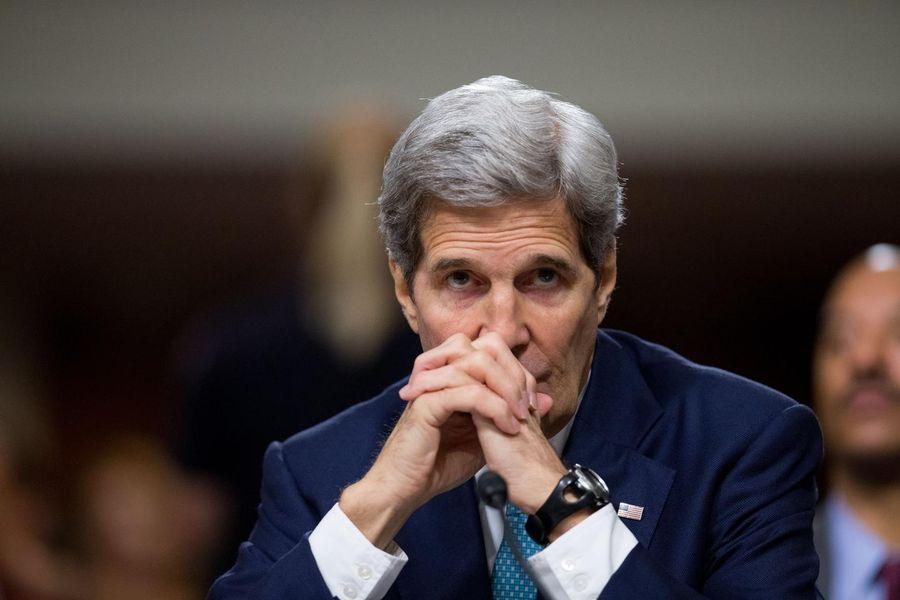
Tempers Flare on Day 1 of Iran Hearings
Published July 23, 2015 • Read time: 7m
The first public opportunity for lawmakers to question administration officials on the Iran deal came Thursday with a Senate committee hearing that provided a detailed and often heated debate over whether the historic agreement is the best path forward to preventing a nuclear Iran, and whether Congress may or may not halt it in its tracks.
Secretary of State John Kerry and Energy Secretary Ernest Moniz, the key negotiators of the agreement, appeared alongside Treasury Secretary Jack Lew for more than four hours of questioning from the members of the Senate Foreign Relations Committee. In the end, it was unclear whether any senators were swayed one way or the other by the testimony, and the agreement still faces stiff opposition and a potentially deal-breaking rebuke from Congress.
The positions of many on the 19-member panel – which is key to setting the tone of the review period – have been fairly clear. The vast majority of the 10 Republicans are vehemently against the agreement, and showed it through their questions. The nine Democrats, for the most part, appear cautiously supportive of the deal, though they have detailed questions and concerns still to raise with the administration.
It didn’t take long for the debate to become heated. Chairman Bob Corker, who until this point had said he was skeptical of the deal, but would not say outwardly that he didn’t support it, told the Cabinet members in his opening statement that they got “fleeced” by Iran on the agreement – a comment he later walked back. Not long after, Idaho Sen. James Risch told them they were “naïve” and got “bamboozled.”
McCain to Code Pink Protestors: Get Out of Here You Low Life Scum
AG Nominee Lynch Deflects Cruz Missile
Senate to Begin Hearings on Obama Attorney General Nominee
Democrats, Republicans Spar Over Benghazi Investigation
On the other side, Kerry, Moniz and Lew were ardent defenders of the agreement, with Kerry getting into several tense back-and-forth arguments with senators on both sides of the aisle, in some cases criticizing both their opposition and their approach. They had some support from Democrats, namely California Sen. Barbara Boxer, who approves of the nuclear agreement and chastised Corker and Risch for their comments.
“Putting aside the fact that I think that’s disrespectful and insulting … there are other ways to express your disagreement," Boxer said.
The debate also took an unavoidable turn into presidential politics due to the fact that two GOP White House contenders, Sens. Marco Rubio and Rand Paul, sit on the panel. Rubio began his questioning by pointing out that in 18 months, Obama will no longer be in the White House and that his potential successors are not legally or morally bound by the agreement.
“This is a deal whose survival is not guaranteed beyond the term of the current president,” Rubio said. “I personally hope that the next president is someone who would remove the national security waiver and re-impose the congressional sanctions that were passed by Congress because this deal is fundamentally and irreparably flawed.”
Kerry directly challenged Rubio for having no alternative – the Florida senator responded that he had presented alternatives to this deal – before directly attacking the idea that the next president would simply abandon the agreement.
“I am confident that the next president of the United States will have enough common sense that if this is being applied properly, if it’s being implemented fully, they’re not just going to arbitrarily end it,” Kerry said.
Paul took a notably different approach to his questioning, appearing much less hostile toward the witnesses despite his opposition to the agreement. He said at the outset that he was supportive of a diplomatic solution to Iran, which was preferable to war, but that this isn’t a deal he can support.
“I continue to support a negotiated solution and think it preferable to war,” Paul said. “I think a military solution in all likelihood will accelerate the possibility of them having nuclear weapons, of ending inspections, etc. However, it does have to be a good deal.”
Several exchanges broke the partisan mold, previewing some of the potential breaking points when the Senate ultimately votes on whether to approve or disapprove of this agreement. Sen. Bob Menendez, the top Democrat on the committee until he stepped down earlier this year after being indicted on corruption charges, is seen as one of the Democrats most likely to break with the White House on the agreement. He and Kerry had a fiery exchange on the ability to re-impose sanctions on Iran.
“If you’re going to snap back, you’ve got to snap back to something,” Menendez said to Lew, at which point Kerry attempted to interject to respond. Menendez cut him off, saying “Let me finish, Mr. Secretary. Mr. Secretary, please, don’t eat up my time. With all due respect, don’t eat up my time.”
The exchange repeated itself a few minutes later, when Kerry attempted to make a point and Menendez told him, “You’ve been with the Iranians two years and I have seven minutes.”
On the other side of the aisle, Arizona Republican Sen. Jeff Flake is seen as one of the few Republicans who could possibly vote in favor of this agreement. He said at the outset of his questioning that he had long been supportive of the negotiations and asked several detailed questions about the agreement in a cordial manner.
One of the main questions from Flake was whether Congress would be able to impose new sanctions on Iran for its support of terrorism, human rights abuses or other issues without violating the nuclear agreement, which the administration officials assured him they could.
Flake released a statement after the hearing stating some of his questions were answered, but others were not, and that he has concerns that some of the administration’s answers don’t quite compute with the text of the agreement.
At the end of the hearing, it was unclear whether any of the senators had been swayed. Maryland Sen. Ben Cardin on Wednesday asked reporters to “have patience” and pointed out that it is the fourth of 60 days of congressional review. Several hearings are planned on the committee in the next two weeks, and more briefings are likely.
The end of the 60-day review period comes in mid-September, at which point the Senate is likely to vote to disapprove of the agreement, though Obama has already vowed to veto that threat. It would take 67 senators – meaning at least 13 Democrats – to meet that threshold.
Some of the issues that remain are how nuclear sanctions against Iran would be put back in place if the country is found to be in violation of the deal; concerns over the length of time before inspectors are able to visit Iranian nuclear sites; frustration with the lifting of the conventional arms embargo after five years; and questions about what Iran will do with the billions of dollars it will get in sanctions relief. Many of those topics were addressed carefully in the hearing and likely will continue to be talking points in the coming weeks.
Kerry and Moniz had to cut the hearing short – after about 4 ½ hours, that is – to head across the Capitol to brief Democrats from the House on the deal. Kerry left after more than an hour briefing the House members, departing on the crutches he has used since breaking his leg in a bicycle accident earlier this year.
He declined to answer reporter questions about the briefings or the hearing, opting simply to say: “I’m all hearing’d out.”

Newsom Defies Voters, Juries and Lawmakers To Spare Murderers While Defending Abortion
Curtis Hill • RealClearPolitics
The Algorithmic Tilt
Frank Filingeri • RealClearPolitics
A RealClear Thanksgiving: Investing in a Better Future
David DesRosiers • RealClearPolitics
Trump’s Newsom Problem: Antagonist-in-Chief
Carolina Lumetta • RealClearPolitics
America’s Free Spirit
John Maxwell Hamilton • RealClearPolitics
The GOP Majority Should Go Out in Glory
Daniel McCarthy • RealClearPolitics
RCP Today
Top stories on RealClearPolitics
The Takeaway
Polling intelligence and analysis delivered to your inbox
World News
Featuring the latest world news
Policy
Featuring the latest policy news
Support Our Mission
As part of RealClearPolitics, authors aim to provide balanced, non-partisan analysis by presenting top reporting and commentary from all sides of the political spectrum.
Trusted by policymakers and citizens alike since 2000