
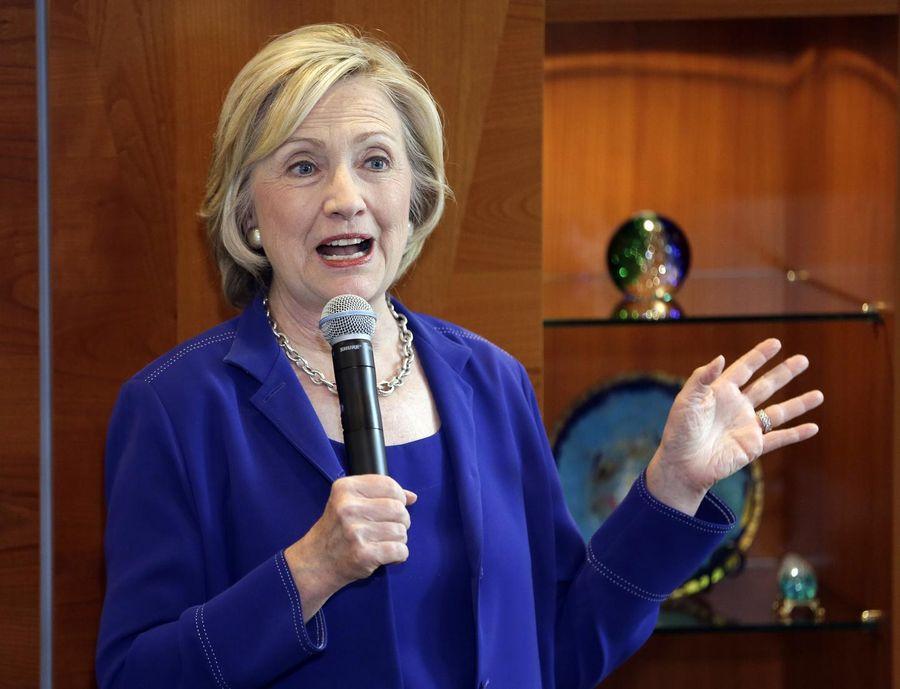
Clinton Blasts "Barrage of Attacks" From Right, Defends Email Handling
Published July 7, 2015 • Read time: 6m
In her first nationally televised interview since jumping into the presidential race three months ago, Democratic frontrunner Hillary Clinton on Tuesday defended her integrity, roundly dismissing Republican suggestions she does not respect the press and is withholding email correspondence.
Clinton’s decision to sit for an interview with CNN signaled a shift in the campaign’s media strategy that previously created a sometimes-testy relationship with journalists covering her campaign.
“I’m not running my campaign for the press. I’m running it for voters,” Clinton said, adding that she respects the many journalists who cover her campaigns and what they are charged with reporting.
The former secretary of state had largely avoided taking questions from the national press, at times going weeks without addressing controversies on a national stage involving her emails and donations to her family’s foundation.
Clinton’s communications team instead opted for a strategy that had the candidate answering questions from local reporters in Iowa and New Hampshire and interacting face-to-face with voters at smaller gatherings in the early voting states. Clinton said she has learned a lot from speaking with voters in small groups, because she was not involved in domestic politics in her most recent capacity as secretary of state.
According to Clinton, “nothing has changed” about her relationship with the press. “I’m determined to have the time that I need to actually meet and listen to people,” she added. The stated goal of the first 90 days of her campaign was to “get a feel” of what was on the minds of average Americans before laying out her specific policy proposals, she said. Clinton will present her economic policies in a speech on Monday.
The ongoing saga, meanwhile, has provided a plethora of fodder for Clinton’s Republican opponents, who continue to portray her as secretive and out of touch with voters. Recent polls show voters view Clinton as dishonest and untrustworthy.
“People should and do trust me,” Clinton said. “This has been a theme that has been used against me and my husband for many, many years.”
Clinton appeared especially aggravated by the repeated questions over the legality of her email practices while she served as the nation’s top diplomat. (Clinton used a private email account and server for personal and work-related communication.)
Clinton maintained, as she did during a new conference in March, that everything she did was permissible. “Let’s take a deep breath here,” she said with apparent frustration. “ …There was no law, there was no regulation that did not give me the full authority of how I was going to communicate.”
Clinton said she's been subjected to a "constant barrage of attacks that are largely fomented by and coming from the right,” and that conservative writers have made “unsubstantiated attacks” against her family.
“I turned over everything I was obligated to turn over, then I moved on,” she said. “I went above and beyond what anybody could have expected” in giving 55,000 pages of emails to the State Department.
A State Department official told RealClearPolitics last week the department never received 15 Libya-related messages exchanged between Clinton and a former confidant. She has repeatedly called for the speedy release of her emails, a process that will be completed by early 2016.
She acknowledged the media’s job to raise those concerns about her trustworthiness, but is confident that the American people will “sort … out” a controversy that has been “blown up with no basis in law or fact.” Clinton also accused Republicans in Congress of exploiting her emails for political gain, a veiled reference to the House committee investigating the 2012 terrorist attack in Benghazi, Libya that resulted in the deaths of four Americans.
Earlier in the day Clinton spoke in Iowa City, Iowa, a progressive enclave that houses the University of Iowa, where she touted her progressive values and the economic growth during her husband’s and President Obama’s tenures in the Oval Office. Winning over voters in the eastern part of the state is vital for the former New York senator and first lady, whose advisers are exercising caution about an insurgent Bernie Sanders.
“We are worried about him, sure,” the campaign’s communications director Jennifer Palmieri said Monday of the Vermont senator who has attracted the largest audiences of any candidate this election cycle.
Sanders’ growing crowds and accompanying message of combatting income inequality and blasting what he calls the “billionaire class” have resonated with progressives, especially in New Hampshire, resulting in a surge in the polls that even Sanders acknowledges he was not expecting.
“He will be a serious force for the campaign, and I don’t think that will diminish,” Palmieri added.
Clinton was asked directly about Sanders, but was reluctant to criticize her Democratic rival. “I always thought this would be a competitive race,” she said, pushing back against claims by some in her party that the primary voting process would be more of a “coronation” for her.
Asked if raising taxes on the wealthy – something Sanders and other liberal Democrats have championed for years – is on the table, Clinton would not answer directly. That and other economic issues will likely be addressed in her Monday speech.
Despite the negative press stemming from the aforementioned controversies and Sanders’ rise in popularity among Democratic primary voters, Clinton still maintains a healthy lead in the RealClearPolitics polling average nationally and in Iowa. Her lead over Sanders in New Hampshire, however, has continued to shrink.
Asked about real estate mogul and GOP presidential candidate Donald Trump’s comments during his campaign launch speech when he described Mexican immigrants who come to the U.S. illegally as “rapists,” Clinton called that characterization “disappointing.”
“I feel very bad and very disappointed with him and with the Republican Party for not responding immediately and saying, ‘Enough, stop it,’” she said.
Some GOP candidates have distanced themselves from Trump’s comments in recent days. Jeb Bush said bluntly, “Trump is wrong on this. He’s not a stupid guy, so I don’t assume he thinks that every Mexican crossing the border is a rapist. He’s doing this to inflame and incite and to draw attention, which seems to be his organizing principle of his campaign.”
Rick Perry said Trump “does not represent the Republican Party,” and Chris Christie called the comments “inappropriate.”
Clinton took advantage of the Trump controversy to criticize the GOP’s stance on comprehensive immigration reform.
“They are all in the same general area on immigration,” she said. “They don’t want to provide a path to citizenship. They range across a spectrum of being either grudgingly welcome or hostile toward immigrants.”
Clinton also took aim at Bush, claiming he is not in favor of a pathway to citizenship for the 11 million undocumented immigrants currently living in the United States. While Clinton used Trump’s comments to group all GOP candidates’ opinions together on the issue of immigration reform, Bush, Marco Rubio, and Lindsey Graham have come under fire from conservatives in their party who contend that their positions amount to “amnesty.”
“I’m 100 percent behind immigration reform that includes a path to citizenship,” Clinton said.


RCP Today
Top stories on RealClearPolitics
The Takeaway
Polling intelligence and analysis delivered to your inbox
World News
Featuring the latest world news
Policy
Featuring the latest policy news
Support Our Mission
As part of RealClearPolitics, authors aim to provide balanced, non-partisan analysis by presenting top reporting and commentary from all sides of the political spectrum.
Trusted by policymakers and citizens alike since 2000