
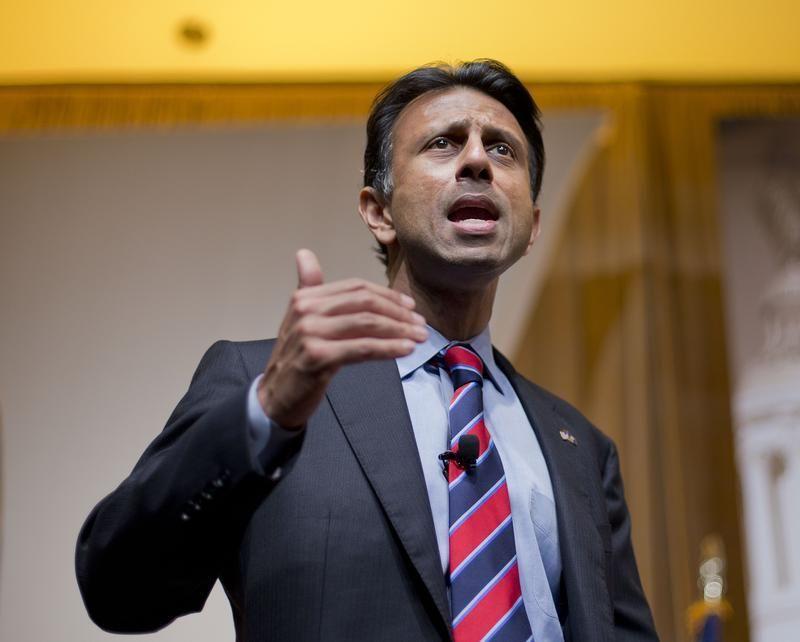
Rising Star to Long Shot: Jindal Joins GOP Race
Published June 24, 2015 • Read time: 8m
Join the Conversation
0Bobby Jindal is in last place in national and early-voting-state polls of the packed Republican presidential field. The two-term governor of Louisiana is less popular in his Deep South home state than President Obama is. What’s more, according to a recent survey, Hillary Clinton could beat him there—even though voters chose Mitt Romney by 17 points in 2012 and booted longtime Democratic Sen. Mary Landrieu from office last year. Even his kids seemed hesitant to embrace his plan to seek the Oval Office.
So why does he think now is a good time to run for president?
For starters, there’s nowhere to go but up. What many observers see as a long-shot bid, Jindal’s campaign sees a chance.
Jindal wore his underdog status as a badge of honor when he launched his presidential bid. “I'm running for president without permission from headquarters in Washington, D.C.,” the governor said Wednesday. “But rest assured -- I'm tanned, rested, and ready for this fight.”
The barriers, the campaign says, aren’t as high as they may seem. After announcing his presidential campaign in a New Orleans suburb on Wednesday afternoon—a launch that comes amid an emotional and politically transformational moment that has sidelined much campaign activity out of respect to lost lives in Charleston, S.C.—Jindal is heading directly to New Hampshire and then to Iowa. His strategy is rooted in these early-voting states, where his showing will make or break any further aspirations.
“As we’ve seen in early state surveys, it’s incredibly fluid: These voters are shopping,” says Wes Anderson, the Jindal campaign’s pollster.
A crowded field, Anderson says, can be an advantage to someone like Jindal. The thresholds for success are lower, given how many candidates are vying for the nomination. And the race to emerge as a viable alternative to Jeb Bush, the campaign says, is up for grabs. “You look at the difference between the leader of the outsiders, Scott Walker, and the tail end of the pack, like us, and you’re only talking about 11 points,” Anderson says.
But many other candidates stand between 11 points and one. With so much competition, Jindal’s challenge is to stand out (as it is for all of his rivals). In some ways, the 44-year old governor already does: He is the son of Indian immigrants, he’s a Rhodes scholar with an Ivy League degree who ran the state’s health care system at the tender age of 24, was appointed to run the state school system at 28, and got elected to the U.S. House by age 32. He won the governorship in 2008 and was quickly dubbed a rising GOP star, winning re-election in 2012 with 66 percent of the vote.
But equally remarkable is how quickly he then fell from favor. Perhaps his most public stumble on the national stage came when he delivered the Republican response to President Obama’s first State of the Union address. His delivery was rapid and awkward, and drew comparisons to an infamous “30 Rock” character. But that was a long time ago, and Jindal was still new to the spotlight.
What’s more telling, perhaps, is the way voters in his own state have soured on him, largely due to his handling of the budget (which plummeted from a $1 billion surplus to more than a $1 billion shortfall) and cuts to education, health care and government jobs. Time spent out of state pursuing national ambitions didn’t help.
In his announcement speech on Wednesday, Jindal said he shrunk Louisiana’s budget by 26 percent and cut the number of government “bureaucrats” by more than 30,000. “The big government crowd hates what we have done – they say we have cut government more than anyone, and that government budgets are always running low on funds with me in the governor's office,” Jindal said. “My response to the big government crowd is simply this – yes. I am guilty as charged, and our state is better off for it today.”
“When he left the state to go run for president, I don’t think that served him well here. We’re not used to that,” said Roy Fletcher, a longtime Republican strategist and consultant in the state, referencing those ongoing ventures into a bigger spotlight. “When the troubles with the budget hit, he was seen as being away from here, instead of attending to it, so he got the double whammy, and it just made a lot of people sour on him.”
But, Fletcher argues, it would be difficult for Jindal to make headway nationally even if he were well-received at home. “If he was the most popular governor in the history of mankind,” he said, “it would be hard to see how he emerges from a crowded field, because he’s from a small Southern state.”
Jindal has long been an avowed conservative, but his recent focus on social issues has nonetheless become a red flag in Louisiana, and underscored what some see as his presidential ambitions affecting state policies. Jindal came out strongly in support of religious freedom laws that stirred controversy in states like Indiana and Arkansas, where governors eventually softened their support.
When the legislature opposed him on this front, Jindal issued an executive order that would protect businesses and individuals from punishment for actions based on religious beliefs, such as denying services to same-sex couples. Though Jindal’s stance has drawn backlash from the business community, the convert to Catholicism said he would not back down.
“I know that some believe that I talk too much about my faith. But I will not be silenced in order to meet their expectations of political correctness,” Jindal said in his announcement speech. “They don't accept the idea that you can be both intellectual and Christian … Christianity is under assault today in America.”
Jindal began testing the 2016 waters by billing himself as the ideas candidate, a wonk focused on policy. Earlier this year, he released extensive policy papers on a number of issues, including energy. But as more candidates have entered the Republican fray, it’s become incumbent upon upstarts like Jindal to carve out a viable place in the field. And so he has signaled that he will court evangelical voters in the early states as a way to break out. In this light, the campaign views Jindal’s competition as much more limited than the broader field suggests. In other words, Jindal intends to compete against Ted Cruz, Mike Huckabee, and Rick Santorum.
“When you look at him and compare him against the [large] field, you say how on earth can he do it? But if you just compare him to the other candidates competing for the conservative vote, all of a sudden he becomes the candidate who has current accomplishments as governor, so that’s the angle he has to exploit,” says Craig Robinson, a Republican strategist in Iowa. Jindal’s low name recognition and standing in the polls could work to his advantage if he spends enough time in the Hawkeye State introducing himself to voters one by one. As Robinson says, “Sometimes never having a target on your back can be beneficial.”
The Jindal campaign plans to focus on Iowa caucuses, where evangelicals make up a significant portion of voters -- who can be welcoming to long-shot candidates. But Jindal will have to spend a lot of time there to be successful. He did not attend a couple of big ticket GOP cattle calls in the state, Robinson notes, and must put himself constantly on voters’ radar to stand a chance.
“Iowa is where we are certainly going to go full out,” says Anderson, the campaign’s pollster. “Every time we’ve stepped foot in the state, we’ve realized this is absolutely wide open and we’d be crazy to ignore that.”
Anderson said Jindal is also focusing on New Hampshire, where voters tend to be more moderate, and where the campaign also sees an open race. His advisers believe Jindal will appeal to the independent-minded electorate as a “truth teller” who can preserve what they see as the endangered American Dream.
While the campaign is focused on the early states, national polls will help dictate who makes it onto the prime-time debate stage Aug. 6 in Cleveland. As it stands now, Jindal would not make the cut and would miss out on a major opportunity to make an impression and improve his standing.
The campaign argues that they can’t control Jindal’s standing in national polls, but they will have the resources to compete in Iowa and New Hampshire. That mean voters there will see a lot of him in the coming months. “We have to put points on the board,” Anderson says. “So we have to hunt where the ducks are.”

RCP Today
Top stories on RealClearPolitics
The Takeaway
Polling intelligence and analysis delivered to your inbox
World News
Featuring the latest world news
Policy
Featuring the latest policy news
Support Our Mission
As part of RealClearPolitics, authors aim to provide balanced, non-partisan analysis by presenting top reporting and commentary from all sides of the political spectrum.
Trusted by policymakers and citizens alike since 2000