
Jeb Still Won't Sign Grover's Anti-Tax Pledge
Published May 2, 2015 • Read time: 4m
Join the Conversation
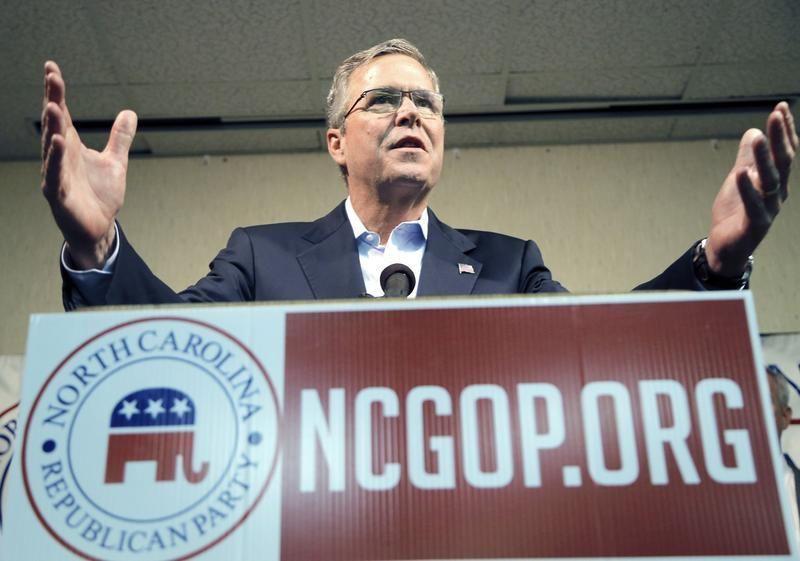
0Jeb Bush wanted to talk about tax reform, which he hopes to make central to his presidential bid.
But, at a National Review summit in Washington on Thursday, the discussion pivoted to Bush’s refusal to sign Grover Norquist’s anti-tax pledge.
"Is there any circumstance in which you would take that pledge?" asked National Review Editor Rich Lowry.
“No,” Bush said firmly — and began, as he does when he is asked this question, to lay out his record: as Florida governor, he reminded Lowry, he cut taxes every year.
"My record is clear," Bush concluded. "In fact, my record is as good or better than any."
But Lowry pressed Bush on the pledge. "So, it’s a principled opposition to pledges of that sort?"
"Yeah," Bush said.
"So, will you promise not to raise taxes?" Lowry tried, to laughter from the crowd.
This week, Sen. Marco Rubio signed the pledge as a presidential candidate, as he has during previous campaigns. Sens. Ted Cruz and Rand Paul, too, have signed on the dotted line.
The pledge has its roots in 1986, and during the 1988 presidential election, every Republican candidate except Bob Dole signed it. Since then, it has gained influence as a litmus test for Republicans, a dynamic apparently not on the wane in this election cycle.
“Those who refuse to take the pledge are, rightly, seen as suspect to Republican primary voters," said one senior Republican operative.
But Bush will not sign this pledge — or any other, for that matter.
"If Gov. Bush decides to move forward, he will not sign any pledges circulated by lobbying groups," spokeswoman Kristy Campbell told CNN earlier this year.
Lies, Assault and Cover-ups Don't Stop Donald Trump
Trump Stands by His Man; Obama on a Health Scourge; Hayden Interview; Reagan's Courage
Analysis: For Trump, Few Limits to Win-At-Any-Cost Approach
What If Clinton Isn't Indicted?
Bush might be the sole Republican with the inherent stature and name recognition to be able to do this. He has a compelling personal reason, too: After Jeb Bush’s father, President George H.W. Bush, signed the pledge in 1988 and promised “no new taxes” as a candidate, he raised taxes as president — and suffered the consequences when he was booted from office after one term.
There is also a practical component to consider for a candidate, who will receive dozens of pledges to sign and questionnaires to complete over the course of an election.
“Campaigns get deluged,” said Doug Heye, a former Republican National Committee spokesman. “I do think a blanket ‘I’m not going to sign any pledges’ is not a bad way to go.”
No doubt encouraging for Bush and his campaign is the impressive public support for not taking such a pledge.
An ABC News/Washington Post poll this month asked voters whether they would prefer a candidate who pledges to never raise taxes, or a candidate who does not make that pledge. Seventy-four percent said they would prefer the latter.
Grover Norquist, president of Americans for Tax Reform, the group responsible for the anti-tax pledge, dismissed such statistics in an interview with Real Clear Politics.
“The poll that matters is, in the last 30 years of elections, when you ask people if taxes are too high or too low, less than 4 percent will tell you too low,” Norquist said.
Bush has argued that his record as governor clearly demonstrates that he would not as president support higher taxes. But, for Norquist, Bush's record in Florida is insufficient.
“It’s not a question of what you did in one state during a period of economic growth,” Norquist said. "It’s easy not to raise taxes then.”
By not signing the pledge, Norquist argues, Bush has "opened up a question mark, where for most Republicans there would be none.”
“Last election, one candidate did not take the pledge: (Jon) Huntsman," Norquist added. "And I think he pulled out after New Hampshire.”
But Huntsman was an unlikely Republican nominee from the start — whereas Bush, as one of the party’s frontrunners, could conceivably clinch the nomination without ever signing on to Norquist’s pledge. Were such an outcome to occur, more Republicans might decide they no longer need the pledge.
Norquist insists he’s not concerned.
“Every two years there is a spate of articles about how the pledge is fading and it doesn’t matter anymore,” Norquist shrugged verbally in a phone interview Friday. “But the tax issue has been central to American politics for a long time, and will continue to be central for some time to come.”
The GOP Majority Should Go Out in Glory
Daniel McCarthy • RealClearPolitics
Republican Majorities Could Return Sooner Than Expected
J.T. Young • RealClearPolitics
The Danger Before the Attack
Leslie J. Sullivan • RealClearPolitics
Jon Finer’s Old and Dangerous ‘New Approach’ to Israel
Peter Berkowitz • RealClearPolitics
The President Deserves Better
John Ullyot • RealClearPolitics
Congress Doesn’t Need Another Blame Game. It Needs To Find What’s Broken
Jarrod Bernstein • RealClearPolitics
RCP Today
Top stories on RealClearPolitics
The Takeaway
Polling intelligence and analysis delivered to your inbox
World News
Featuring the latest world news
Policy
Featuring the latest policy news
Support Our Mission
As part of RealClearPolitics, authors aim to provide balanced, non-partisan analysis by presenting top reporting and commentary from all sides of the political spectrum.
Trusted by policymakers and citizens alike since 2000