
Should Republicans Bet on "Boots on the Ground"?
Published Feb. 23, 2015 • Read time: 5m
Jeb Bush may have given the first foreign policy address of the 2016 presidential race, but two Midwestern governors, Wisconsin’s Scott Walker and Ohio’s John Kasich, along with Sen. Lindsey Graham of South Carolina, may have determined the party’s foreign policy platform—for better or worse.
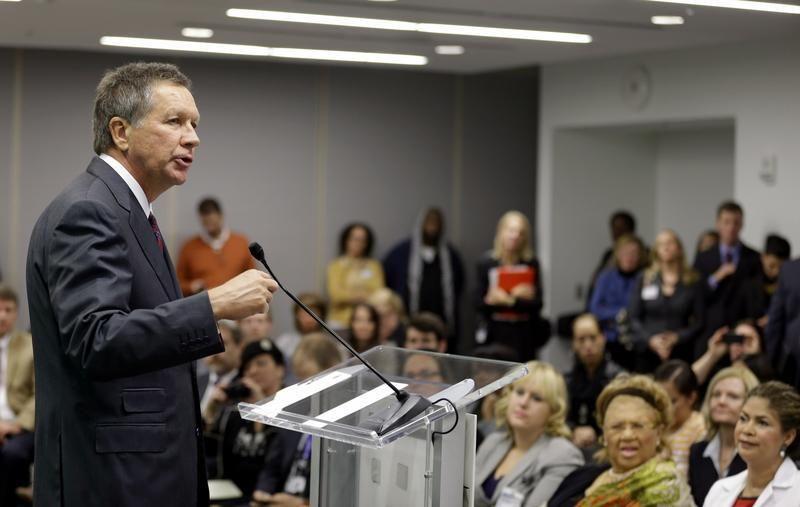
“Ultimately we have to be prepared to put boots on the ground if that's what it takes,” Walker told ABC’s Martha Raddatz while discussing ISIS. Kasich, whose own foreign policy musings suggest a presidential bid, last week raised the bar another notch by removing all qualifiers: “You will not solve this problem with only air power,” he told The Washington Post. “There needs to be a coalition of NATO, Arab states, and ultimately some boots on the ground to stop the advancement of that group.”
On Sunday, while hinting as a possible candidacy of his own, Graham said on ABC News, “I want the Republican Party to talk openly about the hard things, like having boots on the ground in Syria and Iraq, American boots on the ground."
One on hand, such a position should not be that controversial. President Obama’s proposed Authorization for the Use of Military Force allows for ground troops, albeit with the restriction that those troops cannot be used for “enduring offensive ground combat operations” and the authorization expires in three years unless it is renewed by Congress. The president made clear his intent is to prevent “long-term, large-scale ground combat operations like those our nation conducted in Iraq and Afghanistan.” Polls indicate broad public support for ground troops with these caveats—that is, as long as the mission is limited in scope and duration.
The FBI Gained Access; We'd Already Lost Our Privacy
Is Trump Right About NATO?
Arizona's Voting Rights Fire Bell
U.S. Officials Say 2 Americans Died in Brussels Attack
But Republicans contemplating a presidential run don’t want to agree with Obama on foreign policy. With the possible exception of Sen. Rand Paul, they want to portray themselves as being tougher and more decisive that the 44th president. And since Obama has been using military force against terrorist organizations every day of his presidency, this is not easy to do. It translates into saying that Obama’s boots are not enough boots.
Notably, Walker’s initial answer to Raddatz’s question—“What’s your big, bold idea” to stop ISIS?—didn’t mention “boots.” He only said, “We need to take the fight to ISIS.” It was only after he was pressed to differentiate himself from Obama’s record (“You don't think 2,000 airstrikes is taking it to ISIS…?”) that he felt it necessary to go farther.
Kasich’s rhetoric is closer to Obama’s, signaling he doesn’t want an open-ended military operation in Syria and Iraq either: “It is probably something that can be addressed without an extended affair and without nation-building or any of that,” he said.
But these nuances can be easily lost if the Republicans begin beating a “boots on the ground” drum. Already Republican leaders in Congress also are pressing to scrap the president’s proposed restrictions. House Majority Leader Kevin McCarthy declared, “I will not support efforts that impose undue restrictions on the U.S. military and make it harder to win."
Such rhetoric might have been safe for a GOP candidate to utter 10 years ago. But now Republicans suffer from the Iraq albatross George W. Bush draped around their collective necks. Voters will want hard proof that Republicans learned from their mistakes and won’t let their militaristic impulses create another destabilizing Middle East debacle. If Republicans insist on staying to Obama’s right, if they act as if Obama’s military force is never enough, that only signals to the electorate that they are same party that thought all the world’s complex problems could be solved with “shock and awe.”
Republicans can’t seem to let go of the narrative that Democrats are naïve pacifist coddlers. But voters are quite aware of Obama’s comfort with drones, surveillance, special operations and airstrikes when it comes to killing terrorists, and Hillary Clinton won’t be any different.
To the extent that the emergence of ISIS gives Republicans an opening that they lacked in the last election following the Obama-authorized strike to kill Osama bin Laden, their ability to exploit it does not rest on their ability to repeat hawkish catchphrases and flog obsolete Democratic caricatures. It rests on the Republicans’ ability to craft a more sophisticated national security strategy than what they’ve offered in the past.
Everyone knows Republicans are hawks (Sen. Paul notwithstanding). Voters want to know if Republicans are smarter hawks than they were 10 years ago.
Jeb Bush’s address fell short of that goal. While he didn’t box himself in regarding “boots,” he only gave platitudes such as “the president’s word needs to be backed up by the greatest military force in the world” and “tighten the noose and then take them out.” He summed up his broader foreign policy philosophy as “liberty diplomacy,” the flimsy simplicity of which was quickly undermined when he knocked Obama for not treating the new Egyptian dictator as “on our team.”
Which is why the Jeb Bush address will be forgotten. But a forgettable speech is not as troublesome as a memorable catchphrase that conjures up bad memories.

The Danger Before the Attack
Leslie J. Sullivan • RealClearPolitics
Jon Finer’s Old and Dangerous ‘New Approach’ to Israel
Peter Berkowitz • RealClearPolitics
The President Deserves Better
John Ullyot • RealClearPolitics
Congress Doesn’t Need Another Blame Game. It Needs To Find What’s Broken
Jarrod Bernstein • RealClearPolitics
Democrats Won the Midterms. Common Sense Won, Too
Jordanne Kemper • RealClearPolitics
The 120th Congress Shapes Up
Carolina Lumetta • RealClearPolitics
RCP Today
Top stories on RealClearPolitics
The Takeaway
Polling intelligence and analysis delivered to your inbox
World News
Featuring the latest world news
Policy
Featuring the latest policy news
Support Our Mission
As part of RealClearPolitics, authors aim to provide balanced, non-partisan analysis by presenting top reporting and commentary from all sides of the political spectrum.
Trusted by policymakers and citizens alike since 2000