
The Subversive James Comey
Published Feb. 16, 2015 • Read time: 4m
WASHINGTON -- In the days of the civil rights movement, FBI Director J. Edgar Hoover was focused not on the quest for justice but on his fear of Communists.
In "Parting the Waters," the first volume of his magisterial biography of Martin Luther King Jr., Taylor Branch tells of a 1956 Eisenhower administration meeting during which Hoover "expressed no sympathy for civil rights and painted an alarming picture of subversive elements among the integrationists."
As an example, Hoover informed the Cabinet that Chicago Mayor Richard Daley -- the patriarch who became a bane of the left -- had come close to publicly criticizing President Eisenhower for not taking stronger action after the lynching of 14-year-old Emmett Till in Mississippi.
"I hasten to say that Mayor Daley is not a Communist," Hoover said, "but pressures engineered by the Communists were brought to bear upon him."
The absurdity that he felt it necessary to recite the words "Mayor Daley is not a Communist" tells us what we need to know about Hoover's frame of mind.
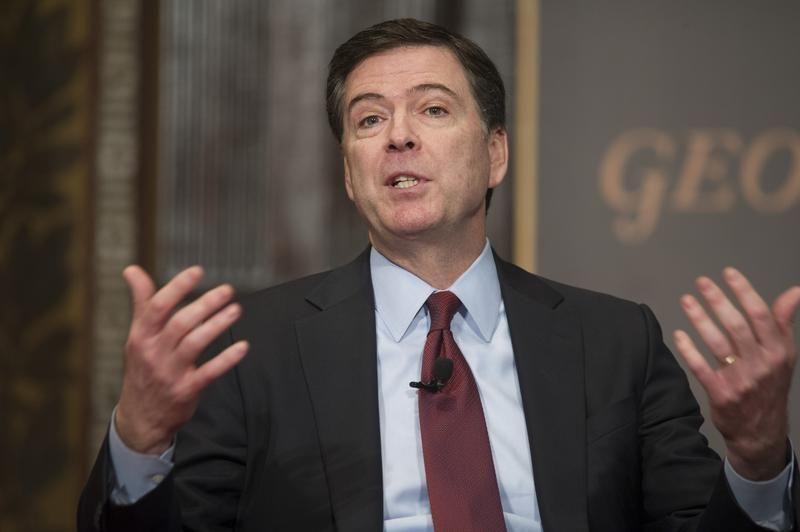
Last Thursday's speech by FBI Director James Comey at Georgetown University was remarkable on its own terms, but revolutionary in the context of his agency's history. You wonder if Hoover would have accused Comey of subversive intent.
"All of us in law enforcement must be honest enough to acknowledge that much of our history is not pretty," Comey said. "At many points in American history, law enforcement enforced the status quo, a status quo that was often brutally unfair to disfavored groups."
Rethinking the Pledge; Trump and Women; One Last Egg Roll; Eulogizing Ike
2016: A Repeat of the 1960s
An Apology, Fashioned for Nancy Reagan
Nancy Reagan, Guardian of a Legacy
He explained why he keeps on his desk a copy of Attorney General Robert Kennedy's approval of Hoover's request to wiretap Dr. King: "The entire application is five sentences long, it is without fact or substance, and is predicated on the naked assertion that there is 'Communist influence in the racial situation.'" He calls agents' attention to the document, he said, "to ensure that we remember our mistakes and that we learn from them."
And who would think an FBI director would cite "Everyone's a Little Bit Racist," a song from the Broadway hit "Avenue Q?" His point: "Many people in our white-majority culture have unconscious racial biases and react differently to a white face than a black face."
Yet Comey was unabashedly pro-cop. He fondly recalled his grandfather, William J. Comey, who rose to head the Yonkers, New York, police department. "Law enforcement is not the root cause of problems in our hardest-hit neighborhoods," the FBI director said. "Police officers -- people of enormous courage and integrity, in the main -- are in those neighborhoods, risking their lives, to protect folks from offenders who are the product of problems that will not be solved by body cameras."
Comey wasn't just giving a let's-respect-each-other speech. He argued that the problems of race, racism and injustice go deeper than policing. His two most concrete suggestions were a call for "more and better data related to those we arrest, those we confront for breaking the law and jeopardizing public safety, and those who confront us," and support for President Obama's "My Brother's Keeper" initiative.
He urged attention to the "the disproportionate challenges faced by young men of color," noting that "the percentage of young men not working or not enrolled in school is nearly twice as high for blacks as it is for whites." The goal should be to "grow drug-resistant and violence-resistant kids."
Let's face it: If Obama or Attorney General Eric Holder had given the same speech (and they've said many of these things), the response would have been political and in some cases nasty. This only underscores why it was essential for the words to come from a white director of the FBI.
Was Comey trying to shift some of the heat away from police and toward society as a whole? No, because he was clear on law enforcement's need to examine and reform itself. But yes, he was trying to concentrate our energies on the root causes of crime, and good for him.
It's worth remembering that liberals were once attacked for being "root causers" trying to downplay the problem of criminality itself. But maybe it takes a cop's grandson to prod us to act on both the problem of racism and the economic, sociological and familial challenges faced by young African-American men.
In this sense, Comey really is a subversive. He's trying to subvert and thus transform a debate that leads us into ideological cul-de-sacs. He must stay at it.
(c) 2015, Washington Post Writers Group

The GOP Majority Should Go Out in Glory
Daniel McCarthy • RealClearPolitics
Republican Majorities Could Return Sooner Than Expected
J.T. Young • RealClearPolitics
The Danger Before the Attack
Leslie J. Sullivan • RealClearPolitics
Jon Finer’s Old and Dangerous ‘New Approach’ to Israel
Peter Berkowitz • RealClearPolitics
The President Deserves Better
John Ullyot • RealClearPolitics
Congress Doesn’t Need Another Blame Game. It Needs To Find What’s Broken
Jarrod Bernstein • RealClearPolitics
RCP Today
Top stories on RealClearPolitics
The Takeaway
Polling intelligence and analysis delivered to your inbox
World News
Featuring the latest world news
Policy
Featuring the latest policy news
Support Our Mission
As part of RealClearPolitics, authors aim to provide balanced, non-partisan analysis by presenting top reporting and commentary from all sides of the political spectrum.
Trusted by policymakers and citizens alike since 2000