
Blizzards Boost, Bury Political Careers
Published Jan. 27, 2015 • Read time: 4m
Join the Conversation
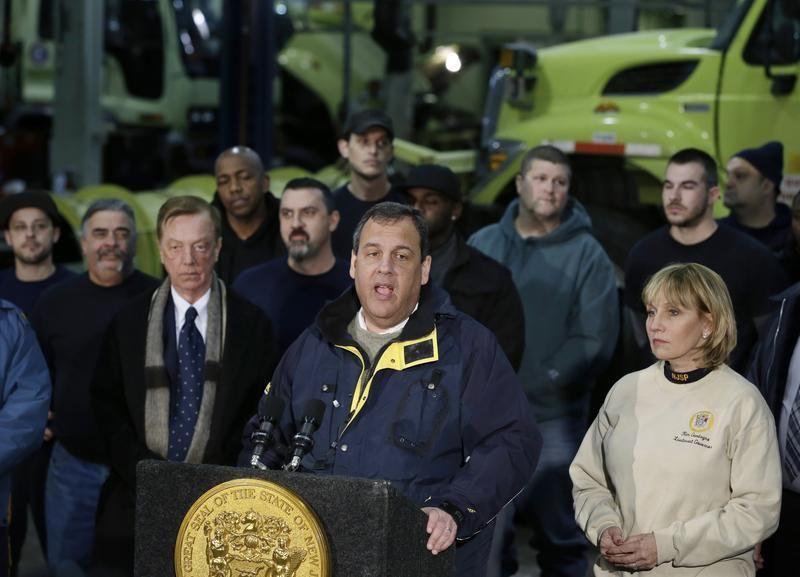
0New Jersey’s Chris Christie spent the weekend courting Iowa conservatives and launching a political action committee ahead of his likely run for the White House. But by Monday, the Republican governor was back in his natural habitat, prepping his disaster-accustomed state for what the National Weather Service called a “life-threatening” blizzard.
The quick change in pace highlights the fact that Christie, unlike a few of his 2016 rivals, has a day job. And when natural disasters strike home, that job can either glorify or damn political ambitions. Storms like the one pummeling the Northeast this week test the executive decision-making and management skills that candidates tout as credentials for the highest political office in the land.
While the spotlight is on the ambitious Christie, the storm also put pressure on other office holders in affected states. New York Gov. Andrew Cuomo has been mentioned as a potential Democratic candidate for president at some point.
Both Christie and Cuomo put their states in official emergency mode, urging people to stay in their homes and off the roads. Public transit systems were suspended and Broadway shows and sporting events were canceled. The stock exchange remained open. In December, Cuomo asked the federal government for $50 million in recovery aid after several feet of snow dropped on Buffalo. Governors in Connecticut and Massachusetts also each declared a state of emergency.
The storm also puts New York City Mayor Bill de Blasio under the bright lights again. The mayor was criticized this time last year, a month into his first term, for keeping schools open after a big snowstorm. De Blasio has also been under fire recently for his handling of the police department before and after the killings of two police officers rocked the city. Storm management in the nation’s largest city is a big challenge for its mayors. Michael Bloomberg was criticized for his handling of a 2010 storm that closed subway lines for days.
“Don’t underestimate this storm,” de Blasio said Monday during a press conference, calling it one of the largest in the city’s history. The mayor banned non-emergency traffic after 11 p.m., noting that food delivery service bicycles were not, in fact, considered emergency vehicles. De Blasio also warned ride-sharing services such as Uber against illegally hiking fares. And the mayor ordered schools closed on Tuesday.
Storms like these can often provide make or break moments for politicians, from the local level on up to higher offices. And history hasn’t been especially kind to office holders in the tri-state area. The late New York City Mayor John Lindsay is still remembered for failing to prepare the city for a deadly snowstorm in 1969. And in Chicago, a 1979 storm helped doom the city’s already troubled mayor, Michael Bilandic. In Denver, a Christmas Eve snowstorm in 1982 contributed to the defeat of longtime Mayor William McNichols the following year.
Christie knows the stakes well, as his responses before and after disasters have come to define his tenure as governor of the coastal state. He was criticized during a 2010 snowstorm for being on vacation in Florida. Christie made headlines during 2011’s Hurricane Irene for telling New Jersey residents to “Get the hell off the beach.”
But Christie’s handling of 2012’s Hurricane Sandy carried lasting political implications. Republicans criticized Christie, who was a top surrogate for Mitt Romney at the time, for embracing President Obama during a visit to the devastated shoreline right before the presidential election. Christie made no apologies and later slammed congressional Republicans over stalled financial aid. Christie’s disaster response played a significant role in his re-election campaign, and he won his blue state by 22 points.
Back in New Jersey on Monday, donning weather-ready attire, Christie appeared to be a man in control, someone who has been around this kind of emergency before. “This is my sixth winter as governor,” Christie said at a press conference Monday. "We've had Hurricane Irene; we've had Hurricane Sandy; for better or for worse, we know how to deal with these situations.”
But when it came time for questions, the first inquiries from reporters regarded the 2016 presidential campaign and the governor’s shiny new political action committee that allows him to raise money and network with top donors.
Christie said he was happy to answer just a couple of questions about the PAC, and described it as a group of people supportive of him addressing the country’s problems. But, he shifted, “The more important issue today is the health and safety of the people of New Jersey.”
RCP Today
Top stories on RealClearPolitics
The Takeaway
Polling intelligence and analysis delivered to your inbox
World News
Featuring the latest world news
Policy
Featuring the latest policy news
Support Our Mission
As part of RealClearPolitics, authors aim to provide balanced, non-partisan analysis by presenting top reporting and commentary from all sides of the political spectrum.
Trusted by policymakers and citizens alike since 2000