What Tuesday's Outcome Will Mean for Obama
Published Nov. 3, 2014 • Read time: 9m
Join the Conversation
0President Obama has turned his last-ditch, get-out-the-vote efforts for Democratic candidates into stark warnings about what’s at stake for America, for working people, and for his presidency.
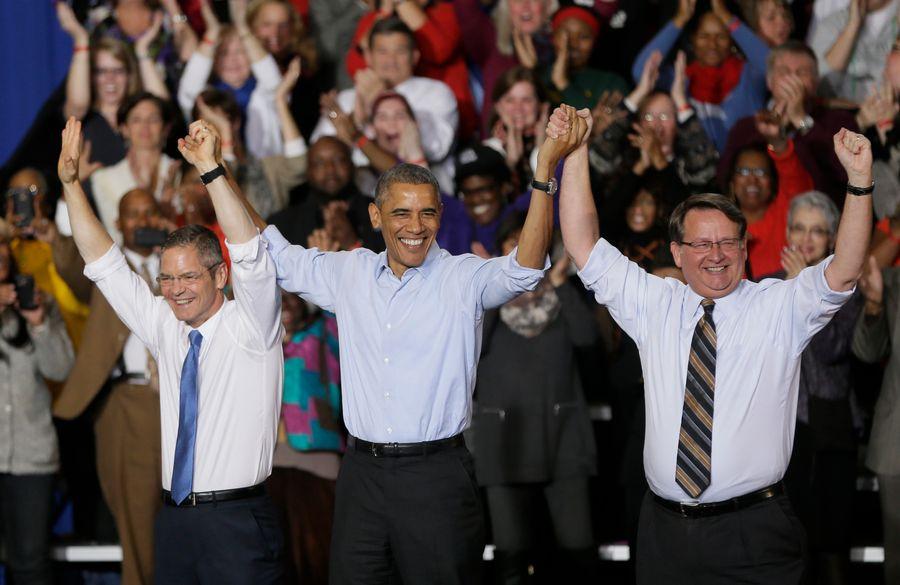
“I need your vote,” he told an energized Detroit audience Saturday at Wayne State University. “Your vote will decide the course that Michigan takes from here [and] whether 28 million American workers get the raise they deserve [and] whether American families continue to benefit from new health care coverage.”
Obama is not on any ballot, he acknowledges, but he begged supporters during his final blitz through states he won in 2008 and 2012 to grab their couch-potato cousins and disengaged friends and head to the polls Tuesday to block the GOP’s “bad ideas” and “the wrong vision for the future.”
Although his own name has been used by Republicans like political poison this year, Obama over the weekend resisted the urge to return the venom in such a personal way. He did not mention by name Senate GOP leader Mitch McConnell or House Speaker John Boehner, or detail with dire hand-wringing what he imagines the duo’s Republican control would mean for his final two years in the White House.
In fact, he said Republicans are “good people” who love their country and families -- an assertion booed by his audience. He said conservatives will fight for wrongheaded tax cuts that help the wealthy, weaker safety nets for working Americans, lighter regulation of big banks and polluters, and antiquated policies affecting women.
Lies, Assault and Cover-ups Don't Stop Donald Trump
Trump Stands by His Man; Obama on a Health Scourge; Hayden Interview; Reagan's Courage
Analysis: For Trump, Few Limits to Win-At-Any-Cost Approach
What If Clinton Isn't Indicted?
“You’ve had my back twice,” he reminded the African-American, urban, young and especially female attendees at a rally for Senate candidate Gary Peters and Mark Schauer, the Democrat seeking to defeat Gov. Rick Snyder.
“You’ve got to vote,” Obama repeated.
Last month during interviews with urban radio stations with large African-American audiences, the president encouraged supporters to help him keep the Senate under Democratic control, even as he conceded that divided government -- still the best-case outcome possible for Democrats after Tuesday -- means plenty of stalemate.
The president has experimented with scaring his supporters into voting, and he’s tried to shame them into participating, scolding his admirers for forfeiting their individual power to be heard in less exciting midterm years. But encouraging Americans to vote with optimism that Washington can resolve anything has been a tougher argument for the president.
“I’ve got a lot of stuff left to do in these last two years,” he told Atlanta hip-hop station V-103.
When Obama isn’t boasting about using his executive authority to thwart congressional Republicans (he vows to change the status of millions of undocumented immigrants after Election Day on his own say-so, for example), he explains that his domestic legislative agenda in the coming two years is primarily about keeping the economy growing and investing in new jobs.
“The only way in these last two years that I’m going to be able to make even more progress on the economic front, putting more people back to work … is if I’ve got a Congress that isn’t just trying to block my agenda, but is trying to cooperate,” he told radio personality Rickey Smiley, whose morning program is carried by 53 radio stations nationally.
“We, for the last four years, have had a Congress that hasn’t worked,” he told the Atlanta station, speaking about the House. “These last two years I want a Congress that does work.”
Pitching more of the same to voters as a reason to return incumbents to Washington has been a toxic message for Democratic Senate candidates. Indeed, GOP candidates have argued that “more of the same” amounts to “more Obama,” a decidedly unpopular concept in the majority of the states in which Senate races will be decided.
Some Democratic candidates, perhaps to their collective detriment, have tried mightily to distance themselves from the president, sounding less sure about policy achievements identifiable on Obama’s watch. The mish-mash has been easy for opponents to lampoon and difficult for voters to sort through.
“He has been a drag, you know. I’m just going to be honest about that,” Sen. Mark Pryor told Fox News while arguing he “never” supported an Obama-proposed budget, and disagreed with the president on gun control and the proposed Keystone XL pipeline.
“Both the president and the Democrats running for election and re-election have been in reaction mode about the criticisms of the president’s policies, rather than talking about the achievements, because the public doesn’t feel that it’s sharing in whatever gains there are,” said Martha Joynt Kumar, Towson University political scientist and author of several books about presidential communications.
Impact on Executive and Judicial Appointments
When radio host Smiley asked the president last month to describe the election stakes, as he saw them, Obama sounded more forthright than he had been with Democratic donor audiences at events at which the media were present, and more pointed than during his get-out-the-vote tour, which ended in Pennsylvania on Sunday.
He described a bleak outlook for confirmation of executive and judicial nominees in his final two years if Republicans control the Senate. And he warned that GOP senators would join their colleagues in the House to gut the Affordable Care Act, his first-term achievement.
“If we lose the Senate, for one thing, the way this Senate’s been operating, they could end up blocking all my appointments, so that I can’t get the people I want to be in a position to move my agenda forward,” the president said.
Obama and Senate Democrats are trying to decide if they can push through a successor to Attorney General Eric Holder during the lame-duck period after the elections, or must wait until next year, after a new Senate is in place.
Holder has said Obama will nominate someone to lead the Justice Department soon after the elections, and he predicted the new Senate would act in January or February. The White House, however, responded that in the days following the 2006 midterm elections President Bush asked the Senate to approve Robert Gates as defense secretary to succeed Donald Rumsfeld, which the Senate did less than a month later. It’s a model Obama could decide to emulate, White House Press Secretary Josh Earnest said.
When he announced his resignation, however, Holder said he would stay on until a successor is confirmed, thus removing some of the urgency Earnest described when Bush finally tapped a new defense secretary in the midst of an unpopular war.
As for judicial appointments, the Senate’s alignment will play a role in Obama’s final two years, just as it did with the appointments of two-term presidents before him. Confirmations become more challenging, especially in the polarized Senate where the Democrats changed the filibuster rules for appointments. In the coming years, Obama will weigh his choices with Senate hurdles in mind, and the business of filling government vacancies will not cease.
As of Obama’s sixth year, the president raised to 53 percent the proportion of Democratic circuit judge appointments, according to a recent Brooking Institution study that examined the potential impact of Senate contests on judicial confirmations in the remainder of Obama’s term.
Impact on Health Care
“If we lose the Senate, I guarantee you they’re going to try to roll back health care legislation again, even though … over 10 million people have health care insurance,” Obama also warned Smiley during his October radio interview.
McConnell has campaigned for re-election in Kentucky vowing to repeal Obamacare. But during a recent Fox News interview, the senator said 60 GOP votes and Obama’s signature would be necessary for repeal -- a threshold he characterized as out of reach. Later his staff clarified that a Senate Republican majority would need 51 votes in order to change the unpopular health law, if budget reconciliation (the technique used by Democrats to pass the ACA in 2010) is used by opponents as their tactical weapon.
Republican leaders have trumpeted their pending agenda in op-ed articles, radio addresses, public events, and letters to constituents, acknowledging Obama’s veto pen may thwart their ambitions.
They want lower corporate tax rates and tax “reforms” that Democrats describe as “trickle down.” They want to scale back entitlement spending and increase defense spending.
They say they would eliminate the Consumer Financial Protection Bureau, which was created as part of the Dodd-Frank financial reform law enacted after the 2008 financial meltdown, because they believe its independence in protecting consumers makes it “unaccountable” to Congress.
They would send legislation to Obama to approve the pending Keystone pipeline; open federal lands for oil and gas exploration; and stop the Environmental Protection Agency from using the Clean Air Act to regulate coal-fired power plants.
They would try to quash Education Department influence on state and local public education decisions, and crack down on undocumented immigrants and illegal immigration through enforcement rather than comprehensive changes that would create a streamlined path to legal status or citizenship.
Obamacare “isn’t working,” Sen. Ted Cruz said in an op-ed describing his 10-point agenda, published Oct. 19 by USA Today. “We should pass repeal legislation, forcing an Obama veto, and then pass bill after bill to mitigate the harms of Obamacare,” he wrote.
2016 Campaign Begins
Cruz is eyeing a run for president, as are several Republican senators. The day after the midterm results are certain, the next presidential contest begins. In that equation are two assumptions.
First, Obama won’t be quite the same punching bag as the ground shifts toward 2016. The president’s job approval is not nearly as low as was Bush’s after the 2006 midterms, and he retains some executive clout in the face of what is expected to be a narrowly divided Senate.
“Right now, the president is not high in the polls, but he is in the 40s -- not the 30s or the 20s,” said George C. Edwards, political scientist at Texas A&M University and author of books about the presidency. “Some perspective is useful. It is not unusual for presidents to have large losses in midterm elections.”
With an eye on legacy-preservation, Obama will remain a force for two more years, albeit a naturally ebbing one. At the same time, Republicans, if they seize Senate control, say they hope to enlarge any gains and assist a GOP nominee to capture the White House.
Two more years of Washington gridlock are not a prosperous formula for either party, if a gazillion public opinion polls this year are any guide. That may help explain why McConnell, delivering the Republican radio address Saturday, wanted to sound less like an impediment to Washington problem-solving with Obama, and much more like a partner.
“I think we’ll be able to work with the president to ensure solid, pro-middle-class ideas are signed into law,” he said.
Obama and his White House advisers remain skeptical, but as the president told Democratic audiences over the weekend, “Hope is a better choice.”

Newsom Defies Voters, Juries and Lawmakers To Spare Murderers While Defending Abortion
Curtis Hill • RealClearPolitics
The Algorithmic Tilt
Frank Filingeri • RealClearPolitics
A RealClear Thanksgiving: Investing in a Better Future
David DesRosiers • RealClearPolitics
Trump’s Newsom Problem: Antagonist-in-Chief
Carolina Lumetta • RealClearPolitics
America’s Free Spirit
John Maxwell Hamilton • RealClearPolitics
The GOP Majority Should Go Out in Glory
Daniel McCarthy • RealClearPolitics
RCP Today
Top stories on RealClearPolitics
The Takeaway
Polling intelligence and analysis delivered to your inbox
World News
Featuring the latest world news
Policy
Featuring the latest policy news
Support Our Mission
As part of RealClearPolitics, authors aim to provide balanced, non-partisan analysis by presenting top reporting and commentary from all sides of the political spectrum.
Trusted by policymakers and citizens alike since 2000