
Pryor's Senate Race: Democrats' Last Stand in Arkansas?
Published Oct. 1, 2014 • Read time: 7m
Join the Conversation
0LITTLE ROCK, Ark. -- Democratic Sen. Mark Pryor ran unopposed for re-election six years ago when Republicans couldn’t even put up a candidate. At the time, Pryor’s party controlled the state legislature and accounted for the majority of the Arkansas congressional delegation.
Now, those days of Democratic dominance here seem like a relic. And this year, Pryor could be making the party’s last stand.
The senator is the only Arkansas Democrat in Congress. He is fighting to hold on to his seat in one of the most competitive and consequential U.S. Senate races in the country. Republicans now control both chambers of the state legislature. An open governor’s seat may well flip to GOP hands, too.
Democrats and Republicans alike attribute that shift to the election of another man six years ago: Barack Obama. No Democratic presidential candidate has won Arkansas since native son Bill Clinton did so in the 1990s. And while almost everything in and around Little Rock is named after the former president, the current commander-in-chief is a drag on members of his party here, where voters rejected him by 20 percentage points in 2008 and 24 points in 2012.
Republicans are thus tying nearly every opponent to Obama, from local officials to federal officeholders. GOP Senate hopeful Tom Cotton is banking virtually his entire candidacy on the president’s negatives. In that high-profile contest, the Republican strategy “has certainly got it to the point that it’s a nip-and-tuck race,” says Democratic Gov. Mike Beebe, a popular figure in the state who is term-limited and leaving office. The race is close, with Cotton leading by 3.6 points in the RCP average.
Portman-Strickland Senate Race Finally Set in Ohio
Portman Wastes No Time Attacking Strickland
Strickland Skirts Primary Debates in Ohio Senate Race
Senate Says Climate Change Is Real
Arkansas is one of several red states that will help determine which party controls the upper chamber next year. Unlike other conservative Southern states with pivotal contests this year, the Natural State has been slower in its conversion from blue to red. Arkansas is considered the last state of the old Democratic South. Pryor’s fate could determine whether it falls completely.
The incumbent senator’s name carries great value in the state, and that could help save him in the end. His father, David, is a popular former governor and senator who, at age 80, has been campaigning statewide for his son, from Walmarts to college campuses. The younger Pryor is one of several so-called “legacy candidates” whose family name and enduring local ties tend to protect them against the harsh national climate. Those connections may harken back to a time when lawmakers actually worked together and Washington wasn’t held in such contempt by voters.
“I’ve always believed I’d win this race,” Pryor recently told RealClearPolitics outside of the Democratic Party’s campaign offices here. “Part of that is because I’ve always believed in Arkansas. People just know what they want as a senator: They want someone who listens, who pays attention to the state.”
“Maybe I’m a little bit of a throwback,” he adds.
If Pryor is a throwback, his 37-year-old opponent is the new face of conservative politics. Cotton is in just his first term in Congress, but has already garnered somewhat of a national reputation as a rising GOP star. The congressman has also become the face of the “vote no” caucus in the House, a group of fiscal conservatives vehemently opposed to increased government spending. Democrats point to votes against the farm bill, disaster relief funding, and funding for a well-known state children’s hospital as the top transgressions. Pryor’s campaign asserts that the senator is out for Arkansas while the congressman is out for himself and outsider interests.
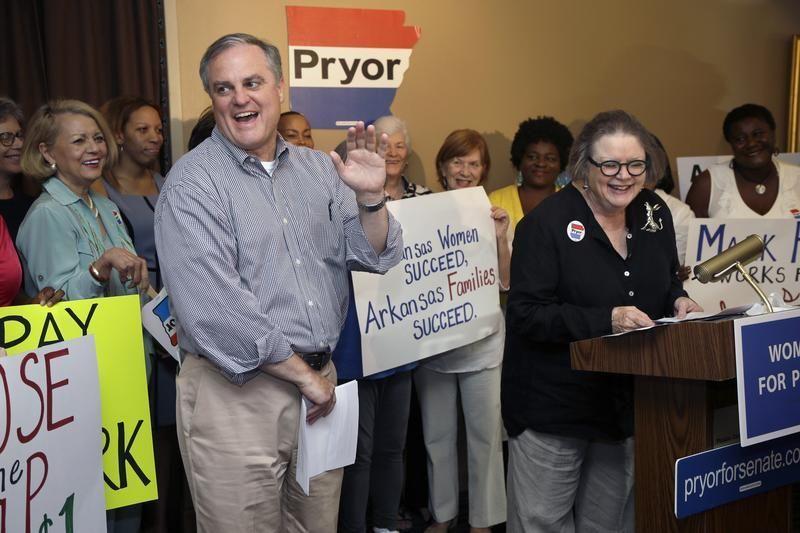
Turnout is expected to be low this year, so the incumbent must also rely on national themes to turn out his base. At a Democratic phone bank here last week, roughly 40 volunteers called women voters in an effort to get them to go to the polls in November. Many callers used their personal cellphones. Pryor’s mother, Barbara, stopped by to encourage the volunteers, citing so-called equal pay legislation and the Violence Against Women Act, among other bills, that her son supported in Congress. ‘Tom Cotton consistently votes against women,” Barbara Pryor told the group.
One of the callers spoke to those gathered about what she saw as the benefits of the health care law, and encouraged the other volunteers to do the same. The law is about as unpopular in Arkansas as it is in other red states, but Pryor has been the only Senate Democrat to run an ad this cycle touting it (though he never mentions the law by name). The Republican state legislature, under Beebe, used the money from Obamacare’s Medicaid expansion to fund a private option of sorts for poorer residents in the state.
The Democratic governor points to that program as one of the greatest accomplishments of a divided local government and as evidence that voters value bipartisanship.
“Arkansas voters, even though they are pretty uniformly opposed to the president … [are] still pretty doggone independent,” Beebe told RCP. “Arkansans, like most folks, are just fed up with Washington -- not just the president but the Congress. They’re fed up with gridlock, hyper-partisanship. One of Mark Pryor’s strengths is he is perceived as someone who has a track record or working across the aisle. It’s one of the reasons why Arkansans have not rejected him.”
But this year may put voters’ independent streak to the test. In 2010, when incumbent Democrat Blanche Lincoln lost dramatically to now-Sen. John Boozman, Beebe won election overwhelmingly. When Pryor won his first race in 2002, Republican Mike Huckabee won the governorship. This year in the race to replace Beebe, Republican Asa Hutchison is leading Democrat Mike Ross by 4.4 percentage points, according to the RCP average.
Some observers say Pryor is in a stronger position than Ross is and that he is also better known across the state. But Democrats know that turnout will likely make or break his fate. The party now has over 40 campaign offices around the state -- 18 of them were activated this cycle. Ground games can’t be judged until after Election Day, of course, but Democrats think they are well positioned on that front.
Even with the Pryor name, there has been a lot of ground for Democrats to make up. “Arkansas hasn’t really had a competitive race since 2002, before the era of big data,” says Jay Barth, a politics professor at Hendrix College in Conway. The turnout effort “is the whole game. If it doesn’t happen, then this is a pretty comfortable Republican win. If it does work, there’s a scenario for eking out a series of victories.”
Still, there is another element to voter engagement. Barth notes that “Arkansas voters have been ready to vote Republican for a while [but] they had not had the products offered to them by the state GOP, which couldn’t present electable candidates.”
A recent Gallup poll found that while the state’s ideology hasn’t changed much over the past six years, conservative Democrats have dropped in number. In 2008, the poll found, 15 percent of Arkansans identified as conservative Democrats. Now, just 9 percent do. Gallup says this decline has contributed to a drop in overall Democratic support. In 2008, 49 percent of respondents identified as Democrats; in 2014, 41 percent do.
Despite all the data and polling, Democrats in the state still maintain that races in Arkansas boil down to a handshake. “Tip O’Neill said all politics is local. And I say it’s all personal. It’s still personal in Arkansas,” David Pryor told RCP.
“People like to be asked for their vote and see their officials working on a hot afternoon,” he said.
Mark Pryor isn’t the only Democrat on the ballot this year. The results of governor’s race as well as a congressional race and state legislature contests will all combine with Pryor’s fate to paint a clearer picture of the state of the party in this part of the old South.
Right now now, Pryor insists, “the Democratic Party is alive and well.”
“The party really took a beating around 2010, and we’re really just coming out of that. I think this is a big year, politically, in the state,” he said. “I just think we need get 2014 behind us and see where we are after that.”

Democrats Won the Midterms. Common Sense Won, Too
Jordanne Kemper • RealClearPolitics
The 120th Congress Shapes Up
Carolina Lumetta • RealClearPolitics
Flooding GOP Primaries With Democrats
Robert Natelson • RealClearPolitics
Washington Keeps Rewarding Oracle—Veterans Keep Paying the Price
Darin Gaub • RealClearPolitics
The Seeds of Unrestricted Warfare
John Teichert • RealClearPolitics
The Primary System Is Losing the Next Generation
Sean Trende • RealClearPolitics
RCP Today
Top stories on RealClearPolitics
The Takeaway
Polling intelligence and analysis delivered to your inbox
World News
Featuring the latest world news
Policy
Featuring the latest policy news
Support Our Mission
As part of RealClearPolitics, authors aim to provide balanced, non-partisan analysis by presenting top reporting and commentary from all sides of the political spectrum.
Trusted by policymakers and citizens alike since 2000