The 2014 Midterms: An Election Without a Cause
Published Sept. 2, 2014 • Read time: 10m
GLOVERSVILLE, N.Y. -- On a sunny afternoon last week, nostalgia permeated the musty air inside the nearly century-old David & Helen Getman Memorial Home, which remains a fixture of this hardscrabble city that once was home to the nation’s glove-making industry.
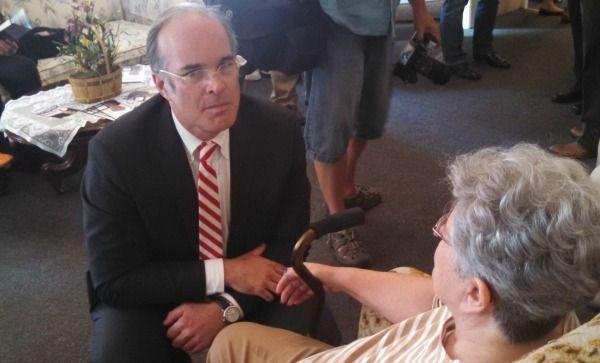
Surrounded by the black-and-white photographs and ancient wallpaper that adorn the assisted-living facility’s walls, “Bowzer” Bauman showed off the patented biceps-curl pose he first flashed 45 years ago as part of the 1950s throwback band Sha Na Na.
As 15 senior citizens watched quietly from their easy chairs, Bauman -- a co-founder of the Democratic-aligned group Senior Votes Count -- played a few tunes on the piano before introducing the afternoon’s main act: documentary filmmaker Aaron Woolf, the Democrat who is running against Republican Elise Stefanik in the open U.S. House race here in New York’s 21st District.
Like Stefanik, Woolf is a first-time candidate, though he began the race in an ideal position to offer something new to the political discourse.
With no controversial votes to defend and no direct experience within the soul-sucking gridlock that plagues Washington, Woolf might have laid credible claim to being a different kind of candidate.
Lacking a political background himself, he might have inspired the preponderance of voters who have mostly tuned out of the political process -- too fed up with Washington to believe that the outcome of the 2014 midterm elections will change much of anything.
But anyone looking for something big, bold or original from Woolf would have left this particular event, which was billed as a forum on Social Security and Medicare -- with a sense of disappointment.
Where "Obama Republicans" Split With Party
Curbelo Gives Spanish-Language Response to State of the Union
Rep. Bachmann Says She Won't Run For Re-Election
No, We Don't All Sin Like Mark Sanford
Like just about every candidate, Woolf was eager to go on the offensive against his opponent, accusing her of wanting to “attack” Social Security.
But when asked to elucidate his plans for ensuring that the big entitlement programs remain solvent for future generations, Woolf offered only the vaguest of generalities.
“I’m not proposing any changes,” he said after the event. “But that doesn’t mean I’m not proposing a solution, which means growing our economy.”
But is the solution really that simple? Would he care to offer some of the “modest reforms” to Medicare that President Obama said in last year’s State of the Union address would be required, so that the country does not “jeopardize the promise of a secure retirement for future generations”?
“I think those are very specific ideas,” Woolf said in defending his platform. “I think investing in our economy is the best thing we can possibly do.”
Though candidates offering few specific policy plans on the campaign trail is nothing new, this year’s midterm elections are particularly notable for how little either side is proposing.
It’s not that the ideological gap between the two parties has narrowed; in fact, it remains as wide as ever. And both parties are still elucidating their differences on central issues like entitlements, health care, and immigration.
But neither Democrats nor Republicans appear to have settled on a common theme or, for that matter, a coherent vision for the future that goes beyond boilerplate, poll-tested platitudes.
The highly competitive U.S. House race in New York’s 21st Congressional District is merely a microcosm for the 2014 elections as a whole -- Exhibit A for how federal-office campaigning has degenerated into the political equivalent of trench warfare.
In this kind of stalemate, both Democratic and Republican strategists regard taking a risky position or proposing an audacious new plan -- anything that the other side may one day exploit -- as akin to wandering unarmed into no man’s land.
About an hour’s drive west of Gloversville, at the other side of this sprawling district that runs through the Adirondacks to the Vermont and Canadian borders, Elise Stefanik sat down for an interview in her Glens Falls campaign office.
Though she has spent the majority of her career in Washington as a staffer in the George W. Bush White House and as an aide to Republican candidates on the 2012 presidential campaign trail, Stefanik, like Woolf, offers a compelling personal narrative.
Having turned 30 just last month, she would be the youngest woman ever elected to Congress.
Asked why the 2014 campaign has become a series of low-impact tactical battles between national Republicans and Democrats, rather than a clash of big ideas, Stefanik cited two of her own proposals to dispute the question’s premise.
The first was her plan to institute a mobile district office to provide better access for the mostly rural electorate. And the second was to post on Facebook and Tweet all of her votes from the House Floor.
“They may not be big issues to you, but they’re big issues to the district,” she said.
That may be, but on the truly big issues that will determine the nation’s course, Stefanik seemed as much the carefully molded embodiment of her party’s hyper-cautious congressional campaign committee as Woolf did.
In the early stages of a press conference last Monday, Stefanik was emphasizing that she would not push for changes to Social Security and Medicare for older Americans when a reporter pressed her to define what she meant by a phrase she kept using to characterize whose benefits would remain the same: those “at or near retirement.”
Instead of answering the question, Stefanik abruptly ended the press conference and walked away.
It was an awkward moment that local news outlets quickly seized upon but one that her campaign appears to have preferred over the fallout she might have been subjected to had she taken a more definitive position.
Asked in the interview with RCP to be more specific about her plans for preserving the entitlement programs, Stefanik again reiterated her previously stated position, adding only that “we should be having a conversation” regarding how cost of living adjustments might be made for people under 50.
And would that “conversation” include means testing?
“I’m willing to have a conversation about any issue,” Stefanik said, before pivoting swiftly to an attack on Woolf’s position.
On the health-care front, Stefanik supports repealing Obamacare and implementing what she calls “common-sense health care reform,” which would include tort reform, allowing constituents to buy coverage plans across state lines, and giving businesses the same incentives that individuals have to buy insurance.
In this area, Stefanik appears to be more forthcoming than Woolf -- who still refuses to say whether he would have voted for the Affordable Care Act in the first place. (“It’s a hypothetical, and I don’t want to engage in hypotheticals,” he said during his interview.)
But if a political campaign once was considered a place to have the very “conversation” to which Stefanik referred, that’s not the case this year.
Though an extreme form of focus-group-tested reticence has become the norm for just about every major party contender, the same cannot be said for many third-party candidates, who often play significant roles in individual races, even as their hopes of actually winning remain dim.
One piece of Stefanik’s political strategy is to draw as much attention as she can to the campaign of Green Party candidate Matt Funiciello, who could have a major effect in a district that voted for President Obama in 2012 but where Republicans maintain a slight voter registration edge.
Unlike his opponents, Funiciello hangs his candidacy on being specific about any and all issues and embracing his status as someone with nothing to lose.
A local bakery owner, Funiciello is calling for an across-the-board progressive agenda that includes a single-payer health care system, a $15 per hour minimum wage, and a national ban on fracking.
That none of these proposals would go very far in the current Congress is beside the point, according to the candidate.
“The national parties bring in advisers and campaign managers who say, ‘Don’t tell them anything because you’re going to upset somebody,’” Funiciello said. “The conventional wisdom is if you’re running for office, you should keep your mouth shut. And I think that’s very sad -- that we run for office in the United States of America without telling anybody anything.”
It’s not that national policymakers and partisan thinkers haven’t been coming up with new ideas. Scarcely a day goes by in Washington without a think tank or interest group rolling out a grand new solution for the nation’s ills.
But for the candidates with a real shot at winning their races, the ability to play small ball effectively has become a far more critical asset than demonstrating inventiveness and pluck.
“No one’s running on The New Deal because that doesn’t exist in our conversation,” said Benton Strong of the left-leaning Center for American Progress. “Right now, the bar in Congress is keeping the place open. Voters in a lot of places are wondering, ‘Are you guys going to show up for work every day?’”
With another government shutdown potentially looming this fall over immigration reform, one might expect national Republicans to be eager to offer a more cogent positive message, especially as President Obama’s sinking approval numbers appear to provide an even wider window for them to do so.
But with the GOP still divided over tactics, Dan Holler of the conservative group Heritage Action for America laments the extent to which most Republican candidates cultivate their identity as being, first and foremost, against everything that the Obama administration does -- a tactic that failed on the macro level in 2012.
“There are different members trying to push different things, but the party isn’t unified around the idea that they have to be for something,” Holler said. “They need to have a positive agenda, but there’s no commitment to actively force that positive agenda, which is frustrating to a lot of folks, including us.”
Back in New York’s 21st District, Republicans and Democrats alike are poring over every polling data point and developing contours of a race that is expected to remain highly competitive through Nov. 4.
In doing so, both parties are operating under a tried-and-true playbook for House contests: paint the opponent as an out-of-touch carpetbagger.
Last month, the NRCC began running a Web ad highlighting Woolf’s ties to New York City, pegging him as “the Woolf of Manhattan.”
Meanwhile, the DCCC has been highlighting Stefanik’s tenure working in the Bush administration, calling her a “protégé of Karl Rove.”
Back in Glens Falls, Stefanik was eager to demonstrate that she is not concerned about any of that.
She emphasized her upstate New York roots and connection to the district, noting that she has already logged over 100,000 miles on the road during her campaign, while visiting all 194 of the district’s towns and villages.
The campaign trail is never easy, after all, but it is particularly taxing for candidates who have to cover such a wide swath of territory.
And here in this swing district, Stefanik made sure to emphasize her willingness to reach across the aisle in order to get results.
“The public is tired of the gridlock, they’re tired of the partisan bickering, and they’re tired of just the overtly political, do-nothing style of politics,” Stefanik said.
Who could argue with that?
And then, in the very same breath she used to decry such negativity, Stefanik added that this detested style of campaigning “is exactly what Aaron Woolf is doing.”

A RealClear Thanksgiving: Investing in a Better Future
David DesRosiers • RealClearPolitics
Trump’s Newsom Problem: Antagonist-in-Chief
Carolina Lumetta • RealClearPolitics
America’s Free Spirit
John Maxwell Hamilton • RealClearPolitics
The GOP Majority Should Go Out in Glory
Daniel McCarthy • RealClearPolitics
Republican Majorities Could Return Sooner Than Expected
J.T. Young • RealClearPolitics
The Danger Before the Attack
Leslie J. Sullivan • RealClearPolitics
RCP Today
Top stories on RealClearPolitics
The Takeaway
Polling intelligence and analysis delivered to your inbox
World News
Featuring the latest world news
Policy
Featuring the latest policy news
Support Our Mission
As part of RealClearPolitics, authors aim to provide balanced, non-partisan analysis by presenting top reporting and commentary from all sides of the political spectrum.
Trusted by policymakers and citizens alike since 2000