Iraq Airstrikes: What's the Goal, and What Lies Ahead?
Published Aug. 9, 2014 • Read time: 5m
Join the Conversation
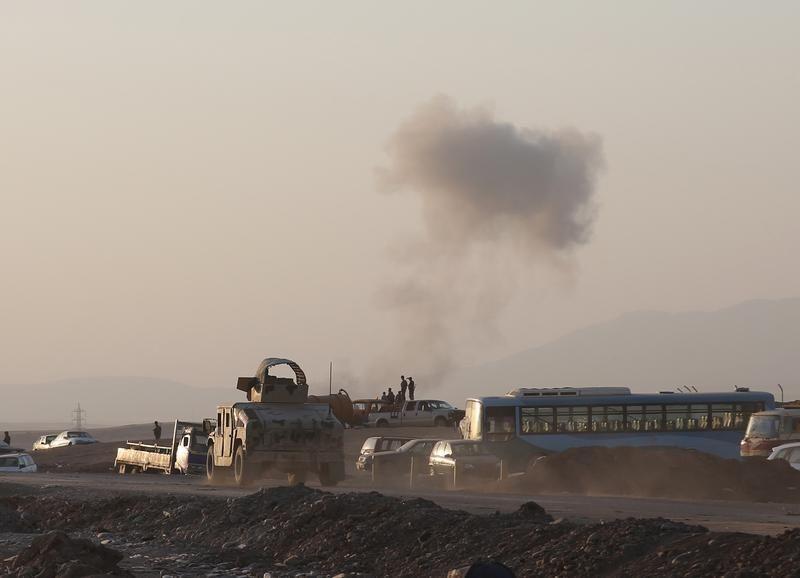
0On the first day of U.S. airstrikes inside Iraq, officials struggled to answer questions about President Obama’s decision to help a nation weakened by years of war as it battled the takeover attempts of a powerful terror group.
As the president prepared to depart Washington for a summer vacation on Martha’s Vineyard, Mass., the U.S. expanded its air operations on Friday. Here’s a look at the issues raised by the policy shift:
How long will the airstrikes continue?
Unclear. The Pentagon announced multiple strikes Friday against terrorist fighters operating near Erbil. White House spokesman Josh Earnest said the air campaign would not be a “prolonged military conflict,” but he also said, “The president has not laid out a specific end date.”
On the first day of airborne engagement, the Pentagon used terms such as “neutralizing” and “successfully eliminated” to describe mortars and convoys destroyed by unmanned drones and U.S. fighter planes.
Does the United States have a strategy to defeat the Islamic State of Iraq and the Levant (ISIL)? Or does the administration aim only to contain the terrorists operating inside Iraq?
This also is unclear. In the near term, U.S. officials say they intend to halt “the advance” of terrorists who they say pose a threat to several hundred American personnel working in Iraq, and to thwart further slaughter or starvation of ethnic and religious minorities living in northern Iraq. But administration officials also say ISIL’s brutal goal is to achieve an Islamic state by force across Iraq, an ambition unlikely to be derailed through U.S. diplomatic efforts or greater political inclusion by Iraq’s uncertain new government.
Nuclear Jihad: The Threats Are Inside Our Tent
Israel's "Sorrow of the Left"
Signs of Progress Against Extremists in Syria
The World Is Getting Worse, But This Time America Won't Save It
Asked if Obama favored letting ISIL hold any territory inside Iraq or Syria, Earnest replied, “It’s difficult to imagine a scenario where you would have a stable Iraq, with a security situation that’s under control, where ISIL is freely operating in the countryside.”
Did Obama and his advisers underestimate ISIL?
Yes. During a lengthy interview published in January, the president likened the skills of the al-Qaeda spinoff group to those of an amateur sports team eager to emulate the pros. “The analogy we use around here sometimes, and I think is accurate, is if a jayvee team puts on Lakers uniforms, that doesn’t make them Kobe Bryant,” Obama told New Yorker editor David Remnick.
On Friday, his spokesman clarified the president meant ISIL’s ability to kill Americans in the homeland was not equivalent to what al-Qaeda plotters accomplished in 2001.
Nonetheless, when ISIL captured the city of Mosul in June and began marching toward Baghdad, Obama’s tune changed. “Given the nature of these terrorists, [ISIL] could pose a threat eventually to American interests as well,” he said.
On Thursday night, after humanitarian air drops were completed, administration officials described U.S. commanders as surprised how fast, efficient and strategically sophisticated ISIL forces proved to be -- capabilities never ascribed to core al-Qaeda militants.
“It is a militarily proficient organization,” an official told reporters. “We are seeing that increasingly across obviously in Syria, and also increasingly in Iraq. And it requires a level of sophistication in terms of a military response.”
What do the American people say about U.S. involvement in Iraq?
Surveys in coming days will test Americans’ reactions to Obama’s announced efforts in Iraq, but in general, the public has expressed dwindling support in the wake of the Iraq War, which the president has said he ended with the withdrawal of ground troops in 2011.
In June, 71 percent of respondents in a Wall Street Journal/NBC News/Annenberg survey said the Iraq War “wasn’t worth it,” while 22 percent supported it. When asked what they thought about U.S. intervention to halt militants from taking over the country, Americans in June were divided. Half said the United States did not have a responsibility to get involved, and 43 percent said it did.
Will the new U.S. military operations in Iraq require additional funding?
Possibly. The White House raised the notion of a request for additional appropriations when the president’s spokesman described administration outreach to House and Senate appropriators. “Should the need arise in the future, they will have a keen understanding as to why that request is necessary,” Earnest said Friday. U.S. taxpayers have spent more than $800 billion in Iraq.
On what authority did Obama deploy U.S. military might to help Iraq?
Obama relied on his constitutional authority as commander-in-chief when ordering the military intervention, which he said was at the request of the Iraqi government. He did not rely on the Bush-era Authorization for the Use of Military Force, his advisers said.
“This was not an authorization of a broad-based counterterrorism campaign against ISIL,” one official explained.
Under the War Powers Resolution, if military hostilities extend 60 days, a president is supposed to notify Congress, although not all presidents have complied. On Friday night, Obama sent Congress a one-page explanation of his decision to use force in Iraq, noting it was his intention to keep lawmakers fully informed.
The military operations he ordered are in "the national security and foreign policy interests of the United States," he said, and "will be limited in their scope and duration as necessary to protect American personnel in Iraq by stopping the current advance on Erbil by the terrorist group Islamic State of Iraq and the Levant and to help forces in Iraq as they fight to break the siege of Mount Sinjar and protect the civilians trapped there."
Obama said U.S. humanitarian assistance in Iraq "will also be limited to supporting the civilians trapped on Mount Sinjar."
Calling his letter a "report," the president added, "I appreciate the support of the Congress in this action."
Newsom Defies Voters, Juries and Lawmakers To Spare Murderers While Defending Abortion
Curtis Hill • RealClearPolitics
The Algorithmic Tilt
Frank Filingeri • RealClearPolitics
A RealClear Thanksgiving: Investing in a Better Future
David DesRosiers • RealClearPolitics
Trump’s Newsom Problem: Antagonist-in-Chief
Carolina Lumetta • RealClearPolitics
America’s Free Spirit
John Maxwell Hamilton • RealClearPolitics
The GOP Majority Should Go Out in Glory
Daniel McCarthy • RealClearPolitics
RCP Today
Top stories on RealClearPolitics
The Takeaway
Polling intelligence and analysis delivered to your inbox
World News
Featuring the latest world news
Policy
Featuring the latest policy news
Support Our Mission
As part of RealClearPolitics, authors aim to provide balanced, non-partisan analysis by presenting top reporting and commentary from all sides of the political spectrum.
Trusted by policymakers and citizens alike since 2000