
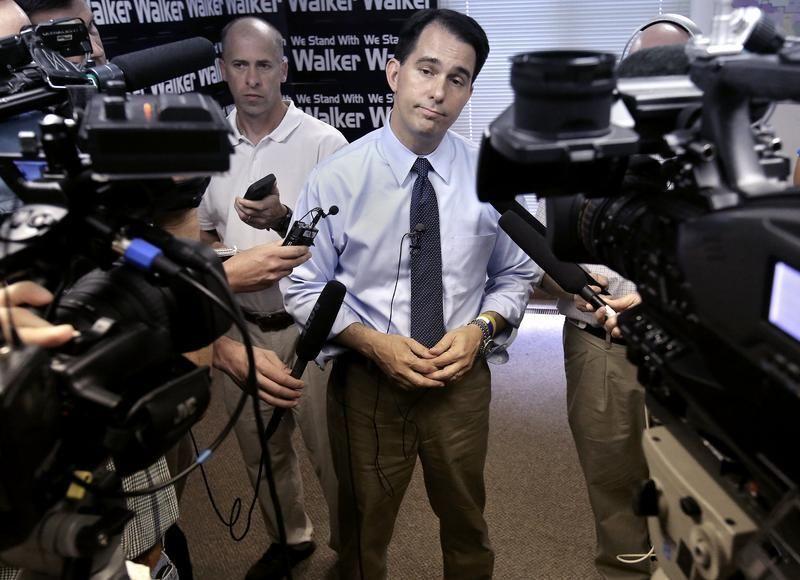
Scott Walker's Cynical Trek Into Populism
Published July 25, 2014 • Read time: 5m
Join the Conversation
0Imagine that 40 years ago two pals started a small company in a barn in the rural Midwest. Through dint of hard work, smart planning, and a little luck, they managed to build the business into a dominant brand that employed 1,800 people around the globe and generated $600 million in annual revenue. Sounds like a case study in the American Dream, right? A story that represents the kind of entrepreneurial spirit that most Americans -- especially Republican politicians -- hail as the bedrock of our upwardly mobile free-market system.
Well, the story isn’t fiction, it’s fact. The company is Trek Bicycle, and its co-founders, Dick Burke and Bevil Hogg, did indeed start it in an old red barn in Waterloo, Wis., in 1975. In less than half a century they built the company into the largest bike manufacturer in America.
So why is Wisconsin Gov. Scott Walker, who is running for re-election as a conservative Republican, attacking Trek? Good question. The answer is that his Democratic opponent, Mary Burke, is the daughter of Dick Burke and a former top executive at Trek.
Last week a group called Friends of Scott Walker released this ad, which accuses Burke of making a fortune at Trek while outsourcing jobs to China where “women and children might work up to 12 hours a day only earning $2 an hour.”
Burke’s campaign fired back with an ad of its own, pointing out Walker’s failure to make good on a campaign promise to create 250,000 jobs in the state during his first term. The candidate herself was even more direct in an interview with the Milwaukee Journal Sentinel on Monday.
Kids' Lives Matter Too
In a Corner of Ohio, Lessons of 2016
2016 Presidential Election Could Decide State Legislative Races
McCaskill Says No to Run for Missouri Governor
"That ad says more about him than it does about me, or Trek," Burke said. "It shows that he puts politics in front of what's good for the state, and for the people. For him to drag a great Wisconsin company through the mud is bad for business. It's all about politics with him."
Walker even received flak from the right-leaning Wall Street Journal, which chastised him last week in a brief item. “Economic populism is usually the province of Democrats who don't understand how free markets work or who cynically hope to exploit voters' insecurities,” it said. “Mr. Walker is better than that.”
Undeterred by the criticism, Walker is standing by the ad -- and the message.
“We’re not attacking the company,” he said earlier this week. “We’re just pointing out to the voters that she’s personally profited from a company that took taxpayers’ money and then sent jobs overseas.”
The flare-up over Trek is the latest twist in a high-profile race that has taken on a through-the-looking-glass quality. Walker, a darling of conservatives and widely considered a serious contender for the 2016 Republican presidential nomination, has adopted President Obama’s 2012 playbook, attacking Burke’s record as a businesswoman and portraying her as an out-of-touch corporate executive who’s been busy amassing a fortune at the expense of the little people. Burke, meanwhile, has been mirroring Romney’s 2012 strategy, hitting the incumbent’s lack of business experience as a reason for his inability to deliver on promises of jobs.
Playing the populist card is a dangerous gambit for Walker. It’s one thing to try and harness anger (which exists on both the left and the right) toward big banks on Wall Street that blew up the economy and then got bailed out with taxpayer money, or to rail against the rampant crony capitalist culture of Washington D.C. It’s something else to bash one of the most well-known, well-liked companies in your state with the aforementioned all-American success story.
Walker’s attack is also risky because it’s so blatantly cynical. It’s so obviously out of step with core Republican beliefs it’s impossible to think Walker actually even believes his own ad. Would he be pushing such a dubious argument if he were up 10 points in the polls? Obviously not.
Which leads us to the last observation about his attack: It smacks of desperation.
A few months ago the governor seemed reasonably well positioned to win re-election in November -- an absolute pre-requisite for any shot at the 2016 nomination. But Burke, a political novice hand-picked by Democrats because of her business background, is proving a formidable challenger.
A new poll released Wednesday by the Marquette Law School shows Burke now leading the incumbent by one percentage point, 47-46. That’s within the margin of error, but it does represent a four-point swing in Burke’s direction from the last Marquette poll, taken in May. Incidentally, it’s worth noting that the latest poll was in the field during the period when Walker released his ad attacking Trek.
So Scott Walker is in the fight of his political life. But while running a negative, angry, populist campaign managed to save President Obama his job in 2012, it may not produce the same result for a Republican governor. And even if it does, adopting a scorched-earth populism this year may have some negative consequences for him in a crowded 2016 field.

Jon Finer’s Old and Dangerous ‘New Approach’ to Israel
Peter Berkowitz • RealClearPolitics
The President Deserves Better
John Ullyot • RealClearPolitics
Congress Doesn’t Need Another Blame Game. It Needs To Find What’s Broken
Jarrod Bernstein • RealClearPolitics
Democrats Won the Midterms. Common Sense Won, Too
Jordanne Kemper • RealClearPolitics
The 120th Congress Shapes Up
Carolina Lumetta • RealClearPolitics
Flooding GOP Primaries With Democrats
Robert Natelson • RealClearPolitics
RCP Today
Top stories on RealClearPolitics
The Takeaway
Polling intelligence and analysis delivered to your inbox
World News
Featuring the latest world news
Policy
Featuring the latest policy news
Support Our Mission
As part of RealClearPolitics, authors aim to provide balanced, non-partisan analysis by presenting top reporting and commentary from all sides of the political spectrum.
Trusted by policymakers and citizens alike since 2000