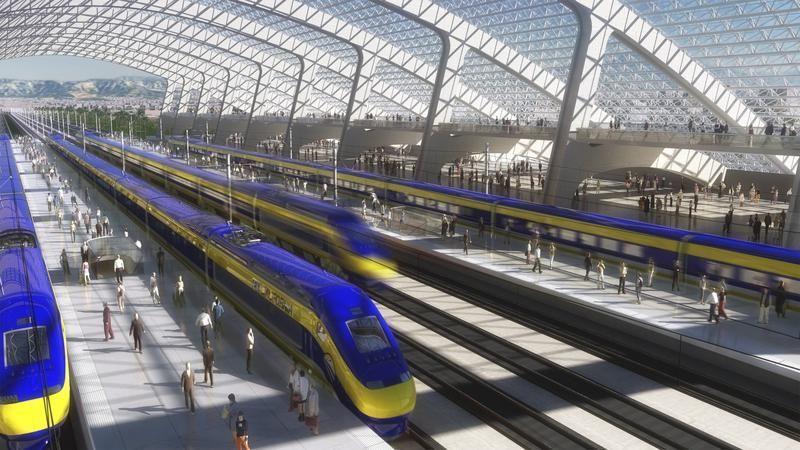
Can High-Speed Rail Opposition Boost California GOP?
Published July 10, 2014 • Read time: 12m
A few weeks before California’s gubernatorial primary, Republican candidates Neel Kashkari and Tim Donnelly gathered at a Southern California hotel to debate each other. Both campaigns expected the event to be a pivotal moment in the closely contested campaign.
Kashkari, a former U.S. Treasury official, and Donnelly, an anti-illegal immigration activist- turned-assemblyman, found plenty to disagree over: abortion, immigration, the 2008 bank bailout, same-sex marriage, education, and other issues -- both stylistic and substantive.
Still, some topics can unite even the most divided political party.
Toward the end of the debate, one of the moderators -- a local radio talk show host often aligned with conservative causes -- asked the candidates, “If elected, will both of you guys promise to throw your body in front of the high-speed train?”
Kashkari replied instantly, eager to highlight his steadfast opposition to California’s high-speed rail project in front of a conservative audience: “Absolutely. Day one, that train is dead.”
Asked if he also opposes the multibillion-dollar infrastructure development, which voters handily approved with a 2008 ballot proposition, Donnelly offered a more caustic response, “I think I’m going to throw the other poor bastard in front of the train.”
Donnelly declined to identify “the other poor bastard,” and Kashkari’s spokesperson had fun speculating whether it was Kashkari or Gov. Jerry Brown.
Gallows humor aside, the question and the candidates’ responses actually underscored how strong opposition to the train has become among Golden State Republicans.
Kids' Lives Matter Too
In a Corner of Ohio, Lessons of 2016
2016 Presidential Election Could Decide State Legislative Races
McCaskill Says No to Run for Missouri Governor
One big question now is whether, despite spending billions already, the project will ever be completed. Another is whether high-speed rail is the issue that can rejuvenate California’s moribund Republican Party.
For his part, Brown continues to embrace the undertaking, which has faced a series of legal, financial, and practical hurdles that have driven up costs and delayed construction for years. Even news that some members of his own party have abandoned the project hasn’t dimmed Brown’s unyielding optimism.
The state’s longest-serving governor is betting that voters will tune out the opposition and rally behind him this November. So far, the train hasn’t hurt his re-election prospects: Brown leads Kashkari (who prevailed over Donnelly) by about 20 points, according to recent polling.
Yet, Republicans remain confident that opposition to high-speed rail is a winning position -- one that might shift the momentum in races across the state. Concurrently, Brown believes he can help radically transform the state’s transportation system with manageable political backlash.
The ultimate test of each assumption won’t come until November, but the project’s history and current state give clues to how the issue might play in the coming months.
Decades of Delays
Californians first elected Jerry Brown governor in 1974, and the former Jesuit seminarian quickly developed a reputation for fiscal restraint, personal austerity, and futurist tendencies. All three of these traits, which don’t always co-exist easily, came into play with his fascination for high-speed passenger trains.
Brown says he believes he rode high-speed rail for the first time in the 1960s during a visit to Japan. Regardless, he became an early advocate for bringing the technology to California.
Two plans for rail in the state went nowhere during his first stint as governor. But as California’s population continued to grow, and traffic congestion worsened, interest in high-speed rail re-emerged. The California High Speed Rail Authority (CHSRA) was created in 1996. The legislature tasked CHRSA, which still oversees the project today, with preparing a rail plan for voter approval.
After years of delays, Proposition 1A finally appeared on the ballot in 2008. The proposition authorized the state to issue nearly $10 billion in new bonds for the high-speed rail authority to build a train line between Los Angeles and San Francisco.
The measure promised to reduce congestion and air pollution, as well as California’s reliance on foreign oil. It required that a “clean, efficient 220 MPH transportation system” be built. Voters approved the measure, 52.6 percent to 47.4 percent.
After decades of setbacks, high-speed rail was finally coming to the Golden State.
Two Worlds
Williams Ibbs, a civil engineering professor at the University of California, Berkeley, has spent decades studying and consulting construction projects throughout the world. He told RCP that California’s high-speed rail plan is an engineering project comparable to the United States’ first transcontinental railroad or the Panama Canal.
Rod Diridon, who served as executive director of the Mineta Transportation Institute for nearly 20 years, added, “It’s much more difficult than anyone could ever imagine. This is the biggest project in the history of the United States.”
Everyone can agree that the project is ambitious and tremendously difficult, but that’s the only real consensus. (Ibbs opposes the project, while Diridon supports it.) Even in today’s hyper-polarized political environment, the high-speed rail project stands out for its ability to elicit dissimilar descriptions.
According to Gov. Brown, “California is getting its act together in a very forward-looking way” by embracing the undertaking. Kashkari counters that building high-speed rail in California today “is like going to Africa and trying to wire them with dial-up” rather than installing high-speed Internet.
Opinions differ, too, on whether -- regardless of its utility -- the political will exists to get it done.
Former Transportation Secretary Ray LaHood, a Republican, said the project is now “the most viable project in the country for a number of reasons.”
California state Sen. Mark DeSaulnier, a Democrat, says that the current rail approach is “going to set the vision back quite a bit” -- and may never be completed.
Since 2008, the project has faced a dizzying series of hurdles that have shifted public opinion polls, surprised political experts, and created a new dynamic that Republicans hope will enable them to mount a comeback in a state where their political power has all but disappeared.
The project originally called for state, federal, and private dollars to fund an estimated $36.1 billion project connecting San Francisco to Anaheim, an Orange County city south of Los Angeles. The CHSRA later revised the estimate to $70.7 billion. The figure has since dropped to $56 billion, but even supporters expect the costs to continue to rise over time.
“High-speed rail is cheaper than building more highways or building more runways,” Brown said of the cost. “It’s a matter of buying and building those things that are either needed or very desirable for the well-being of the society.”
As cost predictions went up, a “state-sanctioned panel of outside experts” estimated that the trip from L.A. to Frisco will actually take 30 minutes longer than the previously expected 2 hours 40 minutes. Ridership projections have also fallen significantly since 2008. The increased costs and logistical challenges have been met with funding challenges from all three of the expected revenue sources.
The CHSRA plans to receive about one-third of its total funding from the federal government. However, Republicans almost uniformly oppose more spending on massive infrastructure projects. With the House firmly in Republican hands, rail advocates will have to seek other federal avenues for funding.
Robert Cruickshank -- a progressive activist who has written in defense of the project for years -- said the state may be able to take out a loan from the Department of Transportation’s Railroad Rehabilitation & Improvement Financing program. The project plan also calls for private investors to help fund some segments of the railway.
But “there has not been any indication that there is any interest by the private sector. There’s just not enough ridership where they’re putting it,” DeSaulnier said, adding that transportation experts throughout the world “scratch their head” when told about California’s plan.
LaHood and Diridon disagree, saying they both know of private investors interested in the project.
Worse than a lack of private or federal interest, Sacramento Superior Court Judge Michael Kenny ruled last year that the state could not tap into the billions of dollars in bonds created by the ballot proposition because the state lacked a legitimate financing plan.
Without access to bond money, Brown proposed tapping into 25 percent of the state’s cap-and-trade revenue (which derives from fees on polluters) to keep the project alive. The move created another problem for the governor: He began to receive criticism from environmental groups who believed the cap-and-trade money could be better used elsewhere.
He responded to the environmentalist criticism: “Here there’s as many opinions as there are political factions. That’s part of the deal. There are lots of people that have different ideas.”
An environmentalist group is now suing the California Air Resources Board for allowing cap-and-trade funds to be used for the train, because, they assert, construction “would result in significant increases in ... emissions.”
And there are more lawsuits.
“One thing that surprised me was the degree to which you saw neighbors living near the project vehemently opposite it,” said Cruickshank, adding that he is concerned about the uncertainty created by legal challenges brought up by opponents “suing every possible thing they could to stop the project.”
The culmination of these problems has led DeSaulnier -- one of the state legislature’s leading transportation experts -- to come out against the project.
“I agree with the governor on a 10,000-foot level,” he lamented. “But when you get into the details -- I just don’t think people have put enough effort into the details.”
A Political Liability?
High-speed rail exists as a top-tier issue in California -- along with the budget, drought, and prison realignment (a policy that shifts responsibility for some inmates from the state to the counties). Politicians have ready answers and they tread carefully in this election year when discussing the state of the bullet train.
Public opinion surveys provide only limited guidance. A January poll found that 54 percent of California voters would stop the proposed project if it appeared as a ballot proposition again. Similarly, 52 percent wanted the project stopped, according to a poll released last September. Both were consistent with most of the polling done after problems began to arise: a slight majority opposed the project.
While Republicans have been the most vocal opponents of high-speed rail, some high-profile liberals have joined the chorus of opposition. Most notably, Lt. Gov. Gavin Newsom -- a likely Democratic candidate for governor in 2018 -- came out against the project earlier this year.
“I am not the only Democrat that feels this way. I am one of the few that just said it publicly,” Newsom asserted. “Most are now saying it privately.”
Sandra Fluke, a state Senate candidate who is running to the left of Brown on many issues, told RCP the program has been “mismanaged” and that she doesn’t think “we should sink more money into it until we see that it’s going to be appropriately fiscally managed.”
But the tide could be shifting. Another survey, released in March, showed 53 percent of adults now favor the train, up eight percentage points from the same survey a year earlier.
Even the project’s opponents broadly agree that something must be done to address the state’s transportation challenges. California’s population will continue to grow -- and the state’s infrastructure will continue to age -- even if the train is stopped (or never completed).
Kashkari and others have suggested that self-driving cars and other technological innovations would solve most of the environmental and financial problems that the bullet train seeks to address.
“If you have a bunch of self-driving cars that are maintaining equidistance, what’s the difference between a train and a stream of cars?” said Kashkari. “All of a sudden, you get train-like capacity in our highways.”
Proponents of the high-speed rail system contend that a train would still be more efficient and would not require costly road maintenance. They also cast doubt about self-driving cars’ ability to significantly reduce traffic congestion in the near-term.
The election, which is expected to feature a high-profile public debate between Brown and Kashkari over the project’s merits, may ultimately sway polls in one direction or another. But it’s clear that a broad swath, if not an outright majority, of the electorate is at least skeptical of the project -- creating an opening for Kashkari.
Voters won’t be able to directly decide whether they want to keep the train. But Kashkari has cast his candidacy as a referendum on the project, if not Jerry Brown’s entire third term.
Kashkari -- who referred to the rail system as a “Jetsons vision of the future” and a “monument to Jerry Brown” -- has vowed to “use the budget authority that I have to just strike it out.” Indeed, he could effectively end the project on his first day in office, as he promised during the radio debate.
Still, even if he is able to effectively capitalize on discontent over the train, Kashkari is a long shot. Brown’s approval rating is hovering in the 50s, and he will significantly outspend Kashkari in the upcoming months. Additionally, the Democrat’s voter registration advantage, and a tainted GOP brand, make Brown’s election an even safer bet.
The incumbent plans to aggressively campaign in the months ahead -- taking nothing for granted -- but Brown is clearly looking beyond 2014. The 76-year-old is now tending to his legacy. While the high-speed rail project may not make the difference in his re-election, it could be one of his greatest achievements -- or failures -- as governor.
He sees the project as a test of California’s greatness -- and, by natural extension, his own ability to implement a grand vision for the state.
“There’s so much squabbling about daily disputes. I’m interested in building a strong America,” reflected Brown. “Building the Hoover Dam or the Golden Gate Bridge, it took commitment over years and even decades. And that kind of commitment is indispensable to a great power.”

A RealClear Thanksgiving: Investing in a Better Future
David DesRosiers • RealClearPolitics
Trump’s Newsom Problem: Antagonist-in-Chief
Carolina Lumetta • RealClearPolitics
America’s Free Spirit
John Maxwell Hamilton • RealClearPolitics
The GOP Majority Should Go Out in Glory
Daniel McCarthy • RealClearPolitics
Republican Majorities Could Return Sooner Than Expected
J.T. Young • RealClearPolitics
The Danger Before the Attack
Leslie J. Sullivan • RealClearPolitics
RCP Today
Top stories on RealClearPolitics
The Takeaway
Polling intelligence and analysis delivered to your inbox
World News
Featuring the latest world news
Policy
Featuring the latest policy news
Support Our Mission
As part of RealClearPolitics, authors aim to provide balanced, non-partisan analysis by presenting top reporting and commentary from all sides of the political spectrum.
Trusted by policymakers and citizens alike since 2000