Still in the Running
Published Dec. 30, 2013 • Read time: 6m
Join the Conversation
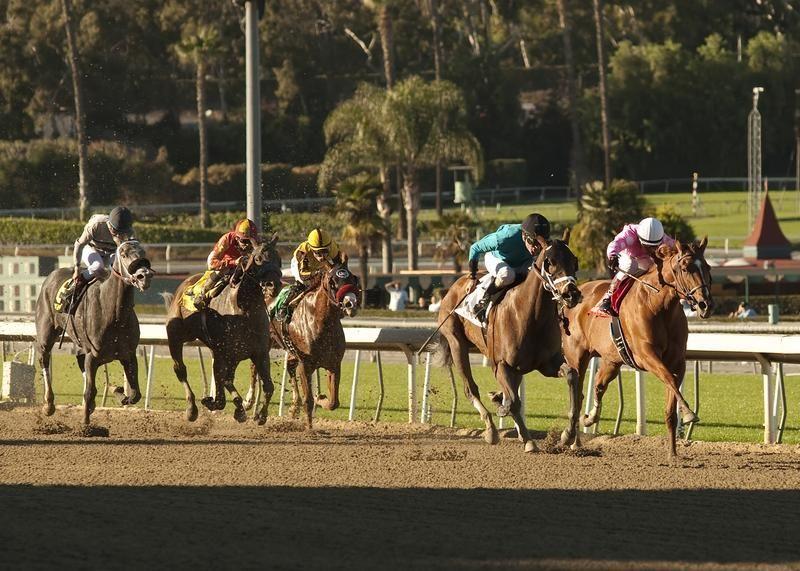
0The day after Christmas was opening day at Santa Anita Park, as it is every year. To me, it’s one of the happy events of the holiday season. Thursday’s first race was won by the favorite, a horse named Crusher, with jockey Martin Garcia aboard.
And so another tradition resumes. We shouldn’t take any of them for granted. I’ve lived in the East for years and don’t make it to California’s thoroughbred tracks much anymore. And there are fewer places to watch horses run than when I left.
Bay Meadows, the track closest to my home as a boy, hosted its last race in August 2008 during the San Mateo County Fair. Its horse-themed art was auctioned, the track bulldozed, the grandstand razed. A mixed-use development rose in its place.
Last Sunday, the thundering sounds of horses coming down the stretch were heard for the last time at another storied California racetrack. Hollywood Park opened its gates in 1938 under the chairmanship of Jack Warner, with backing from entertainment industry legends such as Al Jolson, Walt Disney, Bing Crosby, and Irene Dunne.
That year, Seabiscuit solidified his place in Americans’ hearts by winning the inaugural Hollywood Gold Cup. Now that track, too, will be turned into condos, stores, and office buildings—as if Southern California needs another real estate development.
If Hollywood Park had a storybook premiere, its closing day was film noir. When it came time for the final race, bugler Jay Cohen played a medley of “Hooray for Hollywood” and the bittersweet “Auld Lang Syne.”
Aaron Rodgers Drops a Bomb on Tony Fauci, the 'Absolute Coward'
Knocking Smokeless Tobacco Out of the Park
GOP Crossroads; Party Fractures Help Trump; Rise of the Groupies; Candlestick Memories
For the Patriots, Without Apology
“The thing I remember most was getting up close to the winner’s circle and seeing Cary Grant,” legendary trainer Bob Baffert told reporters. “That was a thrill.”
After more than 50 years in the game, Hall of Fame trainer Jack Van Berg was less nostalgic. He termed the stewardship of California racing by state and local officials “pathetic,” and announced that he’s moving his base of operations to Oaklawn Park in Arkansas.
The lesson here is that not everything we love lasts.
The San Francisco 49ers have probably played their last game at Candlestick Park. The wrecking ball arrives next year. The imposing concrete edifice was built for baseball—to lure the Giants from New York—but the Giants last played there in 1999. Candlestick was a windy, cold, and foreboding venue for sports, especially baseball, but my memories of the place are warm ones.
It’s where I first saw Willie Mays. It was a long time ago and I was a boy, but to see him play was to remember him forever. Candlestick was also the first place—but not the last—where I watched my father confront a racist. Twenty-five years later, I had seats right behind the dugout for Game 3 of the Bay Area World Series. Instead, I worked that night covering the deadly Loma Prieta earthquake for the San Jose Mercury News.
On a sunnier note, I was also at Candlestick for “The Catch,” the 1982 Joe Montana pass to Dwight Clark that put the Niners on the road to the Super Bowl.
Before Candlestick, the 49ers played at Kezar Stadium. I saw the team play there, too, as did my parents. In fact, my parents were scheduled to see a game there the day I was born. It’s why my birth took place at Letterman Army Hospital in the Presidio. And, yes, that hospital was torn down long ago. The Presidio is now a public park, which I suppose is better than the fate of Columbia Hospital for Women in Washington, D.C. My youngest child was born there, as was her mother. The wards are now condos.
This Christmas, I received a first edition of Norman Maclean’s “A River Runs Through It” as a gift. Originally shunned by the New York publishing houses, it was issued by the University of Chicago Press, where Maclean taught for decades. Do you know how that book became a runaway bestseller? The answer is word of mouth, in a pre-Internet world, largely driven by independent bookstore owners. That would be unlikely today: Most of the small booksellers are gone, as are most of the big chains.
I miss bookstores. I’m going to miss newspapers, if it comes to that, even more.
For years, Joel Garreau, a pal of mine who is a writer and futurist, discussed which American city would be the first without a daily newspaper. Our conversation foundered on definitions. How big a city we were talking about? Did New Haven, Joel’s nomination, count? My fear was that it would be San Francisco. It turned out to be New Orleans. Meanwhile, I notice the San Francisco Chronicle soldiers on. God bless it.
God also bless Aaron Kushner and Eric Spitz. I’ve never met them, but they are the visionaries—I hope that’s how they’ll be remembered—who are pouring time, money, and prestige into the Orange County Register, the newspaper that publishes my Sunday column, including this one.
One way to put it is that they have zigged while the rest of the newspaper business has zagged. Another way is that they’ve done their own thinking, just like those independent booksellers who saw genius in “A River Runs Through It,” and they see a way to make money while doing something good.
While almost every other paper in the country is looking to address journalism’s broken business model by cutting costs, these two are concentrating on saving the paper by increasing revenues. They beefed up staffing at the Register, purchased the Riverside Press-Enterprise, and announced the creation of new papers in Long Beach and Los Angeles. They aren’t Luddites—they’ve made money in technology companies as well as in old-line businesses such as greeting cards and in reviving an old beer label, Narragansett, that once enjoyed a monopoly at Fenway Park.
There are no monopolies in journalism anymore, but Kushner and Spitz seem to enjoy the idea of competition. It seems to me that any red-blooded American should wish them success. In the meantime, progress is marching onward at an unlikely location: Orange County’s own Los Alamitos Race Course.
Hollywood Park’s demise left some open dates in the Southern California racing calendar, and Los Alamitos sought to fill them. The Cypress City Council unanimously approved the track’s expansion of the racing strip from five-eighths of a mile to a mile, the distance needed for elite thoroughbred racing.
A new meet will commence at Los Alamitos next July. I plan to be there.

Newsom Defies Voters, Juries and Lawmakers To Spare Murderers While Defending Abortion
Curtis Hill • RealClearPolitics
The Algorithmic Tilt
Frank Filingeri • RealClearPolitics
A RealClear Thanksgiving: Investing in a Better Future
David DesRosiers • RealClearPolitics
Trump’s Newsom Problem: Antagonist-in-Chief
Carolina Lumetta • RealClearPolitics
America’s Free Spirit
John Maxwell Hamilton • RealClearPolitics
The GOP Majority Should Go Out in Glory
Daniel McCarthy • RealClearPolitics
RCP Today
Top stories on RealClearPolitics
The Takeaway
Polling intelligence and analysis delivered to your inbox
World News
Featuring the latest world news
Policy
Featuring the latest policy news
Support Our Mission
As part of RealClearPolitics, authors aim to provide balanced, non-partisan analysis by presenting top reporting and commentary from all sides of the political spectrum.
Trusted by policymakers and citizens alike since 2000