
What to Watch For in Tonight's Elections
Published Nov. 5, 2013 • Read time: 8m
Join the Conversation
01) Washington State Senate Race, District 26. This might seem like an odd contest to cite up front, but in terms of trying to measure the national temperature, it might be the best one. To summarize: Democratic state Sen. Derek Kilmer was elected to Congress last year to replace Norm Dicks. A Democrat, Nathan Schlicher, was appointed in Kilmer’s place at the beginning of this year. He now has to run for a full term in a special election.
This something of the consummate swing district. It runs along the eastern shore of the Olympic Peninsula, across Puget Sound from Tacoma. Barack Obama carried it by a little more than one point in 2012. It voted for Republican gubernatorial candidate Rob McKenna by 12 points but gave Sen. Maria Cantwell a double-digit win. You can see the split personality down the ticket: It went Republican for secretary of state, auditor, and attorney general, but Democratic for lieutenant governor, treasurer, public lands commissioner, and insurance commissioner. It voted narrowly to approve same-sex marriage, and heavily to legalize marijuana.
The Republican candidate, state Rep. Jan Angel, ran ahead of Schlicher by a somewhat-surprising 10-point margin in the August primary. Picking up the seat would make it more difficult for Democrats to take full control of the Senate in the 2014 midterms, so millions of dollars have poured into the race from outside the stae. Liberal groups have pounded Angel for her ties to the conservative American Legislative Exchange Council, while conservative groups have painted Schlicher as an out-of-touch liberal.
Poll: Rahm Ahead, But Facing Possible Runoff
More Keystone Delays; Are Iowa Caucuses Un-Iowan? How Blizzards Bury and Boost Politicians
Have No Gun, Will Sheriff
The Fate of Mirkarimi
This race could have broader national significance for two reasons. First, Obama won only 209 U.S. House districts in the 2012 elections. So to take back the lower chamber, Democrats have to outperform the president in a number of seats.
But one of the key story lines for midterm and off-year elections is the dropoff in turnout for key Democratic groups. We’ve seen this throughout the post-2012 special elections cycle: Democrats have run ahead of the president’s performance in their districts in only a handful of cases. The rule has been a dropoff of about three to four points, similar to what we saw in the recent New Jersey special election to replace the late Sen. Frank Lautenberg.
So if the Democrat were to run ahead of the president here and win by more than a point or so, it would give some hope to Democrats that they can accomplish this next year. This is especially true given that the influx of money has made this face-off much more like a regular midterm contest than a special election.
The other consideration is that we have something of a controlled experiment regarding the effect of the government shutdown outside of the Beltway. As I’ve noted before, partisan performance in Washington state primary elections correlates closely with the general election outcomes. Democrats usually pick up a couple of points due to the increased interest associated with general elections. In a vacuum, given the primary numbers, I’d expect Angel to win by four to six points. When you figure in the influx of cash from third party groups and Schlicher’s increasing establishment of himself as an incumbent, I might expect Angel to win by two points or so. This would also be consistent with the dropoff in Democratic performance of about four points that we’ve seen all year.
So I’d say this: If Angel holds on to that 10-point margin, it would be a very good sign for Republicans that the president’s diminished job approval since August is weighing his party down. If it’s a close race, I’d consider it something of a neutral environment for the party, with a thumb on the scale either way depending on which side wins. And if she loses by more than a couple points, it would suggest that the Republican brand really is causing problems for its candidates in swing districts.
We want to be careful not to read too much into a single race. But given the unique nature of this one, it is worth watching. (If you can keep your eyes open that late!)
2) Virginia Attorney General. There is little doubt that Virginia is about to elect a Democratic governor, and almost no doubt that it is going to elect a Democratic lieutenant governor. But given the problematic nature of the Republican nominees for those posts, a better measure of the overall partisanship of the state likely resides in the AG. Polls have consistently found a close contest there.
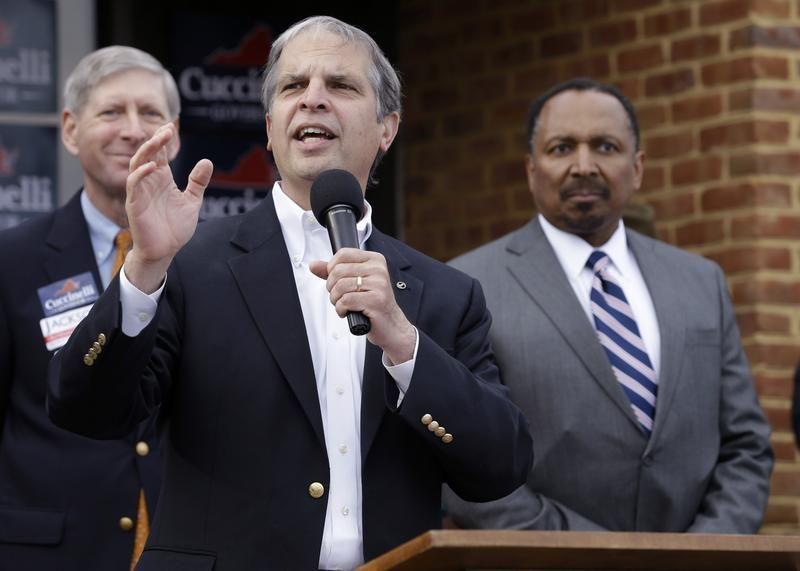
If Republican state Sen. Mark Obenshain (pictured) wins, it will provide some evidence that the personalities up-ticket really are the story there. If he loses, Republicans will argue that the up-ticket losses were too much for him to survive. There’s some truth to this -- due to the decline in split-ticket voting, he’s at an enormous disadvantage being at the bottom of the ticket. But if he loses by more than, say, a point or two, this argument will be pretty hollow, and we’ll have a decent data point showing that Virginia’s march toward purplish-blue status isn’t just an “Obama electorate” phenomenon.
3) Virginia Demographics
We’ve talked a lot about demographics this year, but we’re finally going to get some good data. We’re getting exit polls in the races, as we did in 2009, and it couldn’t be more timely. One of the big question marks for Democrats going forward is whether Obama’s turnout among minority voters is transferable, or whether it is an Obama-specific phenomenon.
Gubernatorial candidate Terry McAuliffe has invested scads of money trying to replicate the Obama turnout patterns. We should probably expect a bounce-back in Democratic groups from 2009, simply because that environment was so overwhelmingly lousy for Democrats (if we don’t, it’s a big problem for the party). But if the breakdowns look like 2012 or 2008, it’s a pretty good sign for Democrats.
4) Virginia House
There’s really no better source for Virginia political analysis than Not Larry Sabato. Ben Tribbett is liberal, but his calls are fair. You can read his seat-by-seat analysis of Virginia state House seats here.
The bottom line is this: Democrats spotted the GOP a seat by failing to get a candidate on the ballot in the 4th District. Another competitive Republican seat in southwest Virginia has swung toward the GOP in the wake of the government shutdown.
But there are a bunch of seats, mostly in northern Virginia, where the GOP took a beating in the wake of the shutdown. Almost all of these districts that Tribbett lists as tossup or leans-Republican went for Obama in 2012, although to widely varying degrees (some were very close, while others gave the president as much as 60 percent of the vote). It wouldn’t be terribly surprising to see Democrats pick up some of these seats regardless, but if they pick up, say, five or six, it could signal, once again, that the Obama electorate is replicable in an off-year election. If Republicans only lose a few seats, even in an awfully favorable environment for Democrats in northern Virginia, it could suggest real problems for that coalition in the absence of Obama atop the ticket.
5) New Jersey Exits/Christie Coattails
I wrote about this earlier today, so I don’t have too much to add. If Christie wins by more than 20 points, it is a historic win. If it’s a single-digit win . . . it’s still a pretty good showing, historically, for the governor, although it will be spun as a disappointment.
What’s more interesting to me are the demographics and whether Christie has any coattails. If he manages to carry the Hispanic vote or to get more than, say, 25 percent of the African-American vote, it would be significant.
There’s been some talk of coattails, and of Republicans picking up the four seats they need to tie up the state Senate. If this happens, it would be a very big deal. The four most Republican seats occupied by Democrats gave Obama 53 percent, 55 percent, 55 percent, and 57 percent of the two-party vote, respectively; there is only one other seat that gave him less than 60 percent of the vote. To be sure, good Democratic presidential performance doesn’t always translate to good Democratic performance down-ticket in the Northeast, but these are still pretty Democratic seats. For Christie’s coattails to go that deep, they would have to be long indeed.
6) N.Y. County Races
Finally, there are two county executive races in New York worth keeping an eye on: one in Westchester County and one in Nassau County. Both went Republican in 2009. Both were surprises, especially Westchester, which elected a social conservative to the top position. It would take a pretty favorable Republican environment to hold on in Westchester, and a Republican hold in Nassau (where the executive has had a somewhat rocky tenure) would serve as a reminder that a lot of these Northeastern counties aren’t as Democratic as the presidential top lines might suggest.

Jon Finer’s Old and Dangerous ‘New Approach’ to Israel
Peter Berkowitz • RealClearPolitics
The President Deserves Better
John Ullyot • RealClearPolitics
Congress Doesn’t Need Another Blame Game. It Needs To Find What’s Broken
Jarrod Bernstein • RealClearPolitics
Democrats Won the Midterms. Common Sense Won, Too
Jordanne Kemper • RealClearPolitics
The 120th Congress Shapes Up
Carolina Lumetta • RealClearPolitics
Flooding GOP Primaries With Democrats
Robert Natelson • RealClearPolitics
RCP Today
Top stories on RealClearPolitics
The Takeaway
Polling intelligence and analysis delivered to your inbox
World News
Featuring the latest world news
Policy
Featuring the latest policy news
Support Our Mission
As part of RealClearPolitics, authors aim to provide balanced, non-partisan analysis by presenting top reporting and commentary from all sides of the political spectrum.
Trusted by policymakers and citizens alike since 2000