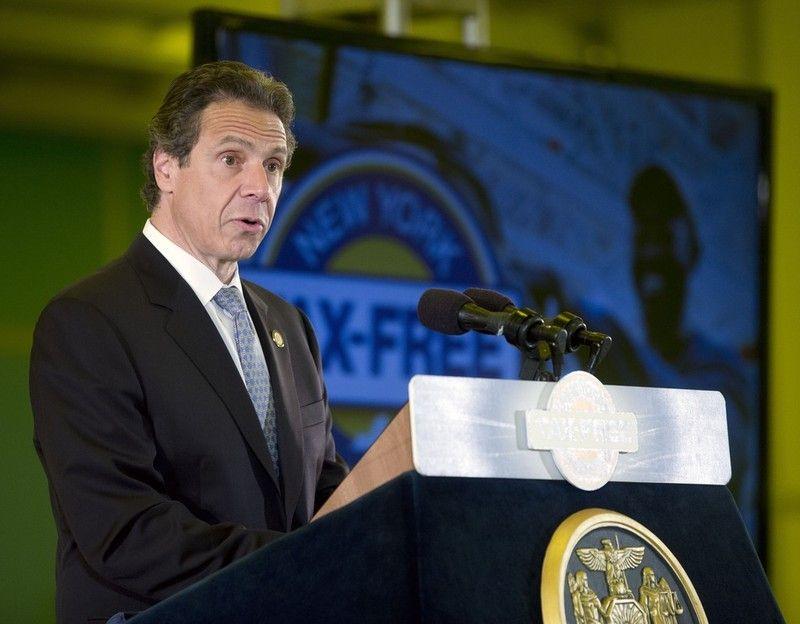
Andrew Cuomo Quietly Builds His 2016 Case
Published June 21, 2013 • Read time: 11m
ALBANY, N.Y. -- A young aide stood impatiently beside the neat rows of folding chairs that lined the ornate executive chamber of the New York State Capitol on Wednesday afternoon.
Andrew Cuomo’s press conference had already entered its second hour, despite the many demands on the governor’s time with just two days remaining in the 2013 legislative session.
Seizing upon a split-second pause, the aide turned to the members of the media and shouted -- for the third time -- “Last question!”
And for a third time, Cuomo ignored him, fielding an additional dozen inquiries from the aggressive New York capital press corps on hot-button topics ranging from casinos to abortion rights to marijuana decriminalization.
The typically media-cautious governor was on a roll.
Besides, with so many important issues still unresolved, there was little chance that anyone would ask him The Question -- whether he is preparing to run for president in 2016.
“By all accounts, we will have had an extraordinary session, OK?” Cuomo said, looking hypnotically intense. “Extraordinary.”
Not even Cuomo’s harshest critics in Albany could argue with that assessment.
Among the achievements the former state attorney general steered through the New York legislature over the last five months: a landmark gun-control law, his third on-time budget in a row, a boost in the minimum wage, new teacher evaluation standards, and a development-boosting initiative for economically distressed upstate New York.
With two days remaining in the legislative session, the hard-charging Cuomo wasn’t done yet, as he laid out a forceful defense of an abortion rights bill that was among his most controversial proposals of the session.
Kids' Lives Matter Too
In a Corner of Ohio, Lessons of 2016
2016 Presidential Election Could Decide State Legislative Races
McCaskill Says No to Run for Missouri Governor
As Cuomo outlined his case for how the bill would merely align New York’s abortion statutes with national law, his dark-brown eyes grew wider. One by one, the former assistant district attorney dismissed the counterarguments of opponents, several times pausing to acknowledge that he “respects” both the pro-choice and pro-life positions, though he has been the former his entire life.
What Cuomo didn’t appreciate, he explained, was inaction and ambivalence.
For legislators who preferred not to vote on the measure at all, he offered a clear response: “No, no, no, no, no,” Cuomo said, waving his finger in the air, in the manner of an imposing NBA shot-blocker.
Cuomo is an enforcer, but one who acts with an end-game in sight, one that typically entails compromise along the way.
“This is a guy who listens better than anybody,” one of the governor’s closest aides told RCP. “He understands where you’re coming from, and he conveys this feeling of ‘I can help you. I’m smart enough, I’m strong enough, I’m committed to whatever issue we’re working on.’ And when you’re a legislator in that room, that’s a very powerful feeling. And it’s not intimidation.”
As the son of former New York Gov. Mario Cuomo -- who declined efforts to draft him into the 1988 and 1992 presidential campaigns, which he would have entered as a front-runner -- Andrew Cuomo’s own White House ambitions are simply assumed in Albany.
Less than 2½ years into his first term at the helm of the nation’s third most populous state, Cuomo already ranks among the most accomplished governors in the nation. And in addition to his legislative achievements, he strikes a commanding appearance, enjoys an extensive fundraising network, and possesses natural political instincts on par with any current officeholder.
But there is reason to be skeptical of a Cuomo presidential bid in 2016. While he shares his father’s raw Queens accent, he did not inherit his gift for speechifying, a trait that could have galvanized Democratic primary voters.
Notwithstanding his behind-the-scenes political dexterity, it is difficult to envision the charisma-challenged negotiator inspiring anything approaching the enthusiasm that elevated Barack Obama to the party’s nomination in 2008.
Nor is he regarded as a “true believer” who acts on conviction, political consequences be damned.
Even while pushing through the landmark 2011 law that legalized same-sex marriage in New York -- perhaps his crowning achievement thus far in a first term full of successes -- Cuomo lacked a visceral personal connection with the issue, those around him acknowledge.
“[Gay] marriage, in a way, can serve as a template for understanding him,” one of Cuomo’s longtime confidants said in an interview. “At some point, you go from being a 23-year-old where the issue doesn’t really resonate and it doesn’t have any significance to you, and you wake up and the world has changed. … It was very controlled, and it was very smart. We did not commit to move legislation until we understood how we were going to get it passed, and there was very tight control on what the people who were working with us were doing and saying.”
The rationale for a President Cuomo, should he decide to run, would be basic: If voters are looking for sizzle, they can turn elsewhere. But if the weaknesses of the Obama presidency have created an appetite for a tough and experienced executive with proven results on big issues, Democrats can do no better in 2016 than the man in Albany.
Will Hillary Block His Path?
That case would be compelling if not for the imposing shadow cast by a certain Democratic titan, whose mundane act of joining Twitter created a mini-media frenzy.
The job titles that Hillary Clinton displayed in her abbreviated biography on the social media platform were themselves enough to suggest why an ambitious Democrat like Cuomo might feel checkmated before the race has even begun: wife, mom, first lady, senator, secretary of state.
“You don’t have to be a genius to figure out that it’s going to be hard for him to make a dent if Secretary Clinton’s in the way,” said New York-based Democratic strategist Hank Sheinkopf, noting that Clinton remains particularly popular in the state she represented in the Senate, and has a fundraising base that not only largely overlaps Cuomo’s but supersedes it.
While most observers expect him to yield to Clinton, should she run, few doubt that Cuomo would pounce on the opportunity if she opts out. And more than a few wonder if there is room for both New Yorkers in the 2016 field.
“It’s not an impossibility, and anybody who predicts what is going to happen in politics should be hospitalized,” Sheinkopf said. “He’s done some pretty amazing things. Is he a hard campaigner? The answer is yes. Is he a tireless worker? He certainly is. Would he be competitive? You bet, if he puts his mind to it.”
Clinton’s unique status as a non-incumbent frontrunner-in-waiting has meant that the early 2016 jostling is less overt on the Democratic side than among Republicans. But it has not been altogether dormant. Vice President Joe Biden set coyness aside when he attended an inaugural ball hosted by the Iowa State Society in January. In May, Biden visited South Carolina, another early voting state, where he delivered a fiery speech at a fundraiser to party activists who will be heavily involved in the primary there.
Maryland Gov. Martin O’Malley has coupled his own early-state visits with an impending nationwide fundraising slate that he is carrying out in his role as finance chairman for the Democratic Governors Association.
But with a gubernatorial re-election fight looming next year, Cuomo has avoided the kind of overt presidential flirtations that the soon-to-be lame duck vice president and term-limited O’Malley have engaged in.
In Andrew Cuomo’s version of Fight Club, the first rule about running for president is that you don’t talk about running for president.
“It’s not how anyone thinks around here,” a close Cuomo aide said. “You break that trust [with legislators], and the whole system breaks down, so we’ve extracted any talk of that from our DNA because we’re so committed to getting things done.”
While claiming not to care about “what’s going on in Annapolis,” this same aide did offer an off-the-record opinion about how Maryland state legislators may be reacting to O’Malley’s national maneuvering, perhaps suggesting a keener interest in the potential rival’s activities than members of Cuomo’s inner circle care to let on.
Still, there is no doubt that Cuomo’s political team has been focused primarily on their more immediate challenges.
During his first two years in office, the Empire State governor earned a reputation as a budget-cutting, fiscal centrist who worked well with state Republicans on a host of issues. In the 2013 legislative session, however, he placed a left-leaning social agenda at the top of his to-do list.
According to Cuomo aides, the shift was a matter of practical politics, as the governor had to work with a Republican-controlled Senate upon taking office in 2011 and has since shifted to the social agenda he ran on in 2010. But Albany Republicans scoff at the idea that the focus of Cuomo’s 2013 agenda was constructed on anything other than building his case for Democratic primary voters in 2016.
“Why else would he do it?” Republican Assembly Minority Leader Brian Kolb asked. “Because, quite frankly, if you looked at his poll numbers, they were very good in his first two years because people really felt he was trying to turn the state around.”
Kolb, who spoke of the Democratic governor with a combination of courteous respect and unvarnished skepticism, said he felt confident that Cuomo’s pre-presidential team is “already doing things with that in mind,” despite their protests to the contrary.
In a Sienna poll released earlier this week, Cuomo’s approval rating had slipped to a new low of 58 percent -- still a formidable number, but a slide of 6 points from last month alone and down significantly from his high of 74 percent in a Quinnipiac poll conducted last December.
Several state Republicans have expressed interest in running against Cuomo next year. None, at the moment, appears able to offer a particularly strong challenge to him, however.
But Cuomo knows what it’s like to be the clear favorite in a campaign and end up losing. He did just that in his 2002 gubernatorial bid when an ill-advised comment about George Pataki’s post-9/11 leadership sank his hopes.
Current GOP efforts to knock him down a peg center on portraying Cuomo as more interested in playing to an outside audience than in reaching compromise on still unresolved issues, like the seemingly endless series of scandals that have plagued the state legislature.
“Rather than spend his political capital addressing the entrenched interests and corruption in Albany and the way New York treats businesses, he used it on social issues,” said New York GOP spokesperson David Laska. “He really wanted to get out ahead of Obama on the gun-control issue. He’s got his eye on 2016 when he ought to have his eye on New York state.”
A Vocal Upgrade?
In a state as heavily Democratic as this one, Cuomo will have at his disposal no shortage of defenders to help him make his case. But among Albany Democrats, he mostly engenders a quiet respect, rather than unshakable devotion, which befits his own personality and governing style.
“I think he’s got a very good team around him,” said freshman Democratic Sen. Brad Hoylman said when asked his impressions of Cuomo. “Most successful chief executives at the end of the day are pragmatic, and he brings to the chamber a combination of progressive ideology and management skills that I think have shaped his agenda so far.”
Fellow first-term Democratic Sen. Terry Gipson was equally measured when asked his impressions of the governor -- and whether he’d support him for president.
“It’s too soon for me to make that call,” he answered. “I haven’t been around him enough to really say one way or the other at this point. I’d like to see how the presidential nomination contest pans out.”
While Cuomo’s strategy of keeping his head down and avoiding the national spotlight appears certain to remain in effect through his re-election campaign next year, observers in the state capital have noticed at least one small, yet potentially telling, change in his style this year:
Cuomo appears to be making a concerted effort to improve his speaking style.
During his January State of the State address, for instance, he drew boisterous applause but also knowing smirks from the press when he unveiled a newly animated delivery, complete with off-key and uncharacteristic shouts.
This speechmaking-enhancement endeavor remains a work in progress, but there remains plenty of time for tinkering.
Its ultimate failure or success, however, could prove pivotal down the line.

A RealClear Thanksgiving: Investing in a Better Future
David DesRosiers • RealClearPolitics
Trump’s Newsom Problem: Antagonist-in-Chief
Carolina Lumetta • RealClearPolitics
America’s Free Spirit
John Maxwell Hamilton • RealClearPolitics
The GOP Majority Should Go Out in Glory
Daniel McCarthy • RealClearPolitics
Republican Majorities Could Return Sooner Than Expected
J.T. Young • RealClearPolitics
The Danger Before the Attack
Leslie J. Sullivan • RealClearPolitics
RCP Today
Top stories on RealClearPolitics
The Takeaway
Polling intelligence and analysis delivered to your inbox
World News
Featuring the latest world news
Policy
Featuring the latest policy news
Support Our Mission
As part of RealClearPolitics, authors aim to provide balanced, non-partisan analysis by presenting top reporting and commentary from all sides of the political spectrum.
Trusted by policymakers and citizens alike since 2000