
Immigration Bill Could Aid Republicans, But How Much?
Published April 8, 2013 • Read time: 7m
Join the Conversation
0Mitt Romney and Paul Ryan earned the dubious distinction of garnering just 27 percent of the Latino vote in 2012. This dismal showing not only assured their defeat, but implied GOP difficulties for years to come: Hispanics are the nation’s fastest-growing minority.
The good news for the party is that the most prominent Republican officeholders have publicly acknowledged the depth of the problem. They are finally focusing in a serious way on immigration, the issue that put Romney most directly odds with Hispanic voters.
The bad news is that Republicans may not be able to get there from here.
For starters, even if significant numbers of congressional Republicans sign off on sweeping immigration reform legislation, President Obama and the Democrats figure to get most of the credit. This may not be fair (or even logical) but it has already happened once -- even when a Republican president, Ronald Reagan, signed a generous amnesty bill. Influential conservatives concede that it’s likely to happen again.
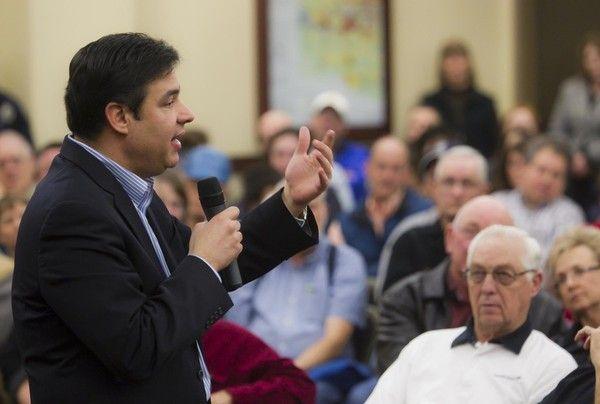
“It’s the right policy,” said Rep. Raul Labrador (pictured), a key GOP player in the reform effort. “I’ve never believed it’s been good politics for the Republican Party. I don’t think we’re going to get any credit. But I’m OK with that. If we have good policy, the politics will follow.”
Perhaps that’s true in part, if only because it will likely inoculate Republicans in the 2014 elections against the perception epitomized by Romney’s infamous “self-deportation” solution to illegal immigration.
Cruz's Path to Nomination
Trump Stands by His Manager
With Tweets on Heidi Cruz, Trump Sinks to New Depths
A Vote for Kasich Is a Vote for Trump
“If we don’t get this done,” notes Republican Rep. Mario Diaz-Balart, “it’s an issue that’s going to be used against us every election cycle.”
But having a new immigration law on the books -- and off the table -- in time for the midterms and the 2016 general election won’t necessarily open the door to the Hispanic community. That’s because Latino voters may have already moved on while Republicans were fumbling for the key to their support.
“It’s not that we pass this bill and all of the sudden the Republican brand with minorities and ethnic communities is ‘Hey, great!’ ” Diaz-Balart concedes. “But if we pass this bill, then Republicans can start going to those communities.”
The question, however, is: Going to them with what? In addition to fixing a broken system, Republicans say that a reform law would give them a credibility card with Hispanic voters, allowing them to talk about the conservatism they believe many Latinos naturally subscribe to.
These voters have had “immigration earmuffs,” said Jennifer Korn, executive director of the conservative Hispanic Leadership Network. They’re not listening to Republicans on the economy, education, the deficit and other issues because immigration hasn’t been addressed yet, she said. Once that issue is resolved, Republicans can emphasize concerns that are less fraught with emotion and ethnic politics: smaller government, erasing the deficit, tax reform and pulling Obamacare “out by its roots,” in the words of Senate Republican Leader Mitch McConnell.
But what if a majority of Latinos don’t share those views?
Obamacare, for example, is popular among this segment of the electorate, especially for the third of Hispanics who are uninsured. A recent Kaiser Family Foundation poll found Latinos more supportive of Obama’s health care law than non-Hispanic whites: 48 percent view it favorably, while 19 percent view it unfavorably.
And a 2012 study by the Pew Hispanic Center found 75 percent of Latinos back a bigger government with more services, compared to 19 percent who prefer a smaller federal system. The overall public favored smaller government, 48 percent to 41 percent.
That support of social programs comes with a caveat, however: Taxes and the deficit ranked high on these voters’ list of concerns in 2012, including the economy and jobs. It is this mixed message that Republicans believe gives them an opening.
Health care was “popular in the past because you’ve had liberals selling it to a community that is underserved and under-insured,” said Korn. “Hispanics, just like the rest of Americans, are going to see their premiums go up and affect their small businesses.”
That’s a theory Republicans are about to put to the test. Ryan, the chairman of the House Budget Committee, introduced a financial plan last month that would balance the budget in a decade -- in part by gutting funding for Obamacare.
It was Romney’s choice of the Wisconsin congressman as a running mate that dismayed Republicans who believed 2012 was an opportune time for the Grand Old Party to put a Latino on the ticket. Marco Rubio was the name most often floated for such a strategy.
Would that do the trick in 2016? No one knows, but recent electoral history shows that making an effort counts. George W. Bush, who speaks the language, invariably sprinkled some Spanish words into his speeches when addressing Hispanic audiences. And, bolstered by an intense community outreach when he ran for re-election in 2004, Bush garnered some 40 percent of the Hispanic vote.
Conversely, although Arizona Sen. John McCain worked with Bush and Sen. Ted Kennedy on a comprehensive immigration reform bill in 2007 (it ultimately failed), his campaign didn’t directly pursue that constituency’s support -- and he attracted only 31 percent of their votes.
Reagan, the last president to sign major immigration legislation, garnered 35 percent of the Hispanic vote in 1980 and 37 percent in 1984. His vice president, George H.W. Bush, attracted 30 percent in his 1988 presidential race, two years after Reagan signed that immigration legislation, but only 25 percent in 1992 when he lost his re-election bid to Bill Clinton. The demographics have changed since then, making the Hispanic vote even more critical.
Republican National Committee Chairman Reince Priebus said the Republican nominee’s “self-deportation” comment made immigration such “a biting, cutting issue in the Hispanic community that many families just shut out Mitt Romney as an option.”
The GOP had no long-term presence in the community, he said, “so the caricature and narrative of what people say you are becomes a reality. . . . We had no presence, so we were not winning on the issues.”
But maybe they weren’t striking the right issues. Romney cut Spanish language ads hitting Obamacare, while Obama’s ad targeting Latinos focused on the benefits of the program.
Some Hispanic leaders say Republican messaging has been missing the mark. “So far, Republican outreach has been to business elites. Latinos, like the rest of Americans, did not respond to an elitist economic message that came from the candidate,” said Alfonso Aguilar, executive director of the Latino Partnership for Conservative Principles.
“We have to go to the kind of Reagan populism that really won hearts and minds. You want to celebrate the entrepreneur, and that’s great. But you also want to talk about the workers.” Most Latinos, Aguilar said, are not entrepreneurs. “You have to explain to them why as a janitor or a cook you’re also helping to build the business you are working in. I think that’s the economic message that resonates with Latinos.”
Republicans also figure that socially conservative values appeal to Hispanic voters, most of whom are Catholic or evangelical, pro-life and in favor of traditional marriage. But here, too, attitudes are changing. Pew research heading into the 2012 election shows these voters are more conservative than the general electorate on the issue of abortion, but they are shifting with the rest of the country toward supporting same-sex marriage.
Immigration reform legislation might cheer Latinos, but it doesn’t necessarily endear them to the GOP. Still, the lack of a reform is a “roadblock” to any potential success.
Most Republicans agree that a reform law in their back pocket, and millions of undocumented immigrants out of the shadows, might gain them entry to this bloc. But skeptics are far from convinced.
“Democrats view the illegal population in the United States as unregistered Democrats,” said Iowa Republican Rep. Steve King. When asked why those prospective citizens won’t become Republicans, King shakes his head. “Why don’t Republicans figure out how to get more than 8 percent of the African-American vote, and then show me how to do that. These Republicans don’t know how to do that.”

The Danger Before the Attack
Leslie J. Sullivan • RealClearPolitics
Jon Finer’s Old and Dangerous ‘New Approach’ to Israel
Peter Berkowitz • RealClearPolitics
The President Deserves Better
John Ullyot • RealClearPolitics
Congress Doesn’t Need Another Blame Game. It Needs To Find What’s Broken
Jarrod Bernstein • RealClearPolitics
Democrats Won the Midterms. Common Sense Won, Too
Jordanne Kemper • RealClearPolitics
The 120th Congress Shapes Up
Carolina Lumetta • RealClearPolitics
RCP Today
Top stories on RealClearPolitics
The Takeaway
Polling intelligence and analysis delivered to your inbox
World News
Featuring the latest world news
Policy
Featuring the latest policy news
Support Our Mission
As part of RealClearPolitics, authors aim to provide balanced, non-partisan analysis by presenting top reporting and commentary from all sides of the political spectrum.
Trusted by policymakers and citizens alike since 2000