
How Obama Is Failing Syria
Published March 29, 2013 • Read time: 5m
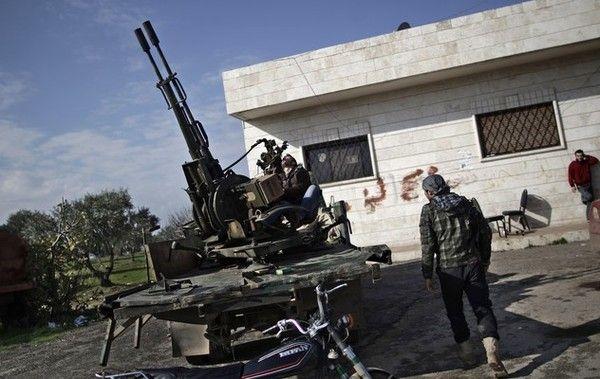
In the matter of the Syrian rebellion, the U.S. hasn’t even “led from behind.” The Obama administration has pioneered a new role for a great power: We are now the traffic controllers, directing the flow of weapons to the rebels.
The money isn’t ours; it is Qatari and Saudi and Libyan. The planes hauling the weapons are Jordanian, Qatari and Saudi. And the risks are run by Syria’s neighbors, principally Jordan, Turkey and Lebanon.
Our officials have opinions on Syria, but no one in the Greater Middle East can divine them. We want Bashar al-Assad gone -- our president said so in August 2011 -- a full five months into a brutal war. Then again, through winks and nods, we suggest that the alternative to Assad might be worse than his despotism.
No sooner do we make one definitive statement against the dictator than we hedge it with an invitation to both the dictatorship and the opposition to come to the negotiating table. Great crimes are committed by the Syrian regime, but we are full of worries about the jihadis who have converged on that country. For American officials, the lengths of the fighters’ beards, one Syrian opposition leader lamented, are more important than the massacres.
Barack Obama is a cool, cerebral man. It is his defining image. History won’t rush him or force his hand. If George W. Bush was the “decider,” his successor is the questioner who “wrestles” with decisions.
Crippling Caution
The ground burns in Syria, a strategically placed country on the Mediterranean, with explosive borders, that unravels before our eyes -- before his eyes. Yet a full two years into the slaughter, the questions keep coming.
Nuclear Jihad: The Threats Are Inside Our Tent
Israel's "Sorrow of the Left"
Signs of Progress Against Extremists in Syria
The World Is Getting Worse, But This Time America Won't Save It
“In a situation like Syria,” Obama said to the New Republic in January, “I have to ask, can we make a difference in that situation? Would a military intervention have an impact? How would it affect our ability to support troops who are still in Afghanistan? What would be the aftermath of our involvement on the ground? Could it trigger even worse violence or the use of chemical weapons? What offers the best prospect of a stable post-Assad regime? And how do I weigh tens of thousands who have been killed in Syria versus the tens of thousands who are currently being killed in the Congo?”
In other words, the cavalry will have to turn up everywhere if it is to turn up anywhere. Congo to the rescue; the Syrians will have to take their turn.
In truth, it isn’t the Congo that weighs on Obama’s Syrian policy. It is the specter of Iraq. The Iraq War is, of course, canonical to Obama. He was, blessedly for him, in the Illinois Legislature when the vote to authorize the use of force against Saddam Hussein was passed by the U.S. Senate.
There was a widespread sense of injury in the country when that vote was cast in 2002. Three of four Americans favored upending the Hussein regime.
Obama’s rise in national politics dovetailed with the American disappointment with the Iraq War. His was an easy task: He would make that politically useful distinction between the “war of choice” in Iraq and the “war of necessity” in Afghanistan.
He isn’t a pacifist, he would proclaim. He didn’t oppose all wars, only “stupid” ones. He made a solitary voyage as a presidential candidate to Iraq in July 2008. He came, he saw, and Iraq confirmed the verdict he had brought with him: The war had to be scaled down so that the troops would be there to sustain a bigger fight in Afghanistan. This wasn’t his war, and he envisaged a big drawdown in Iraq. He had his priorities. Afghanistan was the central front in the war on terrorism.
The war for Syria began in earnest in 2011, the year that the Obama administration was preparing for a full withdrawal from Iraq. Iraq was the prism through which Syria was seen. A great sectarian fault line ran through Syria between Sunnis and Alawites, and there was an ethnic Arab-Kurdish divide as well. This was evocative of Iraq.
As is the way often in searing historic conflicts, American officials overread the lessons of Iraq. In Iraq, the U.S. had rushed into war. In Syria, caution, paralyzing caution, would carry the day.
It was telling that the Libyan venture that toppled Muammar Qaddafi never emerged as a template for a new U.S. role in Arab- Islamic lands. The U.S. had done well by that conflict. A monstrous dictator was toppled, we had “led from behind”: The French and the British had taken the lead, and the U.S. had provided the logistical support. But there was no celebrating, and Obama let it be known that it had been a close call on Libya, that that conflict was sui generis and wouldn’t be repeated.
Surprise Visit
Secretary of State John Kerry made a surprise visit to Iraq last weekend to ask the Iraqi government that had been midwifed by American power to refrain from supporting the Syrian dictator. A corridor runs from Iran to Syria through Iraq, and the Shiite-led government in Baghdad has cast its lot with the Iran-Syria-Hezbollah axis. We had pulled up stakes in Iraq, and there was no residual American presence to shore up our authority.
“The tide of war is receding” has been the mantra of this administration. But in Syria, Iraq and that larger neighborhood, it is America’s power and writ that are eroding by the day.
This article originally appeared in Bloomberg on March 26, 2013. It is reprinted with permission from the Hoover Institution.
Democrats Won the Midterms. Common Sense Won, Too
Jordanne Kemper • RealClearPolitics
The 120th Congress Shapes Up
Carolina Lumetta • RealClearPolitics
Flooding GOP Primaries With Democrats
Robert Natelson • RealClearPolitics
Washington Keeps Rewarding Oracle—Veterans Keep Paying the Price
Darin Gaub • RealClearPolitics
The Seeds of Unrestricted Warfare
John Teichert • RealClearPolitics
The Primary System Is Losing the Next Generation
Sean Trende • RealClearPolitics
RCP Today
Top stories on RealClearPolitics
The Takeaway
Polling intelligence and analysis delivered to your inbox
World News
Featuring the latest world news
Policy
Featuring the latest policy news
Support Our Mission
As part of RealClearPolitics, authors aim to provide balanced, non-partisan analysis by presenting top reporting and commentary from all sides of the political spectrum.
Trusted by policymakers and citizens alike since 2000