
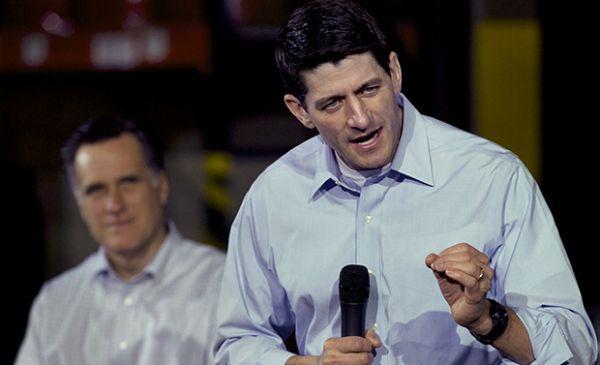
Was Ryan's Budget Really a Losing Issue in 2012?
Published March 21, 2013 • Read time: 8m
Join the Conversation
0Last week, Paul Ryan and House Republicans released their budget plan, which combined spending and tax cuts to reach a projected balanced budget by 2022. It was met with skepticism by pundits from the left and center, and even by some on the right. A common refrain was that the GOP hadn’t learned the lessons of 2012, and that it would probably take another losing cycle or two before the party wised up and moved to the middle.
The problem is, in a reasonably close election like the last one, there are conflicting signals that make it nearly impossible to draw hard, fast lessons, especially as they relate to issue positions. It is certainly difficult to scry any mandate for President Obama, even (perhaps especially) on these economic issues. Consider the exit polls. On two of the three issues respondents indicated were the most important ones for the election -- “Who would better handle the economy?” and “Who would better handle the deficit?” -- Mitt Romney actually led Obama by one and two points, respectively.
With 5,100 respondents, these are meaningful distinctions. We can be 95 percent confident (actually, 96 percent confident) that Romney/Ryan really did lead on the deficit question among the general electorate.* The one-point lead on the “economy” question is closer, but even then the distinction is meaningful for our purposes. We’re about 70 percent sure that the difference is “real,” which is too low to get committed to the annals of American Political Science Review, but still meaningful for election postmortems.
Cruz's Path to Nomination
Trump Stands by His Manager
With Tweets on Heidi Cruz, Trump Sinks to New Depths
A Vote for Kasich Is a Vote for Trump
This polling occurred in something of a perfect demographic storm for Democrats, with African-American voters turning out well above trend, and with fewer whites voting than in 2004. It is unclear whether this can be replicated in the next few cycles; it will certainly be difficult in the upcoming midterms. Regardless, even in an election dominated by Ron Brownstein’s “coalition of the ascendant,” the GOP candidate did reasonably well on the most important issues.
Indeed, the GOP’s basic positioning on the issues hasn’t deteriorated significantly since the early 2000s. Analyst Adrian Gray, an adviser for George W. Bush’s 2000 and 2004 campaigns, compares NBC/WSJ polling from 2000 and 2012 on the “Who do you trust more?” question, and found few shifts:
In addition, Republicans actually maintain historically strong positioning in the House, in governorships, and in state legislatures, despite almost every member in the House having voted for the Ryan plan in 2011, and despite having run on similar themes in 2010 as well. Each and every one of them has their own particular mandate they can claim, regardless of whether it runs contrary to the president’s.
Two basic rejoinders are typically presented to this line of argument. The first is made by Joe Trippi here: The GOP can take no solace from its majority because it is merely a result of gerrymandered districts. A second, related argument came from The Washington Post’s Ezra Klein a few weeks ago: Americans tried to divest themselves of the GOP House majority by voting for Democrats, who won the popular vote for the House.
The gerrymandering issue is overstated as a general matter; it is worthy of a separate article (for pushback from political scientists, see here). Setting that aside for now, there are two problems with these arguments, which both derive from the same basic point: We don’t hold national elections for the House, so it is difficult to divine any meaning from a metric that seeks to approximate one.
First, while it is true that a majority of Americans voted against Republicans for the House, it is also true that a majority voted against Democrats for the House. When I tallied the numbers last month, the national popular vote was 49.18 percent for Democrats, 48.03 percent for Republicans, 1.11 percent for Libertarians, 1.03 percent for Independents, and 0.3 percent for Greens, with another 0.4 percent or so divided among 31 minor parties.**
In other words, if we had purely proportional representation for the House, the American people would have allocated 214 seats to Democrats, 209 to Republicans, 5 to Libertarians, 4 to Independents, 1 to Greens, and two to minor candidates. Your guess is as good as mine as to what coalition would emerge from that conglomeration, or what meaning we should ascribe to it.
Adding up identifiably conservative parties and identifiably liberal parties doesn’t resolve the matter; parties on the left received 49.5 percent while parties on the right received 49.4 percent; we’re still left to debate what meaning should be read into the votes cast for the candidate of the “Bob’s for Jobs” Party or the “Politicians Are Crooks” Party.
Second, and perhaps more importantly, even our two major parties are basically coalitions of dozens of smaller parties. This has become less so with the increase in political polarization over the past few decades, but it is an important factor.
But if we’re going to try to read something into national House votes, we need to figure out exactly what to read into the 119,000 votes cast for conservative Democrat Jim Matheson in Utah, running in a 70 percent Romney district; the 169,000 votes cast for North Carolina Democrat Mike McIntyre (who has been endorsed by the Family Research Council in the past); or the 198,000 votes cast for Minnesota Democrat Collin Peterson (who has a 100 percent rating from the National Right to Life Council). My guess is that many of the votes were not cast in hopes that these winning candidates would support the national Democratic agenda.
This is all the more important when you consider that, had the Democrats gained control of the House with 51 percent of the seats (roughly their share of the two-party vote), these members would be the “pivot votes” -- e.g. the ones needed to supply vote number 218 -- in order to move legislation through the lower chamber.
Now, one might think, “This doesn’t disprove the notion that Obama has a clear mandate; at best it pokes holes in the theory.” This is true, but it really just proves the underlying point. Elections are complex things. Can you still construct an argument that Republicans lost due to their positions on economic issues, and that the Ryan plan affected the GOP in more subtle ways (like on the “Who shares your values?” question)? I think it is a strained argument, though one you can make with a straight face.
But you could also conclude from the evidence that the electorate actually looked favorably on the GOP’s economic proposals, but voted on “valence issues” such as “Who shares your values?” You can note that Obama’s job approval was 54 percent, and conclude that the election was simply a referendum on his job.
You can even decide that all of this is merely superstructure, a false consciousness created by people trying to explain their basic underlying decision to vote their pocketbooks. After all, the improving economy, far from suggesting a massive Democratic loss, was really suggesting a close election all along, with the president perhaps a slight favorite.
Forty-seven years ago, the great political scientist V.O. Key concluded that “[t]he victorious candidate . . . may regard the swing of the vote to him as indubitably a response to the campaign positions he took, as an indication of the acuteness of his intuitive estimates of the mood of the people, and as a ringing manifestation of the esteem in which he is held by a discriminating public. . . . [But e]ven the most discriminating popular judgment can reflect only ambiguity, uncertainty, or even foolishness if those are the qualities of the input into the echo chamber. A candidate may win despite his tactics and appeals rather than because of them.”
Key’s conclusion about the difficulty in ascribing meaning to the victor’s vote totals is equally applicable to the loser. Republicans may actually pay a price in the future for embracing proposals like the Ryan plan. But the evidence is really quite thin that they’ve paid a price in the past few elections.
*The error margin there at 95 percent confidence was plus or minus 1.17 percentage points. For reasonably complex statistical reasons, as a rule of thumb one should multiply the error margin by 1.6 (not 2, as commonly assumed) to determine whether two data points are separated by a statistically significant margin (of course, this assumes no rounding issues -- e.g., we’ll assume the precise results really are 47 percent for Obama and 49 percent for Romney, rather than 47.4 to 48.6).
** The generic vote is complicated by issues such as how one should treat the unopposed races in Florida (the state doesn’t tally those ballots) and the California races that, due to the state’s primary system, had two Democrats or two Republicans running; different methods might yield slightly different results.

The GOP Majority Should Go Out in Glory
Daniel McCarthy • RealClearPolitics
Republican Majorities Could Return Sooner Than Expected
J.T. Young • RealClearPolitics
The Danger Before the Attack
Leslie J. Sullivan • RealClearPolitics
Jon Finer’s Old and Dangerous ‘New Approach’ to Israel
Peter Berkowitz • RealClearPolitics
The President Deserves Better
John Ullyot • RealClearPolitics
Congress Doesn’t Need Another Blame Game. It Needs To Find What’s Broken
Jarrod Bernstein • RealClearPolitics
RCP Today
Top stories on RealClearPolitics
The Takeaway
Polling intelligence and analysis delivered to your inbox
World News
Featuring the latest world news
Policy
Featuring the latest policy news
Support Our Mission
As part of RealClearPolitics, authors aim to provide balanced, non-partisan analysis by presenting top reporting and commentary from all sides of the political spectrum.
Trusted by policymakers and citizens alike since 2000