Forget Obama, House GOP's Target Is Senate Dems
Published Jan. 24, 2013 • Read time: 6m
Recalibrating their strategy after a bruising election and an inauguration that underscored President Obama’s renewed popularity, political savvy and place in history, Republicans are now training their fire on Senate Democrats instead of the man in the Oval Office.
Republican House members have come to terms with the fact that though they control the lower chamber, Democrats run the rest of Washington. In light of that, they are putting more pressure on the Senate to pass a budget -- a basic task of governing that has not been achieved for four years. And GOP groups are seeking to split Democrats into factions by spotlighting various objections to Obama’s policies from those within his own party, rather than assailing him directly.
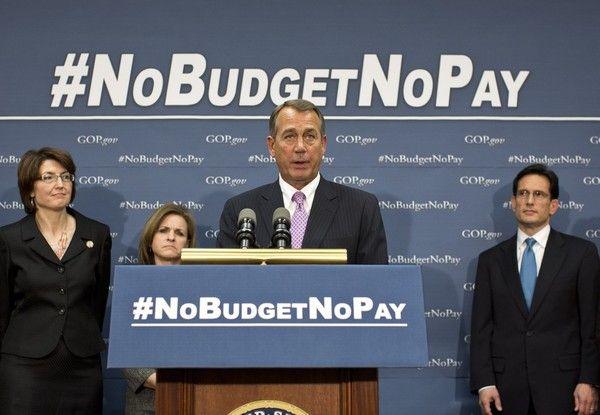
Republicans hope ultimately to water down the president’s agenda. And so on Wednesday House Speaker John Boehner brought to the floor a bill to suspend the debt ceiling until May -- and require the Senate to pass a budget. It passed, 285-144.
“With the passage of this bill today, it’s pretty clear that we’re sending a message to the Democrat-controlled Senate that it’s time to do your job,” Boehner after the approval, which was aided by House Democrats. “We’re committed to doing a budget on the House side -- a budget that will balance over the next 10 years. It’s time for the Senate and the president to show the American people how they’re willing to balance the budget over the next 10 years.”
As evidence of the new Republican strategy, Boehner issued a series of tweets starting Tuesday morning that mocked Senate Democrats for their inactivity on the budget. One read, “You could take 179 round trips to the moon in the time since Senate Dems last passed a budget.”
McCain to Code Pink Protestors: Get Out of Here You Low Life Scum
AG Nominee Lynch Deflects Cruz Missile
Senate to Begin Hearings on Obama Attorney General Nominee
Democrats, Republicans Spar Over Benghazi Investigation
Senate Budget Committee Chairwoman Patty Murray responded that her panel will pass a budget, and she intends to get it to the floor this year for a vote.
Asked if this GOP plan to pressure her conference complicates her own plans, the Washington Democrat told RCP: "The reason why we are where we are is because the House Republicans have decided to govern by crisis. That's not how we operate."
Rep. Trent Franks, a conservative from Arizona, differs, saying the strategy paints House Republicans as the responsible party.
“We are at such a systemic disadvantage given our small majority in one-third of government, that it’s incumbent upon us to reorient the playing field to give us some sort of regular order,” he told RCP. “One of the most advantageous elements of this strategy is to really highlight the Senate’s irresponsibility in the hope that they will have an epiphany and say, ‘Maybe we should do our job.’ ”
Pressuring the Senate is also a way to pressure the president, he said. “There is no question the president has the bully pulpit and that it’s much easier to communicate. We’ve got 233 people out there talking when the president has one unified communication source.”
Texas Rep. Pete Sessions, who devised political strategy for House Republicans as the chair of the National Republican Congressional Committee for two cycles, told RCP that it's not in anyone's best interest for a Republican leader to negotiate one-on-one with the president. He explained that it makes for better policy when the House crafts its own bills and works with the Senate before sending them to the president.
"It's better to start and finish that way," Sessions said, noting that it's not a change in philosophy but rather "a mid-course correction."
Congressional Republicans have made spending and deficit reduction a legislative priority. Boehner told reporters Tuesday that the House’s central focus for the next 90 to 120 days will be the approaching fiscal deadlines. But his party intends to continue to use the Senate to pressure the president beyond those budget battles.
“I think a good rule of thumb this year on the president’s list, is: see if it can pass his own Senate. It’s his party,” Rep. Mick Mulvaney, a conservative from South Carolina, told RCP. “He said what he wanted to do in his [inaugural] speech, so I assume he’s willing to lead toward those stated goals; he can he get his party in the Senate to pass that.”
A leading GOP Senate strategist said he is “a little surprised that the Republicans in the House have gotten that smart.”
He went on: “It's a good move for them. Harry Reid is a hell of a lot better opponent the Barack Obama.”
Republicans know how tough Obama can be after taking a beating during the fiscal cliff negotiations, as well as after their presidential nominee lost badly to him in November. David Winston, a longtime pollster for House Republicans, told RCP that the presidential election did not do any favors for GOP lawmakers in the lower chamber: Mitt Romney made the election a referendum on the president -- making mention of the debt ceiling, for example, only in his closing arguments -- which has made Boehner’s task more difficult and has now forced the party to take this different tack.
"The president is now in office for another four years, so electoral priorities have changed for the GOP. With that reality, it is a wise choice for House and Senate Republicans to go after Democratic senators in red states,” said longtime Republican strategist Ron Bonjean. “These Democrats will have a hard time adjusting to Obama's liberal agenda he outlined in his inauguration speech, [which] puts them in between a rock and a hard place."
Republicans are also using a controversial issue to indirectly hit the president: Rather than complain that the Obama campaign is remaining active as an advocacy organization for the White House, Republican groups are pointing to that advocacy as a problem for Democratic senators. At a DNC gathering this week, some state Democratic chairmen expressed concern that the Obama group might interfere with their own electoral interests.
It underscores how Republicans have adjusted their strategy from attacking the president to trying to drive a wedge between him and his party, because he has proved to be nearly untouchable. Romney campaign aides admitted as much after the election.
RNC Research Director Joe Pounder echoed that point Wednesday morning: “Democrats grumbling about the new [Obama for America] realize the Obama coalition was never about the Democrat Party. It was always about Obama."

A RealClear Thanksgiving: Investing in a Better Future
David DesRosiers • RealClearPolitics
Trump’s Newsom Problem: Antagonist-in-Chief
Carolina Lumetta • RealClearPolitics
America’s Free Spirit
John Maxwell Hamilton • RealClearPolitics
The GOP Majority Should Go Out in Glory
Daniel McCarthy • RealClearPolitics
Republican Majorities Could Return Sooner Than Expected
J.T. Young • RealClearPolitics
The Danger Before the Attack
Leslie J. Sullivan • RealClearPolitics
RCP Today
Top stories on RealClearPolitics
The Takeaway
Polling intelligence and analysis delivered to your inbox
World News
Featuring the latest world news
Policy
Featuring the latest policy news
Support Our Mission
As part of RealClearPolitics, authors aim to provide balanced, non-partisan analysis by presenting top reporting and commentary from all sides of the political spectrum.
Trusted by policymakers and citizens alike since 2000