
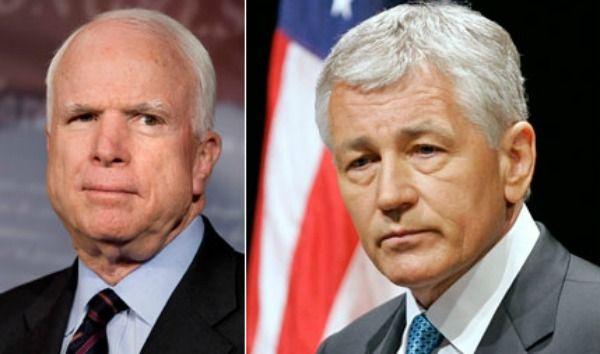
Hagel and McCain: The Truth About Their "Rift"
Published Jan. 10, 2013 • Read time: 5m
In Washington, personal relationships between politicians are almost always scrutinized for their transactional significance. It is inconceivable to most folks here that political people could like or dislike, associate with or avoid each other for reasons that aren’t political or self-serving. It’s an inane but persistent presumption.
We fit every human interaction into a few pat narratives and reduce most of humanity to well-worn stereotypes. As in Hollywood, there are stacks of dog-eared scripts around this town for every occasion. It’s convenient for reporters and useful for the people they cover. Too often, the stories we tell each other are meant to serve something other than the truth.
It’s not as nefarious as it sounds. Washington’s reliance on short-hand, if flawed, narratives is an illustration that necessity is still the mother of invention. To respond to the competitive pressure of the 24/7 news cycle, reporters ascribe great significance to the most ordinary of things. This happens most easily in cable TV and online journalism. To justify all the posts and breaking-news chyrons scrolling across the bottom of the screen, you need to pretend that something momentous or fascinating is always happening in the nation’s capital.
The sources who supply the quotes necessary to sustain the illusion might do so to advance a political agenda or career or to misdirect a reporter in an attempt to protect some interest. But more often they do so only for that most human of reasons: to prove their own significance; to show they’re in the know, on the inside.
I was reminded of that when I read a piece the other day by the indefatigable Washington Post reporter Chris Cillizza. His subject was the relationship between Sen. John McCain, my longtime employer, and former Sen. Chuck Hagel, the president’s nominee to be secretary of defense. He wanted to explain why two men who had once been close friends now appear not to be because the state of their relationship -- or lack of one -- might have implications for Hagel’s confirmation.
Cillizza is a hardworking and fair journalist. I spoke to him for the piece, and gave him my honest opinion. I told him I don’t know why they no longer socialized; there had never been any private or public rupture in their friendship. They had never fallen out after an argument over a personal or political matter. Neither of them had knowingly offended the other.
The two men were close before, during and briefly after McCain’s presidential campaign in 2000. Then, over a period of a year or so, they stopped traveling overseas together and socializing much outside the Senate. By the end of 2002, they remained on friendly terms, and still do, but their friendship could no longer be accurately described as close. They had drifted apart for no obvious reason.
Predictably, that wasn’t a very useful response. Cillizza found other sources who confirmed his working assumption that the relationship had foundered on the two men’s differences over the war in Iraq. The sources weren’t telling him the truth, but they were being helpful.
Both senators had supported the resolution authorizing the war, and both were early critics of the Bush administration’s management of it. They parted company over whether the war could be rescued from its initial incompetent management. By the summer of 2003, McCain was calling for a counterinsurgency strategy and the additional forces required to execute it -- what would become known in 2006 as the surge. Hagel eventually recommended we cut our losses and withdraw from Iraq.
Although McCain disagreed with Hagel’s position, he never resented him for it. By the time their differences emerged they were no longer close friends. But they remained friendly and respectful colleagues, who disagreed without rancor.
I don’t know if Sen. McCain will support or oppose Sen. Hagel’s confirmation. I’m sure he’ll base his decision on the nominee’s current views and intentions, and not on his criticism of a war we’re no longer fighting or on imaginary turmoil in their relationship.
In a city created by and for politics, an explanation that lacks political content seems improbable. In a profession that influences the course of history, it’s hard to accept that there isn’t always a dark drama at work in the relationships between its principal players. But can it really be the case that people here are so very different from people everywhere else?
Haven’t we all had friends from whom we drifted apart for reasons we don’t recall or never really perceived? How many of our relationships have changed for reasons that didn’t involve politics or matters of state? Isn’t it possible that the same holds true for politicians?
Not everything that happens in Washington fits into a neat narrative or affects history. Sometimes it’s just another unremarkable occasion when people go their own way for their own quirky reasons. That isn’t a newsworthy observation, but ignoring it is how Washington manufactures convenient truths from falsehoods.


RCP Today
Top stories on RealClearPolitics
The Takeaway
Polling intelligence and analysis delivered to your inbox
World News
Featuring the latest world news
Policy
Featuring the latest policy news
Support Our Mission
As part of RealClearPolitics, authors aim to provide balanced, non-partisan analysis by presenting top reporting and commentary from all sides of the political spectrum.
Trusted by policymakers and citizens alike since 2000