
Obama Drawn to Shared Views in Choosing Hagel
Published Jan. 8, 2013 • Read time: 7m
Join the Conversation
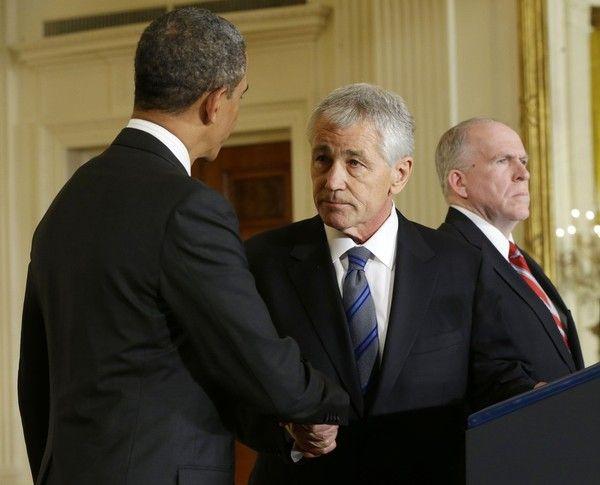
0In selecting former Republican Sen. Chuck Hagel to head the Pentagon and John Brennan, the top counterterrorism adviser at the White House, to lead the CIA, President Obama is banking on trust, friendship and a shared view of the world to carry out his international policies the next four years.
If Obama’s first-term national security Cabinet was his “team of rivals” -- merging opinions and objectives, especially about Iraq and Afghanistan -- the group he’s assembling now is more like a team of pals who share Obama’s goals but also admire one another for occasionally defying institutions, party ideology and the mentality of the pack.
An outspoken and seemingly growing number of senators from both sides of the aisle have suggested Hagel may be the wrong person to succeed outgoing Defense Secretary Leon Panetta. At an East Room event announcing the appointments Monday, Obama acknowledged that he picked a fight that could initially unsettle both parties, but he insisted Hagel would lead at the Pentagon while forging alliances along the way.
“Chuck represents the bipartisan tradition that we need more of in Washington,” Obama said of the former Nebraskan with whom he once traveled to the Middle East as senators, and who advised him before and after his transition to the White House.
“For his independence and commitment to consensus, he's earned the respect of national security and military leaders, Republicans and Democrats, including me,” the president said. “In the Senate I came to admire his courage and his judgment, his willingness to speak his mind, even if it wasn't popular, even if it defied the conventional wisdom. And that's exactly the spirit I want on my national security team.”
The FBI Gained Access; We'd Already Lost Our Privacy
Is Trump Right About NATO?
Arizona's Voting Rights Fire Bell
U.S. Officials Say 2 Americans Died in Brussels Attack
Hagel’s detractors say that he defied the GOP on too many issues while serving two terms in the Senate; has too thin a record of managing large bureaucracies such as the Pentagon; has been too tolerant of Iran’s nuclear ambitions; too tough on Israel and what Hagel once described as “the Jewish lobby” in Washington; and was wrong to object to James Hormel serving as U.S. ambassador to Luxembourg because he was openly gay.
In an interview this week with a Nebraska newspaper, Hagel complained that critics had “completely distorted” his record. He said he would work to correct the facts with senators, with the military, and with the American public. In the period before Obama officially appointed him, Hagel explained he felt he was "hanging out there in no-man's land, unable to respond to charges, falsehoods and distortions."
If confirmed, Hagel and Brennan, who has been a close adviser to the president for more than four years, would join Massachusetts Sen. John Kerry, Obama’s nominee to succeed Hillary Clinton at the State Department, and Susan Rice, the U.S. ambassador to the United Nations, on the president’s national security team. Rice had hoped to succeed Clinton at State until Senate GOP objections persuaded Obama to tap Kerry, the 2004 Democratic nominee for president and chairman of the Senate Foreign Relations Committee. Rice has agreed to continue her role at the U.N.
Kerry’s confirmation hearing, which will take place before the committee he now chairs, could occur after he has a chance to vote on some of Obama’s other Cabinet picks. He and Hagel are both decorated Vietnam War veterans, but Senate Republicans have sounded more enthused about a Massachusetts liberal becoming America’s top diplomat than a Midwestern Republican taking command of troop withdrawals from Afghanistan and upcoming budget tightening at the Pentagon.
Clinton has said she will serve until her successor is confirmed, which the White House originally envisioned as immediately after Obama’s Jan. 21 public inauguration. She told the president last year she would give up her exhausting role if he won re-election; following weeks of medical treatment for the flu, a subsequent concussion and a blood clot in her head, Clinton resumed work at State this week.
Panetta -- whose public career has spanned close to five decades, multiple administrations and leadership roles in two branches of government -- plans to return to his family in California, where he owns a walnut farm and runs the Panetta Institute, which encourages public service.
Life on the farm, the 74-year-old Panetta joked during his prepared remarks Monday, would be “dealing with a different set of nuts.”
Brennan, Obama’s White House expert on counterterrorism and homeland security, worked in the CIA for 25 years. If confirmed, he would succeed former director David Petraeus, who resigned last year after admitting to an extramarital affair with his biographer. Panetta was Obama’s first CIA director before shifting to the Pentagon after Republican Robert Gates, an Obama holdover from the Bush years, stepped down.
Brennan first met Obama after the 2008 election when the president-elect invited him to his Chicago transition office. Obama was searching for a CIA director and Brennan had been recommended by Tony Lake, a national security adviser under President Clinton.
As Daniel Klaidman wrote in his 2012 book, “Kill or Capture,” the two men bonded over tales of their experiences living and traveling in the Muslim world, and their shared belief that America’s war against terrorism had to tackle the range of factors that propelled young Muslims to become radicals and killers. “Their views were so complementary that Obama found himself almost finishing Brennan’s sentences,” Klaidman wrote.
As it turned out, Obama did not nominate Brennan to head the CIA in 2009 because liberals, reacting to news reports about the possible nominee, criticized Brennan as too closely identified with the intelligence agency’s controversies during the Bush years, including torture, renditions, secret prisons and the advent of using unmanned drones to kill suspected terrorists with missiles.
“John, you've been one of my closest advisers. You've been a great friend,” Obama said with evident warmth. His nominee stood ramrod straight next to the president, altering his impassive expression just once -- when Obama hailed Brennan’s long work hours and teased him about telling an inquiring reporter during a briefing in Hawaii that he doesn’t “do downtime.”
Reacting to the anecdote, Obama’s adviser raised his eyebrows and met the president’s gaze with a tiny grin. The assembled White House audience laughed.
Hagel and Brennan, along with Kerry and Rice, have earned Obama’s trust, something the president has frequently emphasized as an essential ingredient in a second term. In Obama’s mind, his picks can challenge members of both parties, with the experience to bolster the administration’s positions.
Nonetheless, Hagel will no doubt eat up some of Obama’s political capital -- capital he will otherwise need for fights over the debt ceiling, the size of government and federal spending, immigration reform, and gun control.
Some senators and interest groups insist Hagel will have to defend past statements and positions. What is interesting is how many Republicans have given Kerry, the GOP’s punching bag more than eight years ago, a much warmer reception as a prospective Cabinet member. When lawmakers assailed Rice after sensing that Obama might name her to head State, Obama came to her defense and argued they used her to target him. But he did not nominate her.
“At the end of the day, I don’t think any leader gets into trouble for saying exactly what he or she thinks, provided you are informed and educated on the issues,” Hagel wrote in his 2008 book, “America: Our Next Chapter.”
Obama is going to test that idea.

The Danger Before the Attack
Leslie J. Sullivan • RealClearPolitics
Jon Finer’s Old and Dangerous ‘New Approach’ to Israel
Peter Berkowitz • RealClearPolitics
The President Deserves Better
John Ullyot • RealClearPolitics
Congress Doesn’t Need Another Blame Game. It Needs To Find What’s Broken
Jarrod Bernstein • RealClearPolitics
Democrats Won the Midterms. Common Sense Won, Too
Jordanne Kemper • RealClearPolitics
The 120th Congress Shapes Up
Carolina Lumetta • RealClearPolitics
RCP Today
Top stories on RealClearPolitics
The Takeaway
Polling intelligence and analysis delivered to your inbox
World News
Featuring the latest world news
Policy
Featuring the latest policy news
Support Our Mission
As part of RealClearPolitics, authors aim to provide balanced, non-partisan analysis by presenting top reporting and commentary from all sides of the political spectrum.
Trusted by policymakers and citizens alike since 2000