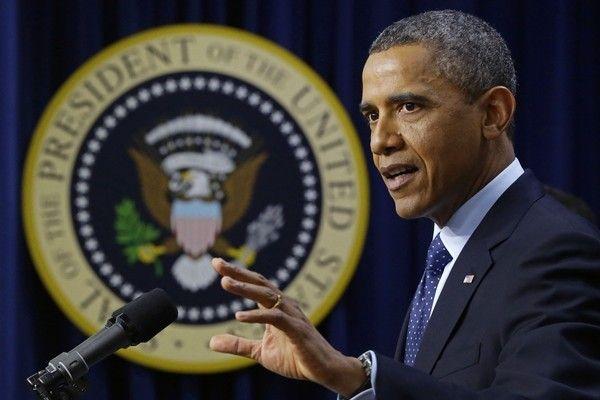
Obama Taking Campaign-Style Approach to New Goals
Published Jan. 3, 2013 • Read time: 8m
Join the Conversation
0In the thick of the fiscal cliff impasse Monday, even as a Senate agreement was hours from being a certainty, Republican lawmakers were chagrined to hear President Obama zoom beyond the tax battle to plant some partisan seeds for spring.
The president warned Americans at a hastily assembled campaign-style event at the White House that conservatives would try to force him, as part of the upcoming standoff on raising the nation’s borrowing authority, to slash spending on programs Democrats support. If they want cuts, he added, Democrats would demand new revenues.
“If they think that's going to be the formula for how we solve this thing, then they’ve got another thing coming,” he said.
Catching himself as he veered off-script, Obama said the GOP would “try to shove only spending cuts down” -- here he paused, trying to choose his words carefully -- “well, shove spending cuts at us that will hurt seniors, or hurt students, or hurt middle-class families, without asking also equivalent sacrifice from millionaires or companies with a lot of lobbyists.”
By that hour on New Year’s Eve, Republican lawmakers assumed they were poised to vote to raise taxes, something they did not want to do, and they were stung by Obama’s determination to wage an endless political campaign into 2013 and beyond. Opponent Mitt Romney had simply morphed into “Republicans in Congress.”
After clinching a deal with Congress to raise revenues, add to deficits and postpone across-the-board spending cuts for eight additional weeks, Obama took a bow in a video message to his base.
Lies, Assault and Cover-ups Don't Stop Donald Trump
Trump Stands by His Man; Obama on a Health Scourge; Hayden Interview; Reagan's Courage
Analysis: For Trump, Few Limits to Win-At-Any-Cost Approach
What If Clinton Isn't Indicted?
“When I take the oath of office this month, I’ll be as determined as ever,” the president said in a three-minute message disseminated by his Chicago campaign team on Wednesday. “Just like four years ago, winning an election won’t bring about the change we seek on its own. It only gives us the chance to make that change. What we fought for in 2012, we’ve got to fight just as hard for in 2013.”
“Make that change” was the president’s most interesting phrase. Does Obama imagine he will “create” support for legislation (a much harder task for any president -- and his aim during the prolonged health care debate)? Or does he seek to work within the bounds of existing public backing for popular policies (such as middle-class tax relief)?
Obama’s second-term domestic agenda hinges on cooperation from Congress, but after Republicans gained control of the House in early 2011 and the two parties splintered over whether Congress would raise the nation’s debt ceiling, the president altered his legislative strategy. He decided House and Senate conservatives would relent if the public condemned them for obstructing something deemed important and valuable to their everyday lives.
Arizona Sen. John McCain told reporters Sunday that Republicans jettisoned their embrace of a revenue-raising inflation calculation for senior citizen benefits -- even if it was loosely endorsed by Obama -- because the GOP believed the White House and Democrats were ready to throttle conservatives in the message wars. “We can’t win an argument that has Social Security for seniors versus taxes for the rich,” McCain explained.
Lyndon Johnson -- who governed with large Democratic majorities and in a very different media environment -- believed as a former legislator that lawmakers were swayed by two basic impulses: hunger for recognition, and fear of losing their clout. As historian Doris Kearns Goodwin wrote, Johnson operated with the belief that “desire opened the door to the exercise of presidential power [and] fear closed it. . . . Johnson’s success in winning congressional support for change depended upon his ability to reduce the fear and increase the desire.”
Obama has drawn a different lesson after serving less than a term in the Senate and four years in the Oval Office. As he heads into his second term, he has enthusiastically tried to stoke political fear among lawmakers, hoping to increase their desire to bend his way. But unlike LBJ or Franklin Roosevelt or even Bill Clinton, Obama is notably stingy with recognition once they do.
Obama and his team of campaign-hardened advisers will soon be embroiled in a fiscal sequel on Capitol Hill, likely to occur within weeks of the president’s inauguration and State of the Union speeches. Obama lost no time warning Americans that Republicans are flirting with U.S. default, using that as political leverage to force him to cut favored spending to curb future deficits.
“While I will negotiate over many things, I will not have another debate with this Congress over whether or not they should pay the bills that they’ve already racked up through the laws that they passed,” Obama said Monday. “People will remember back in 2011, the last time this course of action was threatened, our entire recovery was put at risk. Consumer confidence plunged. Business investment plunged. Growth dropped. We can't go down that path again.”
The fiscal cliff episode did not win the president new friends on Capitol Hill, although that fact does not especially concern the White House. Obama touted the results as a victory for the American people and for his leadership, even as some liberal Democrats joined plenty of Republicans in lamenting the last-minute outcome.
When asked to describe why Senate Minority Leader Mitch McConnell opted to call Vice President Biden over the weekend in an effort to get an eleventh-hour deal, a Senate GOP aide said the Kentucky Republican believed from long experience that Biden understood the art of swift legislative horse trading, which he thought Obama did not.
“He was here for 20 minutes, and Biden was here for 30 years,” the aide said dryly of the president. “Biden understands what senators need.”
On his second-term to-do list, Obama thinks immigration reform lends itself best to a White House campaign to enlist the public. Republicans, who lost key Latino support during the 2012 elections, according to exit polls, fear they oppose or block reform legislation at their electoral peril. The president has not yet described any legislative details.
The power of the GOP-leaning gun-rights lobby will ensure that gun control measures will be a challenge to enact this year, despite the public uproar after 20 children and six adults were murdered at a Newtown, Conn., elementary school.
The president assigned the vice president to convene a task force and present policy initiatives in time for inclusion in his State of the Union address. Those proposals, he suggested, would embrace gun measures, including revival of the expired assault weapons ban; approaches to mental health services and support; education and school safety improvements; and possibly a dissection of any proven links between cultural influences and mass shootings.
The president’s vaguely described energy and climate-change aspirations will also be tough to pass. At a Nov. 16 news conference, he said no clear consensus exists in Congress or among Americans for new climate legislation. Secretary of State Hillary Clinton predicted in November that Obama would pursue his pending climate agenda largely through executive action, where possible, during his second term.
"Look, we're still trying to debate whether we can just make sure that middle-class families don't get a tax hike. Let's see if we can resolve that. That should be easy. This one's hard," the president told reporters.
Obama’s point about pushing legislation that enjoys clear public backing is key, said George C. Edwards, political science professor at Texas A&M University and author of “Overreach: Leadership in the Obama Presidency.” Based on his research, Edwards wrote that presidents who attempted to create or alter public thinking about policy ran into trouble, but those who understood how to exploit existing public opinion to achieve legislative goals proved more successful.
Americans clearly favored preserving temporary tax breaks for the middle class, which were initiated by President Bush, extended by Obama and Congress in 2010, and permanently redefined this week by both parties to cover families earning as much as $450,000 a year. That definition of middle class may be popular among voters, but it will cost the Treasury in the future, especially if the costs of mandatory programs such as Medicare and Social Security escalate unchecked.
In other words, Obama barely managed to move legislative changes that Americans thought they understood and favored. Dueling with congressional Republicans over policies that divide Americans carries long odds.
“There is no evidence here now and in the recent past of his persuading anybody,” Edwards noted of Obama’s legislative record since 2011. Since Republicans took control of the House, Obama has been able to pass major legislation when he can maximize enthusiasm among Americans for initiatives they value, understand and favor -- such as requiring the wealthy to pay higher taxes. “He’s talking about things that people already agree with, and that’s different than trying to move people, say from neutral to his side,” Edwards told RCP.
Because they hail from safely conservative districts, the president’s congressional opponents are largely unimpressed by majority national opinion (and definitely not by Obama’s persuasion). Obama has had a rough time when public support is absent and policies are seen as too complex or too irrelevant to the majority of Americans. And if Democrats are hoping for a political miracle, history suggests that political turnovers in the midst of second terms historically tip away from the party in power, which means Democrats aren’t likely to unseat enough House Republicans in 2014 to take control of both houses of Congress.
Considering how messy the fiscal cliff drama was, it may have served up a lesson in limitations for the president, even before his second term begins. During his campaign, Obama assured voters he had ambitious legislative work yet to finish. It seems sensible, then, to ask him how.

Newsom Defies Voters, Juries and Lawmakers To Spare Murderers While Defending Abortion
Curtis Hill • RealClearPolitics
The Algorithmic Tilt
Frank Filingeri • RealClearPolitics
A RealClear Thanksgiving: Investing in a Better Future
David DesRosiers • RealClearPolitics
Trump’s Newsom Problem: Antagonist-in-Chief
Carolina Lumetta • RealClearPolitics
America’s Free Spirit
John Maxwell Hamilton • RealClearPolitics
The GOP Majority Should Go Out in Glory
Daniel McCarthy • RealClearPolitics
RCP Today
Top stories on RealClearPolitics
The Takeaway
Polling intelligence and analysis delivered to your inbox
World News
Featuring the latest world news
Policy
Featuring the latest policy news
Support Our Mission
As part of RealClearPolitics, authors aim to provide balanced, non-partisan analysis by presenting top reporting and commentary from all sides of the political spectrum.
Trusted by policymakers and citizens alike since 2000