
To Strike Fiscal Deal, Obama Turns to the Public
Published Nov. 28, 2012 • Read time: 5m
Join the Conversation
0President Obama isn’t anchored to a chair in the White House with House and Senate leaders, sweating out a budget deal before Dec. 31 -- not yet anyway. Instead, he’s spending the week meeting with business representatives and other stakeholders before flying Friday to a Pennsylvania toy factory for a photo op to champion middle-class tax breaks.
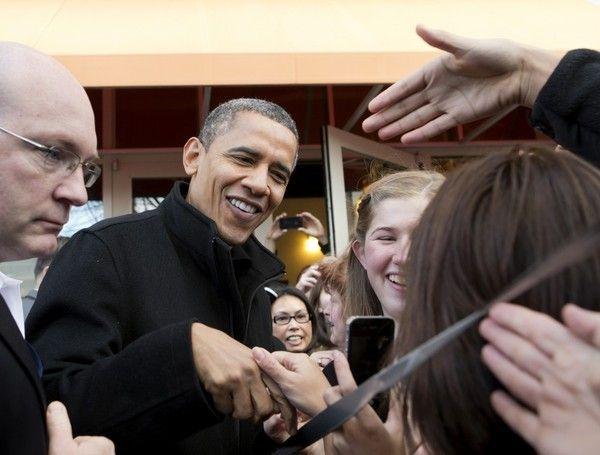
Taking the negotiations to the American people is Obama’s outside communications game, designed to force congressional Republicans to defend their support for tax breaks for the wealthy, even as the clock ticks toward a statutory deadline. The president believes that time, and the weight of public opinion, are on his side.
It is the technique he used a year ago to help win approval of a 12-month extension of the payroll tax holiday, when House Republicans initially resisted any continuance of the 2 percent reduction. Obama learned that public pressure can mold minds in the GOP conference faster than face-to-face negotiations.
“I don't think there is a lot of faith that a bunch of people sitting around a table in a room are going to solve problems on behalf of the American people if those people aren't communicating . . . with the American people to find out what they believe the right answers are,” White House spokesman Jay Carney said when asked why the president would visit Pennsylvania to repeat arguments he made before he won re-election.
Obama has often said that he learned a hard lesson during his first term that enacting legislation that is not well understood or supported by the public carried a political price. With that in mind, the president believes he has to keep explaining “what his vision is, what his policy proposals are, what the nature of the debates are,” Carney said.
Lies, Assault and Cover-ups Don't Stop Donald Trump
Trump Stands by His Man; Obama on a Health Scourge; Hayden Interview; Reagan's Courage
Analysis: For Trump, Few Limits to Win-At-Any-Cost Approach
What If Clinton Isn't Indicted?
Behind the scenes, White House Legislative Affairs Director Rob Nabors and other administration experts continue to negotiate the particulars of a possible package deal with aides to House Speaker John Boehner, according to Sen. Richard Durbin, the Democrats’ vote counter in the Senate and a close Obama friend.
The discussions have been kept private while various proposals are run up and down Pennsylvania Avenue. Even White House discussions with representatives of the Business Roundtable and the U.S. Chamber of Commerce have been off the record, according to the two groups. Obama will meet with the CEO of Yahoo and other corporate executives Wednesday.
“The president isn't going to sign off on any agreement that doesn't include some certainty as to budgets, appropriations, dealing with our debt ceiling,” Durbin said Tuesday at the Center for American Progress. To achieve a framework deal before January, the parties are trying to craft an enforceable agreement to avert the so-called fiscal cliff before the deadline, and then hammer out more lasting changes to entitlement programs and tax policy later on.
“We're not going to find ourselves, you know, with some big party celebrating in February and then turn around in March and have another doomsday scenario with the debt ceiling,” Durbin warned. “We've got to get this done as a package. . . . I think we can do it.”
Lassoing enough Republican votes in the House is key to any agreement that might be inked this year, but so is reassuring House and Senate Democrats that the strongest enforceable pact has been achieved. In their view, a “balanced” approach -- especially in light of Obama’s Nov. 6 victory -- does not mean the two parties must give up equal shares of their favored positions.
The president believes his leverage is at its peak now, making it possible to help defend Medicare and Medicaid and other spending programs from the ax, and to encourage GOP lawmakers to move off their no-higher-tax-rates resistance. The president believes the solvency of Social Security is not at risk and should not be part of deficit discussions, and he has said he will not sign any deal that extends the Bush-era tax breaks for the top 2 percent of tax filers.
“Don’t pack up your bags,” the president advised Democratic Rep. Elijah Cummings, who spoke with Obama privately Tuesday following a White House bill signing. Cummings, interviewed by MSNBC and American Urban Radio Networks, said the president “is determined to get this deal done and to get it done before the end of the year.”
Obama will keep traveling around the country, Cummings told AURN, noting that “it does put pressure on Congress . . . to say it appears that Republicans are holding hostage a tax cut for people making less than $250,000 so they can give their rich donors more tax cuts than they deserve.”
Cummings said he sees a "bad deal" this year as worse than “no deal.” He described a bad agreement as a pact that might harm benefits for Medicare and Medicaid recipients, for instance. Obama's victory and the sorts of voters who helped him win, he added, give him confidence that Democrats' priorities will prevail. “I don’t think the president will sign a bad deal,” he added.

The Danger Before the Attack
Leslie J. Sullivan • RealClearPolitics
Jon Finer’s Old and Dangerous ‘New Approach’ to Israel
Peter Berkowitz • RealClearPolitics
The President Deserves Better
John Ullyot • RealClearPolitics
Congress Doesn’t Need Another Blame Game. It Needs To Find What’s Broken
Jarrod Bernstein • RealClearPolitics
Democrats Won the Midterms. Common Sense Won, Too
Jordanne Kemper • RealClearPolitics
The 120th Congress Shapes Up
Carolina Lumetta • RealClearPolitics
RCP Today
Top stories on RealClearPolitics
The Takeaway
Polling intelligence and analysis delivered to your inbox
World News
Featuring the latest world news
Policy
Featuring the latest policy news
Support Our Mission
As part of RealClearPolitics, authors aim to provide balanced, non-partisan analysis by presenting top reporting and commentary from all sides of the political spectrum.
Trusted by policymakers and citizens alike since 2000