Will Sandy Add Another Twist to Tight Race?
Published Oct. 29, 2012 • Read time: 6m
Join the Conversation
0President Obama, plowing into the final week of what he calls his last campaign, cannot realistically gauge how Hurricane Sandy might change his fortunes in a election so close it could shift in a breeze, let alone a gale.
What meteorologists dubbed "Frankenstorm" is expected to be gone by Nov. 6, but its effects on voters’ thinking may linger -- and could affect the president’s chances for a second term. Research has shown that public distress after disasters and grim economic events can make voters select their leaders based on how they feel about life in the moment, more than what they know over time.
With a presidential election eight days away, Sandy’s unsettling impact -- including any U.S. fatalities -- could make a difference in some voters’ thinking during this final week, particularly because up to 50 million people could experience the storm’s effects.
Power outages, government closures, and transportation interruptions will alter early-voting, mail service, plus door-to-door canvassing and phone-banking in some areas of the Northeast for a day or more. For example, Maryland Gov. Martin O’Malley said early voting would be canceled in his state Monday because of the storm.
Depending on events, Obama and Romney could decide to pull campaign attack ads in some states in the last week. The weather emergency scrambled their travel itineraries over the weekend: Romney shifted appearances in Virginia to Ohio, and Obama scrapped rallies in Northern Virginia, Colorado Springs, Colo., and Youngstown, Ohio. (President Clinton and Vice President Biden are to be Obama’s stand-ins Monday in Youngstown.)
Lies, Assault and Cover-ups Don't Stop Donald Trump
Trump Stands by His Man; Obama on a Health Scourge; Hayden Interview; Reagan's Courage
Analysis: For Trump, Few Limits to Win-At-Any-Cost Approach
What If Clinton Isn't Indicted?
White House and campaign officials said Obama’s political schedule this week will be overtaken by presidential responsibilities during a hurricane.
Asked if Sandy would impact voting, Obama told reporters Sunday afternoon, “We don't anticipate that at this point, but we're obviously going to have to take a look.”
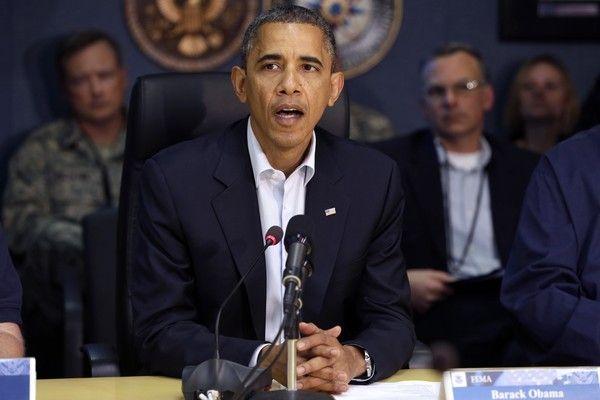
The president said his primary attention was focused on public safety. “This hasn't hit landfall yet, so we don't yet know where it's going to hit, where we're going to see the biggest impacts,” he said during a Sunday briefing with the Federal Emergency Management Agency. “And that's exactly why it's so important for us to respond big and respond fast as local information starts coming in.”
For days, operations of all sorts on the Atlantic Coast will slow, costing businesses money, and scrambling schedules for tens of millions of people. On Sunday, much of the federal government in Washington prepared to shutter Monday; public and private schools canceled classes; airlines rerouted flights; and Amtrak halted service in the Northeast corridor. Up and down the coast, power and cable companies warned customers of expected outages, and businesses girded for anticipated losses. Petroleum refineries along the Atlantic seaboard took a wait-and-see approach Sunday, poised to cut rates or shut down, if necessary. Officials warned New Jersey residents and business owners to prepare to shelter in place for up to a week.
The impact on the economy from what could be the largest hurricane to hit the U.S. land mass in years was impossible to project on Sunday, but was expected to be significant, experts said.
History provides examples of politicians who have prospered by capably handling natural disasters and emergencies. For example, Twitter was full of confident chatter Sunday about how New Jersey Gov. Chris Christie and New York Mayor Michael Bloomberg would reckon with a rare, hybrid storm.
Before flying to Orlando for a planned rally Monday morning, the president on Sunday coordinated with eight East Coast governors and four big-city mayors. (The campaign later said Obama would not attend the Florida event and would return to Washington to monitor the storm. President Clinton will headline the rally instead.) The public messages Obama hoped to transmit were clear: He was leading; the federal government was prepared and experienced; and Americans in the path of the unusual weather emergency should exercise caution and common sense.
“My main message to everybody involved is that we have to take this seriously,” the president said. “The federal government is working effectively with the state and local governments. It’s going to be very important that populations in all the impacted states take this seriously, [and] listen to your state and local elected officials.”
“My message to the governors, as well as to the mayors,” he added, “is anything they need, we will be there. And we’re going to cut through red tape. We’re not going to get bogged down with a lot of rules. We want to make sure that we are anticipating and leaning forward into making sure that we’ve got the best possible response to what is going to be a big and messy system.”
Political scientists argue that voters are emotional creatures -- willing to cast ballots based on feelings and impressions. It’s why voters’ estimations of their own economic well-being are projected to have an out-sized impact on the election results. The destabilizing effects of a massive storm -- on voters living in its path and others watching news coverage of it -- could be another layer of uncertainty.
If a calamity leaves millions of people on the Atlantic coast sodden, house-bound and mournful just days before a president is selected, voters could decide to blame the man in charge, even if they know a weather disaster was not of Obama’s making.
It’s happened before. Droughts and floods going back to 1896 cost incumbent office-holders up to 1.5 percentage points on Election Day, according to Princeton University political scientists Larry Bartels and Christopher Achen, who studied rainfall data and its correlation to election results. Bad weather, more than hanging chads, may have cost Al Gore the presidency in seven states in 2000, the duo suggested in research published in 2004.
Even fluke emergencies can trigger emotional and sometimes irrational responses in voters, spelling trouble for political leaders. Voters in 1916 responded to a series of gruesome and economically damaging shark attacks in New Jersey by withholding support for President Woodrow Wilson in beach towns that were hardest hit, Bartels and Achen wrote.
“When the voters are in pain they kick the government, justifying themselves with whatever plausible cultural constructions are made available to them,” the researchers concluded. “Only if no such constructions are available, or if no ambitious contender for the throne can think of them, will people take out their frustrations on other scapegoats, or just suffer. In most cases, incumbents will pay at the polls for bad times, even in situations where objective observers can find little rational basis to suppose that those incumbents have had any part in producing the voters’ pain.”
With barely a week to go and a major storm afoot, Romney (the ambitious contender) will look for ways to see Sandy’s wrath become Obama’s pain. And in this suspenseful contest, Mother Nature could be the October surprise.

Newsom Defies Voters, Juries and Lawmakers To Spare Murderers While Defending Abortion
Curtis Hill • RealClearPolitics
The Algorithmic Tilt
Frank Filingeri • RealClearPolitics
A RealClear Thanksgiving: Investing in a Better Future
David DesRosiers • RealClearPolitics
Trump’s Newsom Problem: Antagonist-in-Chief
Carolina Lumetta • RealClearPolitics
America’s Free Spirit
John Maxwell Hamilton • RealClearPolitics
The GOP Majority Should Go Out in Glory
Daniel McCarthy • RealClearPolitics
RCP Today
Top stories on RealClearPolitics
The Takeaway
Polling intelligence and analysis delivered to your inbox
World News
Featuring the latest world news
Policy
Featuring the latest policy news
Support Our Mission
As part of RealClearPolitics, authors aim to provide balanced, non-partisan analysis by presenting top reporting and commentary from all sides of the political spectrum.
Trusted by policymakers and citizens alike since 2000