
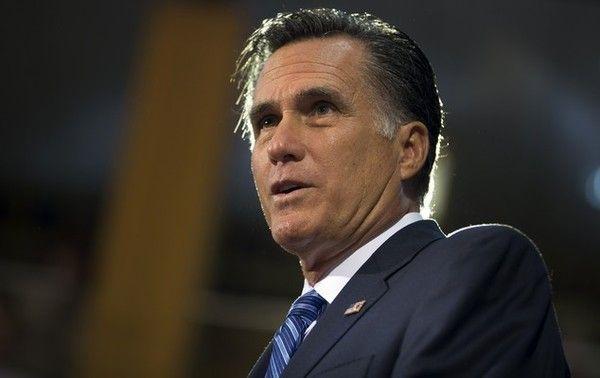
Debate Topic Could Limit Romney's Closing Argument
Published Oct. 22, 2012 • Read time: 5m
From the day he announced his candidacy in June 2011, Mitt Romney has grounded his case for the Oval Office in what he calls President Obama's failure to reinvigorate the economy, asserting that his own business background gives him the experience and skill set to do a better job.
Romney’s strategists have tinkered with that sales pitch from time to time and have emphasized other issues to varying degrees, but what has not changed is their overriding belief that the election will be won or lost on the concern that voters have consistently rated as most important to them.
The parameters of the third and final presidential debate on Monday, therefore, pose a challenge for the Republican nominee: How does he make a strong final pitch to tens of millions of TV viewers when debating foreign policy rather than domestic issues?
Even as Romney has made inroads convincing undecided voters of his abilities as an economic steward, he is running against a president whose approval rating on foreign policy remains high. What’s more, Romney has twice missed recent opportunities seemingly tailor-made to cut into the incumbent’s advantage on this front.
Despite this challenge, the Romney camp says it has no qualms about his ability to make a persuasive overall closing argument when CBS News’ Bob Schieffer moderates the final head-to-head battle of the campaign Monday night in Boca Raton, Fla.
“I think Americans will care about the standing of America in the world, and I think instinctively they understand and believe that America’s standing in the world has been damaged by Barack Obama over the last four years,” said Romney’s policy director, Lanhee Chen. “And so part of the case that we’re going to be making on Monday is: Look at the results. Look at the outcome of what Barack Obama’s leadership has gotten. And we believe it’s gotten us to a place where America’s leadership isn’t as strong.”
Lies, Assault and Cover-ups Don't Stop Donald Trump
Trump Stands by His Man; Obama on a Health Scourge; Hayden Interview; Reagan's Courage
Analysis: For Trump, Few Limits to Win-At-Any-Cost Approach
What If Clinton Isn't Indicted?
Republicans outside the campaign have expressed frustration over the challenger’s failure to take advantage of prime opportunities to press Obama on the Sept. 11 consulate attack in Libya, most recently after the lone foreign policy question of Tuesday’s debate. (The question concerned who was to blame for the lack of adequate security at the consulate, which led to the killing of U.S. Ambassador Chris Stevens and three other Americans in Benghazi.)
Rather than hammering home his case about the administration’s failure to assess adequately the threat that preceded the attack, along with its muddled response afterward, Romney followed a stern rebuke from Obama with a semantic argument over the president’s initial characterization of the event. Suddenly, it was the Republican who was forced to assume a defensive posture on the issue.
Romney surely will be prepared this time not to make the same mistake.
“We’re happy to talk about foreign policy and the great, sweeping failures of the Obama administration,” said chief campaign strategist Stuart Stevens. “When people turn on the television now, I don’t think the first thing they think is, ‘Wow, things have really worked out great.’ Usually seeing embassies in flames is not considered a positive sign that things are working out well.”
Romney, however, has gone quiet on the Benghazi attack since the last debate, suggesting that he would prefer to step back and frame his overall argument in broader terms.
Since launching his first presidential run in 2007, he has been a forceful advocate for a more emphatic American footprint on the world stage, calling for boosts in overall troop levels, increases in the defense budget, and a more aggressive osture toward Iran.
But there have been reports of internal disagreements among his foreign policy advisers -- some of whom come from the Bush/Cheney neoconservative mold, while others have a more traditionally conservative, non-interventionist background.
After giving a foreign policy speech earlier this month that was notable for its lack of detailed differentiation from Obama’s approach, Romney’s broad task on Monday night is fairly straightforward: He must offer a clear argument why he can be trusted to perform better on the world stage than an incumbent whose overall foreign policy portfolio is one of his strongest political assets.
In a Pew Research poll conducted after the first presidential debate and released on Thursday, Obama maintained a 47 percent to 43 percent lead over Romney when respondents were asked who could best make wise decisions about foreign policy.
The good news for Romney is that Obama’s advantage had narrowed significantly from the previous Pew poll -- conducted last month, when the Republican trailed the president on this issue by 15 percent.
Still, Romney’s team knows that foreign policy is not likely to be a decisive factor in the election. For that reason, his aides suggested that he will look for opportunities to broaden his answers to Schieffer’s questions and tie them to domestic matters.
“It’s a question of leadership, and the thing we’ve been talking about is how Americans can’t afford four more years of the last four years,” said Romney spokesperson Andrea Saul. “And that’s not only on the domestic front with debt, jobs, food stamps, and poverty, but it’s also on the foreign policy front. And what we’ve seen from this president is a lack of leadership in both scenarios.”

Congress Doesn’t Need Another Blame Game. It Needs To Find What’s Broken
Jarrod Bernstein • RealClearPolitics
Democrats Won the Midterms. Common Sense Won, Too
Jordanne Kemper • RealClearPolitics
The 120th Congress Shapes Up
Carolina Lumetta • RealClearPolitics
Flooding GOP Primaries With Democrats
Robert Natelson • RealClearPolitics
Washington Keeps Rewarding Oracle—Veterans Keep Paying the Price
Darin Gaub • RealClearPolitics
The Seeds of Unrestricted Warfare
John Teichert • RealClearPolitics
RCP Today
Top stories on RealClearPolitics
The Takeaway
Polling intelligence and analysis delivered to your inbox
World News
Featuring the latest world news
Policy
Featuring the latest policy news
Support Our Mission
As part of RealClearPolitics, authors aim to provide balanced, non-partisan analysis by presenting top reporting and commentary from all sides of the political spectrum.
Trusted by policymakers and citizens alike since 2000