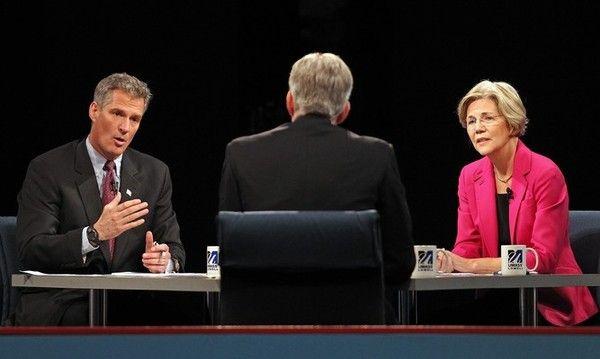
Brown, Warren Hone Their Pitches to Working-Class Voters
Published Oct. 10, 2012 • Read time: 12m
Join the Conversation
0BOSTON -- Flanked by his wife and a few staffers -- and trailed by that famous green Chevy truck -- Massachusetts Sen. Scott Brown makes his way down the annual Columbus Day parade route here on a cloudy Sunday afternoon, jogging at times to keep pace while touching as many onlookers' hands as he can.
Parade watchers dressed in baseball caps and sweatshirts touting Boston sports teams yell out to Brown and wish him good luck in his re-election bid.
Not far behind him is Democratic challenger Elizabeth Warren -- surrounded by dozens of sign-holding volunteers, local party candidates and the city’s mayor, Tom Menino. The candidates are separated only by a university marching band and seem to be generating equal support from the crowd.
The two are running in one of the most impassioned and consequential races in the country, and some say Brown needs all the luck he can get in a state President Obama will likely carry handily. And that means he needs votes from the people he passes here in East Boston, a gritty, working-class neighborhood where residents may well be planning to vote for the Democratic president but perhaps see more of themselves in Brown. The Republican’s re-election depends upon getting enough Bay State voters to pull the lever for Obama and then do the same for Brown.
It’s a tough challenge for the incumbent, who got to Washington by roughly 109,000 votes (out of more than 2.2 million cast) in a 2010 special election. Most analysts would characterize a one-point win for Brown here as a landslide. Even some of his most ardent supporters fear the presidential election turnout may complicate things for him.
Portman-Strickland Senate Race Finally Set in Ohio
Portman Wastes No Time Attacking Strickland
Strickland Skirts Primary Debates in Ohio Senate Race
Senate Says Climate Change Is Real
Marcia Zichittella says she is heartened by the “Democrats for Brown” and “Women for Brown” bumper stickers and yard signs she sees in Billerica and elsewhere, located about 20 miles north of Boston. “I’m hoping that’s enough,” the retired teacher says after eating lunch at the town’s Liberty Bell pizza and sub shop, where Brown has stopped by on another day. “Obviously Scott was elected during a very special election. . . . So now, with so many people coming out, I worry a little bit.”
Massachusetts traditionally is a blue state, but it has an increasing number of independent voters, who now make up about half the electorate. Brown tends to hold an edge among these voters, but analysts figure he needs to pick up 18 to 25 percent of the Democratic vote. The RealClearPolitics average shows a close race, with Warren leading by 1.7 percentage points. A WBUR poll released Tuesday found Brown ahead by three points. A Western New England survey released Sunday found Warren leading by five points among likely voters. Forty-six percent of respondents identified themselves as independent and backed Brown by 27 points. But the Republican senator pulled just 11 percent from Democrats.
Part of Brown’s strategy in attracting ticket-splitters is to sell himself as the everyman candidate who grew up in a neighborhood like theirs and understands the economic troubles they face, and as a man who reaches across the aisle in Washington.
“We have a tremendous amount of crossovers,” Brown says in an interview with RCP, insisting the presidential race won’t play much of a role in his race. “I know [Warren] is trying to rely on President Obama’s coattails. . . . She is trying to nationalize the race. People are smarter than that. They understand that I’ve been here, I’m from here, I married a local girl, kids, you know, I’m from here. That being said, she’s not.”
The other part of Brown’s game plan is to paint the woman marching behind him in the parade as someone far removed from the people watching it. Her milieu, he asserts, is Cambridge, where Warren has taught law courses at Harvard. Brown invariably calls Warren “professor” to pin her to the perceived elitism associated with prestigious universities, and he has accused his challenger of using her self-identified Native American heritage to advance her career.
The heritage controversy had been swirling for several months, but was reignited in recent debates, forcing Warren to launch a television ad defending herself against the criticism. Democrats are growing increasingly frustrated with the issue. Gov. Deval Patrick last week called Brown a “Bay State birther,” connecting him to those who question President Obama’s place of birth. At a press conference last week at the Twelfth Baptist Church in Roxbury, Mayor Menino and black church leaders who endorsed Warren over Brown called for an end to the controversy. Brown “has taken on an issue that I think is very derogatory” towards Warren, Menino said. “Elected officials take on those issues when they have nothing else to say. . . . It’s about dividing people. What about bringing people together?”
Brown, though, shows no signs of backing away, arguing that the matter is more about character than race or identity. Indeed, he has been building that campaign narrative in recent weeks, pointing out that Warren was paid over $200,000 by Travelers insurance to defend the firm in a Supreme Court case involving asbestos victims. Brown is accusing Warren of helping the insurance company avoid future lawsuits which denies settlement payments to the victims. Warren argues she was working to get access to a settlement trust set up for the victims by the company. The Boston Globe published an extensive report on the complicated issue.
Warren released two ads of her own this week in which family members of asbestos victims defend her as working for them to get a settlement.
“She’s not who she says she is,” Brown tells RCP. “Aside from the Native American stuff, which is self-explanatory, she’s been out saying she fights for the little guy . . . then we find out she’s a hired gun.”
Warren has focused her campaign on economic populism and the middle-class family -- a message in sync with the president’s and one that seems to particularly resonate in a place like Massachusetts -- using her experience in establishing the Consumer Financial Protection Bureau as a prime example. Warren certainly hopes to benefit from Obama’s coattails here, but she hopes her own personal narrative as the daughter of a janitor in Oklahoma and her zeal for the middle class make her relatable to voters.
Brown is doing everything he can to drive a wedge between Warren and those voters. But some observers caution that, in the process, he risks tarnishing his likable persona -- perhaps Brown’s most valuable asset in wooing voters. He has been stern in debates, launching zingers at his opponent and putting her on the defensive. His debate performances might be lauded by those who want to see him dig in and fight, but might disengage others apt to perceive his treatment of a woman candidate in a negative light.
The moderators at both debates brought up the heritage controversy, but Brown was surely happy to see that happen. While Democrats want the issue to go away, it seems to be resonating in some ways with some voters. “I don’t trust her,” says Wayne Widtfeldt, a house painter eating chowder on his lunch break at Liberty Bell in Billerica. Asked why, he says, “I just can’t put my finger on it.” At another table, Ken Bradley, a welder and a self-identified independent, rolls his eyes when he hears Warren’s name. “I’m at a loss of words . . . ‘dishonest,’ ” he says in describing her.
But for Judy Tolan, a substitute teacher and independent voter who also spoke with RCP at the eatery, the ancestry issue is preventing her from learning much more about Warren, who is spending more time defending herself than getting her message out. “Everybody just harps on her and the Indian heritage thing. . . . All Elizabeth Warren does is refute what everybody is saying she did and it’s just really frustrating. I haven’t heard anything from her that would make me vote for her.”
Tolan says she voted for Obama but is undecided about which candidates she will support in the presidential and Senate races. Economic issues, she says, are key. “I have a child ready to go to college, and that scares me to death. I’m not worried about Elizabeth Warren being Indian. I can’t get bent out of shape about that,” she says.
“Yeah, that’s the least of your worries,” adds her friend Debbie Laquidara, a homemaker also from Billerica who also identifies as an independent and undecided voter. “She is just defending her heritage. I don’t know what she stands for.”
For Sandra Celona, a retired nurse watching the Columbus Day parade with her extended family in East Boston, the election is not so much about heritage as it is about hometown roots. Warren, she says, is not a bad person, but she is a “carpetbagger,” while Brown is a “home-grown boy. That means a lot.”
But Celona’s cousin Joe Celona thinks Brown “is making bigotry an issue [by] pointing out this whole business about Indians,” he says, watching the parade a few feet away with his wife, Pat. (Both are retired teachers from Whitman who support Warren.) Sandra Celona is holding a Scott Brown sign while Joe and Pat have Warren stickers.
“He has a lot of personality and he wows people with that, but she has the substance,” Pat says. “In this state, he doesn’t campaign as a Republican. That’s deceitful. So, here he is on stage saying Elizabeth Warren is deceitful because maybe she should have said this, that and the other thing, but I find him deceitful. I think his campaign against her says a lot about him.”
Still, she says Warren “needs to mingle more, and be more aggressive,” noting that she had to go into the street to get Warren’s attention. “She’s too aloof.” Her husband nods. “Got to get out there and take it from him,” he says.
Warren’s campaign also hopes that just as voters might associate her with Obama and the Democratic Party, so too will they associate Brown with Republicans in Congress and Romney, the former Massachusetts governor who isn’t exactly popular here. In her campaign, Warren tells supporters that this Senate race will determine the balance of power in the Senate. Former President Bill Clinton emailed Warren’s supporters with a message to that effect. The Republican path to the majority is narrow, and holding on to the state makes that GOP goal more difficult to achieve.
Asked by RCP what kind of an impact Obama and Romney might have on her Senate bid, Warren joined herself to the president. “I think Gov. Romney and President Obama make it clear what the issues are in this election. Romney says let’s cut taxes for the wealthiest individuals. . . . President Obama says everybody pays a fair share . . . build a future for ourselves,” she said, as she waited to march in the parade. “I am very proud to stand with President Obama . . . for working families.”
Brown says he supports Romney, but he has distanced himself from his party. He was quick to denounce Romney’s “47 percent” comments, for example. Often on the campaign trail, Brown cites a Congressional Quarterly report ranking him among the most bipartisan senators on Capitol Hill. In a recent debate, he said he might not back Mitch McConnell as the GOP Senate leader. In August, Brown wrote a letter to the Republican National Committee asking that the party loosen its stance on abortion rights. He often recalls standing with Obama in the Rose Garden as the president signed one of his bills.
Why, then, doesn’t Brown run as an independent? When asked by RCP, he says it’s because he is a “fiscal conservative and national security hawk.”
But, he adds, “I believe you can have moderate, independent Republicans. And there are some moderate, independent Democrats too. There’s a place for us down there. You don’t need to be so entrenched in your party that you need to be in lock step with them. That’s the beauty of being an independent: you can still have a party affiliation but still do your job and be that independent voter.”
Last week at a press conference in which former Republican Gov. Bill Weld, a popular moderate who served in the 1990s, endorsed him, Brown seemed to characterize the race here as somewhat puzzling given the “partisanship and the rancor” in Washington.
He cited moderates like Republican Sens. Olympia Snowe of Maine, Democratic Sen. Kent Conrad of North Dakota and Independent Sen. Joe Lieberman of Connecticut, all of whom are retiring. “Why would Massachusetts voters want to send down another extreme liberal. . . . The last thing in the world we need is that partisanship and divide that is so visible and visceral in our country right now,” he said. “Please tell me why? I don’t understand why you would not want to have me and people like me down there.”
Still, the question remains whether enough voters are willing to split the ticket when they go into the voting booth on Election Day. And with polls reflecting a tight race, it’s not clear whether Massachusetts voters themselves know the answer.
Sitting along the parade route, Louis Rizzo and his wife Marjoie, both artists, say they are supporting Brown. But when asked who he thinks will win the race, Louis quickly replies, "Warren."
"But the fact that the race is close, there is a little bit of optimism he might win. That’s unusual for Massachusetts.”
For Brown, though, turnout could either be his making or his undoing. After eating a roast beef sandwich at the Liberty Bell and shaking hands with every customer there, Brown lays out those stakes. “Don’t go the bed on November 6 saying, ‘Darn I should have done more,’ ” he tells those he meets.
If Brown succeeds, observers say, it will be in large part because of his retail campaign. Both candidates are criss-crossing the state and meeting voters. But given the stakes, Brown needs each hand he shakes to cast a vote for him.

Newsom Defies Voters, Juries and Lawmakers To Spare Murderers While Defending Abortion
Curtis Hill • RealClearPolitics
The Algorithmic Tilt
Frank Filingeri • RealClearPolitics
A RealClear Thanksgiving: Investing in a Better Future
David DesRosiers • RealClearPolitics
Trump’s Newsom Problem: Antagonist-in-Chief
Carolina Lumetta • RealClearPolitics
America’s Free Spirit
John Maxwell Hamilton • RealClearPolitics
The GOP Majority Should Go Out in Glory
Daniel McCarthy • RealClearPolitics
RCP Today
Top stories on RealClearPolitics
The Takeaway
Polling intelligence and analysis delivered to your inbox
World News
Featuring the latest world news
Policy
Featuring the latest policy news
Support Our Mission
As part of RealClearPolitics, authors aim to provide balanced, non-partisan analysis by presenting top reporting and commentary from all sides of the political spectrum.
Trusted by policymakers and citizens alike since 2000