
Clinton's Legacy, Obama's Fate Still Entwined
Published Sept. 5, 2012 • Read time: 8m
Join the Conversation
0CHARLOTTE, N.C. -- Twenty-four years ago, the keynote speaker at the Democratic National Convention in Atlanta was a highly touted young Southern governor who delivered a long-winded speech that was such a snoozer it made the humdrum Michael Dukakis seem exciting by comparison.
Thus did William Jefferson Clinton -- who returned to the convention podium Wednesday night -- make his inauspicious debut on the national stage.
Last week, Clint Eastwood induced indigestion among Republicans by going off-message in a 12-minute ad lib that seemed much longer. That was nothing for Bill Clinton. At the 1988 Atlanta convention, he droned on for half an hour, ignoring DNC officials who were emphatically giving him the “cut” sign from the wings.
Even after they started flashing “GET OFF NOW” into his teleprompter, Clinton went on for another five minutes, ignoring the hooting in the hall, apparently unaware that his only real applause line was the derisive cheer that erupted when he finally intoned, “In conclusion . . .”
Only four years later, the 1992 Democratic convention was all his, and by the time of his 2000 convention speech on behalf of Al Gore -- which was billed as President Clinton’s last such campaign address (it wasn’t) -- he had so acclimated Americans to lengthy orations that no one seemed to mind that he bragged on Gore (and himself ) for 40 minutes.
In 2004, a new face appeared on the scene, one destined to challenge Clinton hegemony over the Democratic Party. And although Barack Obama’s electrifying 2004 keynote speech in Boston had very nearly the opposite effect as Clinton’s 1988 fiasco, both men ended up in the Oval Office.
Sanders Seeks Caucus Trifecta Win to Close Delegate Gap
Sanders Fighting Perception He Can't Overcome Clinton Edge
Clinton Targets Trump as Sanders Circles
Sanders, Clinton Differ Sharply at Flint Debate
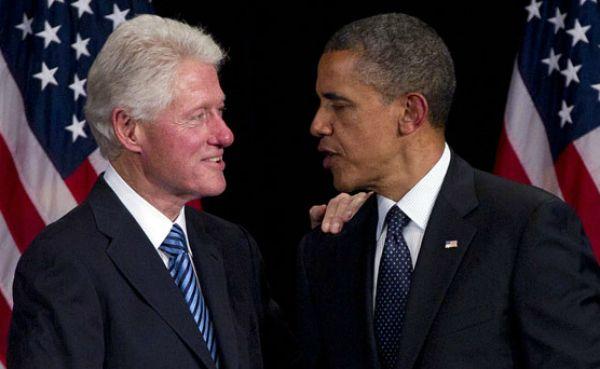
Now here they are again, two mutually dependent, mutually mistrustful alpha dogs -- two of the three most dominant Democrats of their era, which would be awkward even if the third member of the triumvirate was someone other than Bill Clinton’s wife.
He left office amid personal scandal and public prosperity. But in most voters’ minds the scandal has receded like an ebb tide, while the prosperity of the Clinton years remains a high-water mark in the mists of American memory. Also, after a very slow start that paralleled his record of convention speeches, Clinton emerged as an influential and highly respected statesman on the world stage, while remaining a partisan operator in U.S. domestic politics.
Those at his side during the crucible of impeachment have marveled at Clinton’s resilience -- and the growth he has shown as a public figure. When a friend mentioned this week to former White House press secretary Mike McCurry that the former president seems like the ocean tides, the old spokesman replied, “Yes, in the sense he comes in and goes out, comes in and goes out -- but sometimes he can be a bit of a tsunami, right!”
“The remarkable thing is that his voice has matured and mellowed, reflecting his own transformation into post-presidency statesmanship,” McCurry told me. “His experiences in life and his career post-presidency give some added weight to the argument he can make for Obama. . . . I think people appreciate and understand he has used his time since being president doing some really great things. He’s done that and remained in the thick of politics, unlike his successor, who has also done some really good things but avoids the hurly-burly.”
The contrast with George W. Bush is indeed stark. Not only was Bush absent in Tampa, he was nearly airbrushed from the GOP yearbook. Both ex-presidents are going around the world doing great things. But Bush seems uninterested in intramural GOP intrigue, weary of Democratic-Republican hostilities and, as McCurry suggested, seemingly happy to be out of the “hurly-burly.”
Not Bill Clinton. Quadruple-bypass surgery took Big Macs away from Big Bill (and made him smaller), but it didn’t rob him of his appetite for politics.
In Clinton’s mind, the moral of the 1988 campaign wasn’t his much-panned keynote address at the convention. It was the Dukakis team’s willingness to allow the candidate to be successfully defined by his adversaries as an out-of-touch liberal elitist. In 1992, the James Carville-led Clinton campaign had a different approach. If your opponents slap you, they told each other, hit them with a fist. If they punch you, knife them.
That approach propelled the Clinton team to victory twice, but it’s an instinct that is difficult to turn off and on at will. Clinton left office with some incongruity: high job-approval ratings, yes, but also the lingering redolence of sex, lies, and a videotaped deposition that led to a blue dress with DNA on it. Because of that -- or maybe it’s just his nature -- Bill Clinton didn’t go semi-quietly into retirement.
In Clinton’s mind, his legacy depended on Democrats reclaiming the House of Representatives in the 1998 elections, getting Al Gore to succeed him as president, and seeing wife Hillary elected as senator from New York. He was one out of three, but by 2008, the referendum -- and, in his thinking, history’s judgment -- hinged on Hillary becoming president of the United States.
Standing in the way was the man from Chicago, along with his lethally skilled political team. Certainly Barack Obama lacked Hillary Clinton’s qualifications to be president. He was perhaps the most inexperienced candidate ever elected to that office. But Obama benefited from a story line that emerged within the Democratic Party: The Clintons and Their Perpetual Drama vs. the Fresh Start.
Bill Clinton resented this construct, and it showed. While trying to persuade Sen. Edward Kennedy to endorse Hillary, Clinton reportedly said of his wife’s chief opponent, “A few years ago, this guy would have been carrying our bags.” Kennedy was put off, and endorsed Obama.
On the eve of the 2008 New Hampshire primary, Clinton dismissed Obama’s reputation for opposing the Iraq War as “the biggest fairy tale I’ve ever seen!” As the campaign turned to Dixie for the South Carolina primary, the Obama camp suggested that “fairy tale” was racially insensitive.
The New York Times agreed, claiming that the former president had come “perilously close to injecting racial tension” into the campaign. As Mitt Romney has learned this year, one must be immersed in liberal political correctness to credit such arguments, but when Obama swept to victory in the South Carolina primary four years ago, Clinton again displayed dismissiveness toward the Illinois upstart by noting that Jesse Jackson had carried the state in the 1984 and 1988 primaries, to little real effect.
For this he was widely attacked within his own party. Now, it must be said that suggesting Bill Clinton is racist is absurd on its face. Yet, it can also be argued that Clinton was reaping what he had sown. In fact, this precise point was argued, passionately and skillfully, by journalist Christopher Hitchens.
In a scathing 1999 piece, Hitchens wrote that Clinton had pandered to racial animosities in the traditional Southern Democrat manner by overseeing the 1992 execution of Rickey Ray Rector, a black man who killed a white police officer and then turned his gun on himself, essentially lobotomizing himself.
Six years later, in efforts to counteract the stigma of impeachment, Clinton enlisted the help of Jesse Jackson as his personal atonement coach. “He had become,” Hitchens wrote, “the first president to play the race card both ways -- once traditionally and once, so to speak, in reverse.”
Some of Clinton’s friends did him no favors. Defending Clinton during the crucible of impeachment, African-American author Toni Morrison famously dubbed him “the first black president.”
At times, Clinton trod too easily on this ground himself. Fifteen years before Elizabeth Warren’s Senate campaign stalled on her dubious claim of Cherokee ancestry, Clinton blurted out something similar at a conference on race he initiated. (This fanciful-sounding assertion, never heard before, would have actually made him the first Native American president.)
The historic fact of the matter, of course, is that Barack Obama is the first African-American president. The only rub is that by running when he did, Obama almost certainly forestalled the election of the nation’s first female president.
It is not too late to rectify that setback, which many Democrats in Charlotte believe is the reason Clinton agreed to speak to the convention this week. That may be overthinking things. Although Bill Clinton has a complicated relationship with his political party, its women voters, the incumbent president and his own wife, he has rarely been ambivalent about speaking publicly when asked. And he definitely was asked.
Ryan Lizza, the talented Washington correspondent for The New Yorker, created a stir in Charlotte this week with an article asserting that Clinton political adviser Douglas Band has told friends he is voting for Mitt Romney -- all the better to leave a clear field in 2016 for Hillary. Band, as he must, promptly denied the report, but it was a symbolic point anyway: Band lives in New York, where his lone ballot won’t matter in a state Obama should carry by a million votes.
In any event, an Obama second term hardly precludes a second Hillary presidential campaign anyway. Unless, that is, Michelle Obama, Tuesday night’s star speaker at this convention, decides to expand the Clinton and Obama triangle into a foursome.

The Danger Before the Attack
Leslie J. Sullivan • RealClearPolitics
Jon Finer’s Old and Dangerous ‘New Approach’ to Israel
Peter Berkowitz • RealClearPolitics
The President Deserves Better
John Ullyot • RealClearPolitics
Congress Doesn’t Need Another Blame Game. It Needs To Find What’s Broken
Jarrod Bernstein • RealClearPolitics
Democrats Won the Midterms. Common Sense Won, Too
Jordanne Kemper • RealClearPolitics
The 120th Congress Shapes Up
Carolina Lumetta • RealClearPolitics
RCP Today
Top stories on RealClearPolitics
The Takeaway
Polling intelligence and analysis delivered to your inbox
World News
Featuring the latest world news
Policy
Featuring the latest policy news
Support Our Mission
As part of RealClearPolitics, authors aim to provide balanced, non-partisan analysis by presenting top reporting and commentary from all sides of the political spectrum.
Trusted by policymakers and citizens alike since 2000