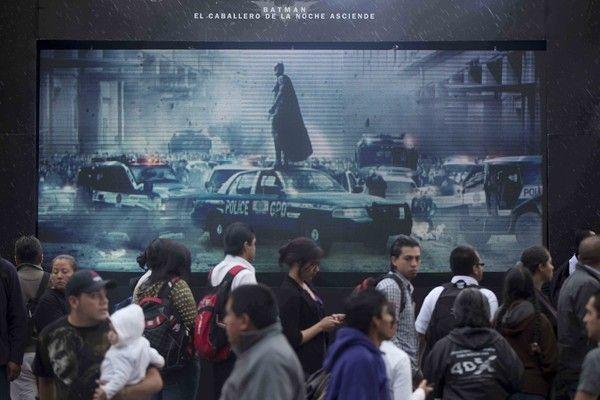
Screen Violence's Effects: A Dark Knight Indeed
Published July 24, 2012 • Read time: 9m
Join the Conversation
0Commercial television was in its infancy when policymakers noticed something disturbing about this new medium: the camera -- or rather, the men behind the camera -- were morbidly attracted to depicting violence and gore.
Could this possibly be good for the mental well-being of viewers, especially children? That’s what several members of Congress wanted to know. In 1950, Sen. Ed Johnson, a Colorado Democrat, asked that a July 16 New York Times column be placed in the Congressional Record. Its headline: “Time for a Halt -- Radio and TV Carnage Defies all Reason.”
“If radio and television aren’t careful, somebody’s going to call the cops,” wrote well-known Times critic Jay Gould in a piece that prefigured the grim scene at a Denver-area multiplex by more than six decades. “The two media have exceeded the bounds of reasonable interest in murder, mayhem and assorted felonies.”
The first congressional hearings were held in the House in 1952 and in the Senate in 1954-1955. Because of a change in control of Congress in the 1954 midterm elections, the latter sessions were chaired by powerful Democratic Sen. Estes Kefauver of Tennessee, who harbored presidential ambitions and who had made his mark heading a special Senate investigation into organized crime.
Basically, what Kefauver wanted to know was whether all the violence on television contributed to juvenile delinquency. Nearly 60 years later, the answer to that question is not really in doubt -- and hasn’t been for some time. A hundred studies have demonstrated conclusively that viewing violence on the screen increases aggression in those who watch it, particularly children.
Donald Trump's Useful Idiots
The Campus Affluenza Epidemic
Are Today's Millennials a New Victorian Generation?
A New Voice for Sexual Assault Victims in Uniform
The more vexing issue has always been what, if anything, policymakers ought to -- or can -- do about it. This has never been satisfactorily addressed, although last week’s slaughter of innocents at the Cineplex 16 at Colorado’s Aurora Mall underscores this grim truth: Simply ignoring the massive quantities of violent Hollywood-produced fare has not made the problem go away.
It’s difficult to know what mid-century adults would even think about the current Batman series directed and produced by Christopher Nolan. The nihilism and glorified carnage of “The Dark Knight,” which came out in 2008, shocked even seasoned reviewers.
“The greatest surprise of all -- even for me, after eight years spent working as a film critic -- has been the sustained level of intensely sadistic brutality throughout the film,” wrote Jenny McCartney of the London Daily Telegraph. “The film begins with a heist carried out by men in sinister clown masks. As each clown completes a task, another shoots him point-blank in the head. The scene ends with a clown – The Joker – stuffing a bomb into a wounded bank employee’s mouth.”
This role evidently took a heavy toll on the man playing it: Heath Ledger, an uncommonly intelligent 28-year-old method actor, had trouble sleeping after filming ended. In a revealing interview with the New York Times, he noted that his Joker character was “a psychopathic, mass-murdering, schizophrenic clown with zero empathy.”
“I couldn’t stop thinking,” Ledger added. “My body was exhausted and my mind was still going.” He’d take a sleeping pill, to no effect, and take another -- only to awake an hour later with his “mind still racing.”
The young actor did not live to see “The Dark Knight” make it to the theaters. Today, 12 other young people are gone, slain in a Colorado movie house during the showing of the sequel.
Hollywood has always given short shrift to the body of social science pointing to the carnage its violent programming leaves in its wake. But this one is harder to dismiss: The shooter attended a midnight showing of “The Dark Knight Rises,” with dyed hair and guns, having left chemical booby traps back in his apartment, which was adorned with Batman posters. He is reported to have told cops he was the Joker.
Back in the 1950s and 1960s, Hollywood executives who were keelhauled before various congressional committees and parents’ groups would cite their protection under the First Amendment, point to their various non-violent programming, and assert blithely that nothing on the screen could directly influence the actions of viewers.
This last claim struck nearly everyone as disingenuous. A very partial list of the human behaviors that programmers tried to influence, often successfully, with ads, serials, infomercials -- and sometimes only a fleeting scene in a movie -- include: what kind of cigarette to smoke; how to shave; what kind of undergarments to wear; the best music to listen to; how to score with the opposite sex; which sports to watch; where to vacation; what make of car to buy (and whether to use a seatbelt while driving it); and whom to support for president of the United States.
So the studios quickly changed their story. Make-believe mayhem on the screen, they said in their revised strategy, doesn’t encourage real-world violence. It may actually decrease it, they added, due to a “cathartic” effect on the audience.
Now this was a fascinating theory. Counterintuitive, surely, but intriguing. And so legions of social scientists lined up to test it. Unfortunately, it didn’t turn out to be true. No matter how they sliced it, no one could find any such effect. What they discovered was the opposite. Violent programming desensitized young people to violence, made them more likely to hit other children, and often engendered copy-cat behavior.
“There is more research on this topic than on almost any other social issue of our time," a University of Kansas professor, Aletha C. Huston, told me in 1989. “Virtually all independent scholars . . . agree. We keep pumping children with the messages that violence is the way to solve their problems -- and some of it takes hold.”
By the time I started writing about this issue in the late 1980s, most of the studies were winding down: There was so little variance in any of the findings that it ceased to be interesting as a matter of scientific inquiry. In the meantime, as Hollywood violence became more and more graphic, homicide detectives in big cities and small towns alike began having disturbing encounters.
Some three dozen American boys and men committed suicide by playing Russian roulette after seeing a similar scene in “The Deer Hunter.”
In Greenfield, Mass., 19-year-old Mark Branch stabbed an 18-year-old coed to death and then took his own life. Investigating officers unearthed a stash of 90 horror movies, as well as a machete and a goalie mask like those used by Jason, the grisly star of the “Friday the 13th” series. In Los Angeles, a teenage robber who killed at least once sported a blue bandana and fedora -- and told victims he was Freddy Krueger.
The most disturbing interview I did was with a small-town California police detective named Jeff Boyd about his questioning of a 13-year-old boy, apprehended after accompanying another teenager to a neighbor’s home where they broke in, stabbed him, beat him with a fireplace poker, and then choked him to death with a dog chain.
But why, the police officer asked, had they poured salt in the victim’s wounds?
“Oh, I don’t know,” the kid replied with a shrug. “I just seen it on TV.”
In 1995, Republican presidential candidate Bob Dole went into the lion’s den -- Los Angeles itself -- to challenge the entertainment industry to do better. Dole promised to name names, and he did so, accusing record and movie conglomerate Time Warner Inc., in particular, “of mainstreaming deviancy.”
A decade earlier, Tipper Gore had challenged record labels over violent and misogynist lyrics in music marketed to children. For her troubles she was called a would-be censor and “a dumb b*tch” (Ice-T) and a “cultural terrorist . . . and a bored, sex-starved housewife” (Frank Zappa).
Now Dole was expanding the issue to films, and doing so in the context of a presidential election. “A line has been crossed -- not just of taste, but of human dignity and decency,” he said. “It is crossed every time sexual violence is given a catchy tune. When teen suicide is set to an appealing beat. When Hollywood’s dream factories turn out nightmares of depravity.”
Hollywood’s response was to accuse Dole of politicizing an issue, criticize him for opposing gun control legislation, accuse him of censorship -- and to funnel money into the coffers of the Democratic ticket, which included Al Gore.
On Sunday, Barack Obama went to Colorado and said many consoling and affecting words. After quoting Scripture, he assured the mourners, “Out of this darkness, a brighter day is going to come.”
But those words do not necessarily apply to Hollywood. The gritty Batman series of the 1980s and 1990s with Michael Keaton, Val Kilmer, and George Clooney in the title roles -- considered pretty grim when they were made -- were markedly less dark and violent than Christopher Nolan’s trilogy. This merely mirrors the trend in moviemaking and television.
Three years ago, the bipartisan Parent’s Television Council released a report showing that between 2004 and 2009, violence depicted on television against women increased by 120 percent, a number that transcends partisanship.
“Hollywood has launched an all-out assault on women on our publicly owned airwaves,” said conservative writer Tracie Walker. “This is not OK,” added liberal writer Melissa Silverstein, “and if TV is helping to make young men think that this behavior is ‘normal,’ something must be done about it.”
But what?
While President Obama was consoling Coloradans, back in Washington those watching the hometown major league baseball team on television were treated to his campaign’s familiar attack ads insisting that Mitt Romney cares nothing for the American middle class.
This is inane, and the president knows it, and yet the Obama re-election campaign has spent an estimated $100 million on such negative ads in the past month. Think how much better it might be for the country if he had spent that money telling American parents to avoid nihilistic and violent movies. It would dry up some sources of his funding, but the thing of it is -- it might make the country safer, and it would almost certainly gain him votes.
NEXT: The news media's role.

A RealClear Thanksgiving: Investing in a Better Future
David DesRosiers • RealClearPolitics
Trump’s Newsom Problem: Antagonist-in-Chief
Carolina Lumetta • RealClearPolitics
America’s Free Spirit
John Maxwell Hamilton • RealClearPolitics
The GOP Majority Should Go Out in Glory
Daniel McCarthy • RealClearPolitics
Republican Majorities Could Return Sooner Than Expected
J.T. Young • RealClearPolitics
The Danger Before the Attack
Leslie J. Sullivan • RealClearPolitics
RCP Today
Top stories on RealClearPolitics
The Takeaway
Polling intelligence and analysis delivered to your inbox
World News
Featuring the latest world news
Policy
Featuring the latest policy news
Support Our Mission
As part of RealClearPolitics, authors aim to provide balanced, non-partisan analysis by presenting top reporting and commentary from all sides of the political spectrum.
Trusted by policymakers and citizens alike since 2000