
Ariz. Ruling Cements Parties' Divide on Immigration
Published June 25, 2012 • Read time: 5m
Join the Conversation
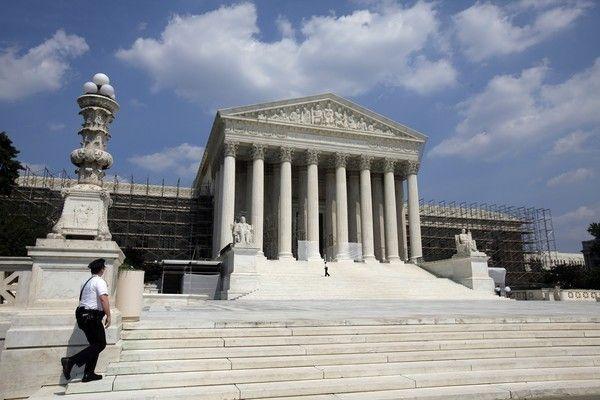
0The Supreme Court's ruling Monday striking down most of an Arizona immigration law guaranteed that both parties will continue to champion opposing views on immigration through November. The two sides agreed Monday on one big idea, however: Congress must fix immigration. And that is unlikely to happen before 2013 or 2014.
President Obama, according to analysts, emerged as a partial winner and political benefactor after ordering his administration to challenge Arizona’s law. The president has been running 40 points ahead of Mitt Romney among Latinos in some polls and is eager to contrast his outlook on immigration with policies proposed by members of the Republican Party.
Court-watchers described the justices’ decision as largely a legal victory for the administration, despite their ruling that law enforcement officers in Arizona can verify the immigration status of suspected undocumented persons in the state. In allowing that aspect of the law to go forward, the ruling encouraged Republican Gov. Jan Brewer to boast during a news conference that Arizona had been “vindicated.”
The court struck down provisions of the law that made it a crime for undocumented residents to be in Arizona, and to seek employment or perform work. And it ruled against the state’s requirement that foreigners “complete or carry an alien registration document.”
Obama thinks he can win in key states such as Colorado, Nevada, Florida and Virginia by increasing the participation rate among Latinos, and perhaps also in Arizona, a reliably red state in presidential races since 1996. Encouraging Hispanics, African-Americans, Asian-Americans and younger voters to perceive Republicans as intolerant on immigration is part of the Obama campaign’s strategy to compensate for an expected fall-off in support -- from 2008 levels -- among white working-class voters.
The Rise and Fall of Marco Rubio
An Invasion of Artificial Outrage
Obama Administration Tells Agents to ID Which Immigrants Not to Deport
Green Shoots of Sanity?
Obama’s challenge is to galvanize Latino voters without alienating the rest of the electorate that said -- at least before the court ruled Monday -- that they supported Arizona’s decision to let police check the immigration status of suspects stopped or apprehended in the state for other reasons. Seventy-five percent of Hispanics disapprove of Arizona’s approach, while 58 percent of the general public approve it, according to an early-June survey cited by the Pew Hispanic Center.
It is unlikely that the Supreme Court’s partial affirmation of the federal government’s position will dramatically alter public opinion about Obama, Romney or immigration before Election Day, but the candidates can use elements of the 5-3 ruling to bolster arguments on the stump. (Associate Justice Elena Kagan recused herself from the case because of her previous involvement in it as U.S. solicitor general.)
Arizona’s pursuit of information about suspects’ immigration status will require cooperation from the Department of Homeland Security. In directives Monday, the administration advised its employees that requests for such data could rank behind the federal government’s public safety and border security priorities. In other words, Arizona police may call U.S. Immigration and Customs Enforcement for information about suspects in custody, but ICE will not drop “priority” duties to run searches for Arizona in all circumstances.
The president, through DHS, issued a directive this month temporarily halting the deportation of qualifying offspring of illegal immigrants who came with their parents to the United States as children. The change in enforcement policy opened the door for the children of illegals to obtain work permits for as long as the policy remains in effect.
Romney and his campaign team stepped cautiously Monday, aware that divisions over immigration within the Republican Party run deep. Those fissures have prevented the party from grasping a consensus middle ground position up to this point. The presumptive nominee did not say Monday if he supported the Arizona law on which the Supreme Court ruled, or if he embraced the court’s ruling in its entirety.
At a February GOP primary debate in Arizona, Romney sounded generally sympathetic to that state’s approaches to halting illegal immigration. Other Republicans, including Sens. Marco Rubio of Florida, John McCain of Arizona and Gov. Rick Perry of Texas, have all expressed reservations about the impact of Arizona’s stance on the issue.
Romney, in a written statement Monday, said that “each state has the duty and the right to secure our borders and preserve the rule of law, particularly when the federal government has failed to meet its responsibilities.” He blamed Obama for not resolving immigration challenges in his term, as the Democrat pledged to do when he campaigned for the White House in 2008.
“Today's decision underscores the need for a president who will lead on this critical issue and work in a bipartisan fashion to pursue a national immigration strategy,” Romney said.
In a written statement, Obama said state-based approaches to immigration were legally vulnerable because the Supreme Court ruled that the federal government has the authority to control U.S. borders and immigration, not states.
“What this decision makes unmistakably clear is that Congress must act on comprehensive immigration reform,” he said. “A patchwork of state laws is not a solution to our broken immigration system -- it’s part of the problem.”
Obama said the government would “ensure” that Arizona police don’t violate the civil rights of Americans. Romney said states have a “duty” to defend their rights when it comes to immigration. And Brewer said Arizona fully expects to be back in court to defend its enforcement of what she called the surviving “heart” of its law.
The GOP Majority Should Go Out in Glory
Daniel McCarthy • RealClearPolitics
Republican Majorities Could Return Sooner Than Expected
J.T. Young • RealClearPolitics
The Danger Before the Attack
Leslie J. Sullivan • RealClearPolitics
Jon Finer’s Old and Dangerous ‘New Approach’ to Israel
Peter Berkowitz • RealClearPolitics
The President Deserves Better
John Ullyot • RealClearPolitics
Congress Doesn’t Need Another Blame Game. It Needs To Find What’s Broken
Jarrod Bernstein • RealClearPolitics
RCP Today
Top stories on RealClearPolitics
The Takeaway
Polling intelligence and analysis delivered to your inbox
World News
Featuring the latest world news
Policy
Featuring the latest policy news
Support Our Mission
As part of RealClearPolitics, authors aim to provide balanced, non-partisan analysis by presenting top reporting and commentary from all sides of the political spectrum.
Trusted by policymakers and citizens alike since 2000