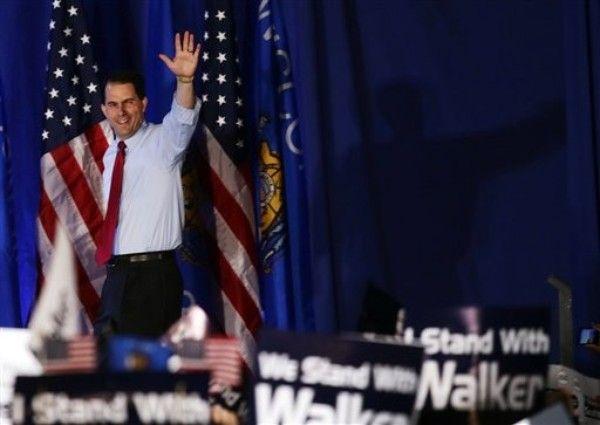
Wisconsin Gov. Scott Walker Wins Recall Election
Published June 6, 2012 • Read time: 7m
Join the Conversation
0WAUKESHA, Wis. -- Sixty million dollars in campaign spending and 15 months of protests later, Wisconsin voters decided Tuesday that Republican Gov. Scott Walker should keep his job after all. With 99 percent of the precincts reporting, he held a seven-point lead over Milwaukee Mayor Tom Barrett, 53 percent to 46 percent.
The victory was the culmination of a heated recall election that began in the corridors of the state capitol and then transformed into a national test of the conservative grassroots and the power of organized labor. Walker's win deals a blow to the latter and energizes the former.
“Wow,” Walker said when he took the stage here at the Waukesha County Exposition Center around 10:30 local time. “Tonight we tell Wisconsin, we tell our country, and we tell people all across the globe that voters really want us to stand up and make the tough decisions. Now it is time to move on, and move forward in Wisconsin.”
In his concession speech, Barrett told his supporters “to please, please, please remain engaged; remain involved. . . There are more chapters to come. And in those chapters, it is my sincere hope that all of us here will remain engaged.”
With turnout in this special election nearing presidential levels, observers will be reading the tea leaves for clues to the Obama-Romney contest this fall, especially if Republicans can replicate the turnout operation they produced here.
On the local level, this race was all about Walker, a first-term governor who curtailed collective bargaining rights for public workers in order to balance the budget. The reforms, which even many of his supporters say were pushed through the legislature abruptly, triggered weeks of protests and ultimately led to the recall -- the third of its kind in the nation’s history.
Kids' Lives Matter Too
In a Corner of Ohio, Lessons of 2016
2016 Presidential Election Could Decide State Legislative Races
McCaskill Says No to Run for Missouri Governor
In his victory speech, Walker addressed the complaint that he pushed the reforms too quickly. “Early in 2011, I rushed in to try and fix things, before I talked about it,” he said, noting he was tired of politicians “who talked about things but never fixed them. Looking ahead, we know it’s important to do both. . . . We’re both going to be committed to talking together about how to solve problems.”
During the campaign, and much to national Democrats’ chagrin, the race flowed beyond the Badger State’s borders. Republicans saw Walker as something of a poster boy for cutting budgets and taking on unions, a constituency that traditionally favors the Democrats. A win for Walker, they thought, might embolden his colleagues. And that was a top concern among many Barrett supporters as they went to the polls Tuesday. “A lot of Republicans will feel encouraged,” said Nathaniel Ragatz, a former student, outside his Milwaukee polling place. Ragatz said he voted for John McCain in 2008, but protested at the state capitol last year against Walker’s reforms.
“I think it will give other states more momentum to possibly do the same thing,” said Richard Miller-Dillon outside his Milwaukee polling place, where Barrett had cast his vote just a few hours earlier. Miller-Dillon and his wife, Kathleen, a state university employee, voted for Barrett, they said, to express their opposition toward Walker. “I think . . . many other states will see this as a victory for traditional conservatism” if Walker wins, said Kathleen. “It will prove to be a real hard battle here. It will show that the state really has gone more red than blue; that we really lost our working-class roots.”
Popular former Gov. Tommy Thompson, who is currently seeking the Republican nomination for Wisconsin’s open U.S. Senate seat, said Walker’s win is going to “demoralize” Democrats heading into the fall campaign. “The state of Wisconsin isn’t going to be Obama Country anymore,” he said in an interview with RealClearPolitics at the Walker election party.
While the win for Walker by no means guarantees victory for Mitt Romney in November, Republicans activated their ground game here months earlier than they would have in any other general election year, which could boost the GOP challenger in a state that has voted Democratic in every presidential race since 1988 -- though by close margins in 2000 and 2004.
Republican National Committee Chairman Reince Priebus, also a Wisconsinite, was on hand at the Walker rally, and told reporters ahead of the election results that a Walker win would hurt Obama’s chances in the fall. Democrats are “going to look back and say, 'Thanks a lot pal, we appreciate the help.' I don’t think that goes over well in this state.”
Notably, though, exit polls taken on Tuesday found Obama leading Romney by 53 percent-42 percent.
Obama did not visit the state as the recall campaign played out, perhaps signaling that he didn’t want to be tarred if Walker won or to alienate independent voters in the highly polarized election. He backed Barrett from afar, while Democrats dispatched former President Bill Clinton, Democratic Governors Association Chairman Martin O’Malley, and Democratic National Committee Chairwoman Debbie Wasserman Schultz to the state. “This isn’t Obama’s fight, and I think he was really smart not to come,” said Kathleen Dillon-Smith, the Milwaukee voter.
"While tonight’s outcome was not what we had hoped for, no one can dispute the strong message sent to Governor Walker,” Tripp Wellde, the Obama re-election campaign’s Wisconsin state director, said in a statement.
The DGA poured more than $3 million into this race. Unions, anti-Walker groups and the state Democratic Party organized a massive get-out-the-vote operation. O’Malley blamed Walker’s financial advantage. Despite Walker’s victory, he said the recall alone sends a message to Republican governors that “the people of their states will not tolerate partisan overreach.”
Some groups were even registering voters on the day of the election. “People are going to the polls to support collective bargaining. . . . This has to do with losing our rights,” said Wisconsin AFL-CIO President Phil Neuenfeldt in his office on Election Day, with members making calls upstairs and canvassing the neighborhood just hours before the polls closed.
“We’ve been building a movement, and it started last year,” he said. “And we’re going to continue to build that movement. . . . Our to-do list is the same no matter who wins today. . . . Of course, we want to win.”
The Republican Governors Association allocated $9.5 million to the race -- $1.5 million of that in the last couple days of the campaign. Walker outspent Barrett, $31 million to about $5 million. Both camps dominated the airwaves with negative ads. With spending by outside groups added in, over $60 million was poured into the recall campaign, the most expensive in Wisconsin’s history. “Tonight, Wisconsin voters rewarded political courage,” said RGA Chairman Bob McDonnell, Virginia’s governor.
Given the polarization and the mudslinging, Wisconsin voters feel relieved to have the contest come to an end. The election pitted neighbors and friends against one another, as few voters were undecided on Election Day. The political climate “was miserable,” said Leah Strong, a stay-at-home mom from Milwaukee who walked with her baby daughter to her polling station to support Walker. Strong said she was afraid to put up a yard sign in her Barrett-friendly neighborhood. Ragatz, the former student who backed Barrett, said his brother’s support for Walker made for difficult family dinner conversations. At the end of the day, though, “blood runs thicker than water and thicker than Walker,” said Ragatz’ mother, Susan, who also backed Barrett.
That comment underscores a serious point: Will Walker be able to bridge this raucous divide between Wisconsinites? The answer might depend upon whom you ask. “Somehow, we’ve got to pull together,” said Lee, a retired Wauwatosa resident who walked arm-in-arm to the polls with his wife, Mary Jane, to vote for Walker. (Both asked that their last names not be used.) “I think he probably learned also from this as well,” said Mary Jane. “A little more tact in the beginning rather than coming on so strong, to give people a little more preparation,” she suggested.
“The healing begins tonight,” former Governor Thompson told RCP. Walker said he would invite all the members of the state legislator for “brats and burgers.”
Walker supporters exitubg the expo center exhibited a sigh of relief. “ It means everything to me. . . . We can finally move forward, like we should have been for the last year,” said Leslie Pabich of Waukisha.

Newsom Defies Voters, Juries and Lawmakers To Spare Murderers While Defending Abortion
Curtis Hill • RealClearPolitics
The Algorithmic Tilt
Frank Filingeri • RealClearPolitics
A RealClear Thanksgiving: Investing in a Better Future
David DesRosiers • RealClearPolitics
Trump’s Newsom Problem: Antagonist-in-Chief
Carolina Lumetta • RealClearPolitics
America’s Free Spirit
John Maxwell Hamilton • RealClearPolitics
The GOP Majority Should Go Out in Glory
Daniel McCarthy • RealClearPolitics
RCP Today
Top stories on RealClearPolitics
The Takeaway
Polling intelligence and analysis delivered to your inbox
World News
Featuring the latest world news
Policy
Featuring the latest policy news
Support Our Mission
As part of RealClearPolitics, authors aim to provide balanced, non-partisan analysis by presenting top reporting and commentary from all sides of the political spectrum.
Trusted by policymakers and citizens alike since 2000