
Obama's $3.8 Trillion Budget Is a Pre-Election Salvo
Published Feb. 14, 2012 • Read time: 9m
Join the Conversation
0Once upon a time, American presidents unveiled their annual budgets to Congress with green-eyeshade seriousness and a certain degree of policy suspense.
But it has been quite a while since President Ford dragged members of his Cabinet with him into the State Department auditorium while he attempted to dazzle reporters with his budgetary know-how about block grants, Medicare reimbursements, and federal funding for ballistic missiles. Ford, running in 1976 for an office he inherited when Richard Nixon resigned, thought his commanding knowledge of the executive branch and of Congress could help him appeal to voters. It didn’t work out that way when a Georgia peanut farmer beat him.
Budgets are where incumbent presidents, at least in the modern age, often run into trouble. Recall magic asterisks, unfunded mandates, evaporating surpluses, and ketchup as a vegetable (President Reagan’s ploy to economize on hot lunches in schools). Federal budgets are easiest to construct in times of peace and prosperity; hardest in times of war and economic crisis -- and when painful policy choices have been deferred by both political parties through several administrations.
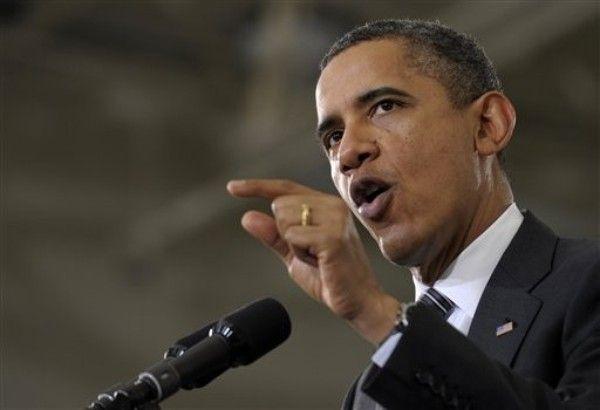
And that explains how President Obama came to deliver his $3.8 trillion fiscal 2013 budget to Congress on Monday after basically fleeing Washington. He didn’t go far -- just across the Potomac River to give a speech at a community college in Virginia -- but the fact that he opted to hold his budget event in a swing state and not in the capital spoke volumes.
The FBI Gained Access; We'd Already Lost Our Privacy
Is Trump Right About NATO?
Arizona's Voting Rights Fire Bell
U.S. Officials Say 2 Americans Died in Brussels Attack
The president’s fiscal blueprint, which makes a bid to help the middle class at the expense of upper-income Americans, was written with voters in mind, even more than the House Republicans the president and his top aides delighted in taunting.
“Some people go around, they say, ‘Well, the president is engaging in class warfare,’ ” Obama said at Northern Virginia Community College. “That’s not class warfare. . . . Asking a billionaire to pay at least as much as his secretary when it comes to his tax rate, that’s just common sense, because Warren Buffet is doing fine. I'm doing fine. We don’t need the tax breaks. You need them. You're the ones who see your wages stall. You're the ones whose costs of everything, from college to groceries, has gone up. You're the ones who deserve a break.”
The president was referring to the administration’s proposed “Buffett rule,” in which no individual earning more than $1 million a year would pay less than a 30 percent effective tax rate. The budget envisions this new rule functioning as a millionaire’s version of an alternative minimum tax to ensure that wealthy Americans -- Mitt Romney became just one example, based on his recently disclosed tax return and estimated liabilities -- pay what most middle-class Americans pay in taxes.
Obama’s budget called on Congress to work with the administration on comprehensive tax reform, but because such a project is considered nearly impossible to accomplish in an election year, the president’s blueprint proposes instead to end a bipartisan assortment of tax loopholes, some new revenue-raisers that would “broaden the tax base,” and the expiration this year of the Bush tax cuts that benefit families earning more than $250,000 a year. All of those proposals, the administration said, could move the tax system closer in fiscal 2013 to achieving the Buffett rule.
Obama’s message Monday was a companion to his Kansas speech in December, and the State of the Union address he gave in January. “The budget we’re releasing today is a reflection of shared responsibility,” he said. “We’ve got to make some choices.”
The president’s goals continue to include new spending for programs that rev job creation and the economy, and a balanced approach to replace spending cuts that he and many in Congress fear will strike the executive branch across-the-board in 2013 -- the residual punishment for not achieving more ambitious and more artful deficit-reduction horse-trading last year.
The $1.2 trillion in across-the-board cuts known as budget sequestration will become law in 2013 if Congress and the president do not work together before January to come up with a substitute. “We firmly believe the sequester [trigger] is bad policy,” said acting Office of Management and Budget Director Jeff Zients. “We believe the sequester should be replaced.” But when asked, he clarified that there are no circumstances under which Obama will sign legislation to amend or alleviate the planned cuts for certain departments, such as the Pentagon, absent a broader, negotiated accord to achieve more than $1.2 trillion in deficit reduction over 10 years, as provided by law. “The president is not calling for the sequester to be taken away,” Zients said.
In effect, Obama is setting the table for negotiations with Republicans that could happen this year, but are almost guaranteed to become necessary during a December lame duck session when the president and Congress will be at the center of a fiscal policy storm. That’s when steep tax hikes, deep spending cuts, the end of key short-term stimulus and the nation’s maxed-out borrowing authority may all collide within weeks of a contentious presidential election.
At the end of 2012, the Bush tax cuts expire for the middle class and for families making more than $250,000. Obama wants to keep the tax breaks for the middle class and Republicans want to preserve the cuts for the wealthy. It is also when Congress and the next president will be staring at automatic deep spending cuts if they do not further rein in future deficits.
Congress is also expected to extend through the end of this year the payroll tax holiday, unemployment insurance benefits, and Medicare reimbursement relief for doctors that are all set to expire at the end of February. Obama has called on Congress to renew those breaks, and Republicans appear disposed to agree, although they are still arguing with Democrats about how to pay for it all. The short-term stimulus now benefits about 160 million Americans, but is assumed to end once and for all in December. Therefore, just as deep spending cuts are expected to loom across the executive branch, and the Bush tax cuts are poised to sunset, payroll taxes would also be set to rise 2 percent for employees who have enjoyed more money in their pockets since 2010.
At around the same time, the president and Congress may also face another battle over the nation’s borrowing authority, which could hit the legal limit between August and next February, depending on policies enacted, the pace of the recovery, and Treasury’s management of accounts.
Last summer, Republicans refused to grant Treasury continued authority to borrow to meet U.S. obligations without achieving a negotiated deficit settlement between Congress and the White House. That “grand bargain” on deficits eluded negotiators at the White House last year, but a lame duck session this year could present new political incentives. If there is an opening for a deficit accord, Obama’s budget blueprint was meant to outline how he would resume such talks. The bargaining chips have been laid out, including the president’s ideas for $4 trillion in proposed deficit reduction over a decade.
If Republicans pick up congressional seats in November and there is a Republican president-elect, the mood in Washington for significant December concessions could either be auspicious (a mutual desire to clear decks for the incoming crew) or contentious (a frosty reception for legacy-building after a hard-fought election).
Former deputy Treasury secretary Roger Altman, who served under President Clinton, described this potential collision of events “a giant budget moment which provides an opportunity to start to fix this problem.”
“The most important date from a budget point of view in 2012 is Dec. 31,” he said on CNBC Monday. “Why? Because that's when all of the Bush tax cuts expire, not just the high-earner tax cuts but all of them. That's when the $1.2 trillion, 10-year mandatory spending cuts under the sequester begin, all on the discretionary side. And that's when the debt limit is projected to be needed to be raised again.”
Altman argued that the president should let the Bush tax cuts expire under current law and wield his veto pen to override any congressional effort to restore those breaks. “That would raise $3.6 trillion of revenue over 10 years. And then you add that to $1.2 trillion of mandatory spending cuts on the discretionary side,” he said. Even without tackling entitlements or enacting comprehensive tax reform, the result might tackle in one lame-duck session “two-thirds or three-quarters of the problem in terms of stabilizing the debt-to-GDP ratio.”
Obama’s budget proposes to raise nearly $1.6 trillion in net new revenues, an idea Republicans have flatly opposed. And the president seeks to gradually lower deficits as the economy improves -- missing his campaign pledge to cut the deficit in half by at least a year. The budget envisions deficits falling to less than 3 percent as a share of the economy by 2022, from 2012’s 8.5 percent.
The ultimate result, White House officials said Monday, would be “sustainable” accumulated U.S. debt. The president’s budget envisions the obligations now at $15 trillion growing to nearly $26 trillion by 2022, a figure quickly underscored by some of his GOP detractors.
As a political document, Obama’s budget serves as a placeholder for the election season. The contrast the White House seeks to draw against Republicans is that the president’s approach “balances” sensible spending cuts with reasonable tax hikes, while the GOP favors a lopsided approach to lower federal spending that would jeopardize the recovery.
It is highly unlikely that Congress will take up the president’s proposals as presented before the election. Senate Majority Leader Harry Reid has said the Senate will not vote on a budget resolution this year because Congress agreed in 2011 to set spending caps as part of a deficit-reduction law. Reid’s decision, condemned as an abdication of responsibility by Republicans, allows Democrats to campaign against House Republicans, who are preparing their own politically crafted budget plan, without casting tough votes.
“The only question is whether the House Republican budget . . . will include any semblance of that balance,” White House economic adviser Gene Sperling told reporters during a budget briefing Monday.

The Danger Before the Attack
Leslie J. Sullivan • RealClearPolitics
Jon Finer’s Old and Dangerous ‘New Approach’ to Israel
Peter Berkowitz • RealClearPolitics
The President Deserves Better
John Ullyot • RealClearPolitics
Congress Doesn’t Need Another Blame Game. It Needs To Find What’s Broken
Jarrod Bernstein • RealClearPolitics
Democrats Won the Midterms. Common Sense Won, Too
Jordanne Kemper • RealClearPolitics
The 120th Congress Shapes Up
Carolina Lumetta • RealClearPolitics
RCP Today
Top stories on RealClearPolitics
The Takeaway
Polling intelligence and analysis delivered to your inbox
World News
Featuring the latest world news
Policy
Featuring the latest policy news
Support Our Mission
As part of RealClearPolitics, authors aim to provide balanced, non-partisan analysis by presenting top reporting and commentary from all sides of the political spectrum.
Trusted by policymakers and citizens alike since 2000