
Free Buddy Roemer!
Published Jan. 21, 2012 • Read time: 12m
Join the Conversation
0As two presidential debates took place this week in South Carolina, the number of participants dwindled ahead of each one. Jon Huntsman quit the race Monday, throwing his support to Mitt Romney, and winnowing the field to five. The morning of Thursday's debate, Rick Perry tossed in the towel -- he promptly endorsed Newt Gingrich -- leaving only four lecterns on stage.
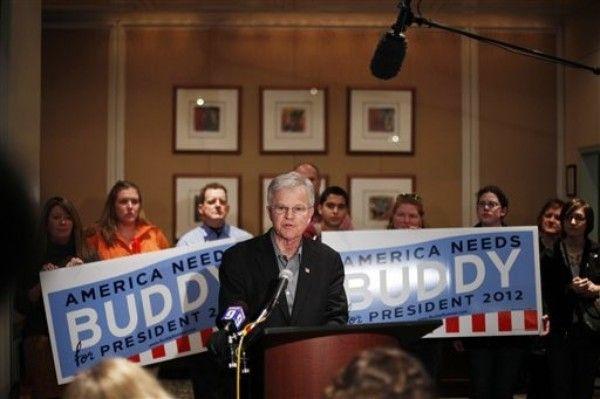
These comings and goings are particularly vexing to one Republican presidential candidate, Charles E. “Buddy” Roemer. A former four-term congressman and former Louisiana governor , Roemer soldiers on despite miniscule poll numbers -- a weak showing he attributes to the refusal of the debate sponsors to let him participate. On Thursday night, he was denied entry again, which means that Roemer has now been passed over for all 20 GOP debates.
Is this fair?
Roemer certainly doesn’t believe so. “It’s corrupt, man,” he told RCP. “To fix this country, you need experience running a state and you need experience in Washington -- and I’m the only one in the field who has both. And they won’t let me debate. Not one single time.”
He has a point, a particular crew of well-regarded political advisers can corroborate. Six months ago, most of Newt Gingrich’s team, including seasoned operatives Dave Carney, Sam Dawson, and Rob Johnson, quit en masse because they didn’t believe Gingrich was serious about putting together a first-rate campaign effort. Gingrich insisted to his aides that the rules of campaigning had changed -- and that he would force his way into the top tier of candidates with his debate performances. They didn’t believe that plan could succeed, and went to work for another old client, Texas Gov. Rick Perry.
On Thursday morning, Carney, Dawson, and Johnson were forced to endure the experience of watching their current candidate quit the race while throwing what little support he had managed to muster to their old candidate.
There’s no assurance Buddy Roemer would have duplicated Gingrich’s commanding performance in any of the debates. But then again, anyone who watches one of these sessions on television with Roemer, which I did in New Hampshire, is hard-pressed to come up with a reason he wouldn’t have made his mark.
Yes, Roemer dutifully watches all the debates he isn’t invited to -- this week he did so from his home in Baton Rouge -- and it is not a passive pursuit. Roemer paces the room as he shouts his rebuttals to the television, barking out brief responses to the moderators and verbally tweaking the other contenders. A young aide who asks only to be identified by her first name (Jill), dutifully records Roemer’s unplugged observations and posts them on Twitter. This is the closest Roemer can come to debating his GOP rivals.
The candidate -- most people just call him Buddy -- has been running since spring of 2011, but when the campaign left New Hampshire for the looming showdowns in South Carolina and Florida, Roemer didn’t go with it. He plans to make his next stand in Michigan, which holds a primary Feb. 28. South Carolina votes on Saturday, but as it happens, the Palmetto State charges candidates $35,000 to file the paperwork to run for president. The Roemer campaign doesn’t have that kind of money, let alone the millions it takes to compete on the airways in the mega-state of Florida.
This is Roemer’s own choice, or at least he believes it is. He has refused to accept special interest money of any kind, and installed a self-imposed ceiling on individual contributions of $100. He says he’s trying making a point about money and politics. The question is whether Americans will ever get to hear it, which forms the essential paradox of Buddy Roemer’s presidential campaign.
Without money, Roemer can’t run many television ads, or even hire much of a staff, and because he can’t get publicity or build up his name identification outside of his native state, he can’t rise in the public opinion polls. Because he doesn’t rise in the polls, the news organizations that have sponsored the 20 GOP debates haven’t let Roemer participate.
Roemer’s adherence to principle is not new; neither is the stubborn streak that makes it difficult for him to actually alter the entrenched institutions he is so intent on reforming. There is nothing magical about $100 limits, however, and Roemer can’t quite explain even to his small but committed staff why he settled on that arbitrary ceiling.
“The unconscious,” Italo Calvino once wrote, “is the ocean of the unsayable.” Buddy Roemer has no trouble saying what he thinks about money in politics, but if one knows Buddy and has spent time with him recently, the thought occurs that even after all these years the subject never far from the unconscious mind of Charles E. Roemer III is . . . Charles E. Roemer II.
Dear Old Dad
Buddy Roemer grew up in a family of Southern Democrats, and he went away to Harvard -- the only Louisiana farm boy in his freshmen class -- in 1960, the year that one of the school’s favorite sons, John F. Kennedy, was elected president. Roemer often expresses pride in that historical confluence. He also likes to point out that exactly 20 years later, Louisiana’s fourth congressional district -- and the voters of the United States -- sent Ronald Reagan and Buddy Roemer to Washington in the same election.
Louisiana always had something of a reputation for fast dealings when it came to political money, but it was not alone. When Reagan governed in Sacramento, the loyal opposition was captained by Jesse “Big Daddy” Unruh, famous for coining the axiom, “Money is the mother’s milk of politics.”
Except that by 1980, when Buddy Roemer thought of politics and money, neither milk nor motherhood came to mind -- not even his own mother, a formidable political matriarch named Adeline McDade Roemer. Instead, Buddy thought of his father and namesake.
That was the year that Roemer’s father, Charles Elson “Budgie” Roemer, was indicted on corruption charges stemming from the FBI’s famed Brilab investigation. Budgie Roemer had risen to prominence in Louisiana helping Edwin W. Edwards win elections and run the state government in Baton Rouge. Budgie had a large family to support and a 2,000-acre cotton farm to operate in Bossier Parish near the Red River. Conflict-of-interest rules were looser in those days and outside work for those in politics was commonplace.
When the old man learned the feds were going to charge him with conspiracy to defraud the state under the racketeering statutes, he called his eldest son to let him know. When he heard this news from his father, Buddy wept. Budgie, who always professed his innocence, apologized only for complicating his son’s congressional campaign.
Convicted and sentenced to prison, Budgie went to the federal penitentiary at Fort Worth. Buddy went to Washington, to serve in Congress.
Buddy’s done a lot in life since then. He’s been divorced twice, raised children, served four terms in Congress, ran successfully for governor, tried to reform Louisiana’s politics and clean up its oil and chemical industry-ravaged environment, dabbled in New Age pop psychology, switched political parties from Democrat to Republican while in the governor’s mansion, lost his re-election effort, started a bank, returned to his roots in the Methodist Church, married a third time, had more children, got bored with the bank -- and, just when it seemed everything had turned normal again -- mounted a quixotic presidential campaign.
Off and Running
He is running in the first cycle since the Supreme Court essentially gutted limits on campaign contributions. But even without the controversial decision that blessed the dastardly work of super PACs, Buddy’s $100 limit would have created problems for any presidential campaign.
“It’s been difficult to gain traction in this race,” he is explaining the other day. “This 2012 campaign is not about good ideas or innovative thinking. It’s about money. Money has always been important to politics, but never have we faced such huge amounts of money wrapped in a lie. The lie is super PACs.
“Each candidate in this race, except me, has a super PAC,” he added. “Rick Perry has seven. Mitt Romney has two. Obama has two. They’re all run by close associates: A business partner. A political partner. A former campaign manager. A former chief-of-staff. It’s illegal and disgusting. They’re supposed to be independent -- that’s the law -- but there’s nothing independent about them.”
A couple of days before the final New Hampshire debate, Roemer held a press conference that his aides slyly hinted might be his last. It was game attempt to generate some news coverage, and it worked to a small degree. “Look, I know the power of money -- I’m a banker,” he said that day. “But we set our limits so every American can participate -- hundred-dollar limit. That’s why debates are much more important to me than to anybody in the race. It’s so frustrating to be the only guy who’s a governor and a congressman and not get invited to a single campaign debate.”
But it wasn’t to be, and that night, Roemer watched the debate like any other New Hampshire resident or political junkie -- on television, from the couch in the apartment building of his campaign spokesman, Carlos Sierra.
It was a small group, more resembling an indoor tailgate party than the brain trust of a presidential campaign. But there was no football on this night -- even though Buddy’s New Orleans Saints were on television -- because there was only one TV set, and the channel can’t be changed even during the commercials, because one of Buddy’s rare advertising spots was running during the broadcast. And so Buddy watches, along with Sierra, a couple of his friends, and three or four campaign aides including Jill, who tweets out Buddy’s observations uttered in a rapid-fire stream of consciousness.
Two other journalists are present: Tucker Carlson, editor of the Daily Caller, and stylish essayist Matt Labash of The Weekly Standard, who occasionally holds his tape recorder up to Roemer and asks him a question. Buddy likes Labash and he likes the attention, but he’s focused on the television, at one point telling him, “Let me just concentrate.”
And concentrate he does. Roemer’s steady patter ranges from a running commentary on the evils of money in politics to flippant asides about Gingrich’s physique. He calls Jon Huntsman “an apologist for China,” while adding that he likes Huntsman’s family, especially Elizabeth Huntsman, one of the former Utah governor’s daughters, with whom he has discussed how to cope with diabetes.
Roemer says it’s patently unfair that Rick Perry, who isn’t campaigning in New Hampshire and is stuck at 1 percent in the polls, is allowed to debate. “He’s not going to be around long; he’s not a factor.” Asked by Labash why Perry is risking such humiliation, Roemer returns to his main theme: “I guarantee you it’s an obligation to the people who have given him money,” he says. “That’s the problem.”
Roemer cheers Ron Paul when the Texas congressman talks about reducing both the federal budget and overseas U.S. military commitments, and praises Romney’s tough stance on Chinese trading practices: “Way to go, Mitt! He’ll be my ambassador to China.” When the debate nears its end, Roemer adds: “I thought Mitt Romney did well. I’m a little surprised any time he does well. I don’t think he’s that good a debater.”
Buddy isn’t terribly impressed by Gingrich, either. When the former speaker turned sideways to the camera to address Romney -- showing his considerable girth -- Roemer quips, “Newt is pregnant! It’s just an observation. I could be wrong. I say eight months. Eight months, three days. That’s my best guess.”
That kind of humor may be all Buddy has left.
This week, Roemer has also tried to tap into populist support from restive Internet communities by ramping up his opposition to two controversial legislative provisions designed to stop Internet piracy.
On his website Thursday, Roemer left a message of solidarity for Wikipedia and other outlets protesting the bills: “America has always been a beacon of freedom -- freedom of thought, freedom of information, freedom of communication,” the statement said. “How can we advocate for greater liberties in China and around the world while restricting our own?”
You can’t blame a candidate for reaching for the megaphone wherever he finds it, and in hindsight, it’s fair for Roemer to ask why an unproven commodity like Herman Cain was accorded so much deference. Yet the question also lingers as to why Roemer wouldn’t play the game a little more seriously. Sometimes even smoke jumpers have to light backfires while fighting a forest fire. It’s called fighting fire with fire. Couldn’t Buddy Roemer have raised enough money to get the word out about the perils of unregulated political money?
In the end, you see, Budgie Roemer’s conviction was set aside by the appellate courts, and not over some trivial legal technicality. Budgie and his fellow defendants, as it happens, were going to profit personally from commissions they planned to make on investing state pensions. But that wasn’t illegal, and they weren’t intending to defraud the state: Testimony at the trial revealed that their scheme would have saved the taxpayers of Louisiana some $1 million.
This is the kind of governance lauded by all the Republican presidential candidates on display at these debates. So what’s the moral of the story when it comes to Budgie Roemer’s son? Perhaps this: Jesse Unruh didn’t only pay homage to the importance of political money. At a time when lobbyists routinely plied state legislators with any manner of favors, licit or otherwise, Unruh also passed along this impure, but practical, advice to his freshmen members:
“If you can’t eat their food, drink their booze, screw their women, take their money, and then come in here the next day and vote against them,” he often said, “you’ve got no business being up here.”



RCP Today
Top stories on RealClearPolitics
The Takeaway
Polling intelligence and analysis delivered to your inbox
World News
Featuring the latest world news
Policy
Featuring the latest policy news
Support Our Mission
As part of RealClearPolitics, authors aim to provide balanced, non-partisan analysis by presenting top reporting and commentary from all sides of the political spectrum.
Trusted by policymakers and citizens alike since 2000