Super Committee Struggles With Deficit Endgame
Published Nov. 18, 2011 • Read time: 6m
Join the Conversation
0“It’s tougher than you think,” said Rep. Xavier Becerra, a Democrat from California, as he exited another super committee meeting Thursday afternoon.
The good news was that lawmakers were still talking as a Nov. 23 deadline approached. The bad news was that Democrats were huddled with themselves in the Capitol and not with the opposing party, while Republicans were dug in elsewhere. Each side taunted the other across acres of cold marble, quarreling about the meaning of “balance” when it comes to $1.2 trillion in future deficit reduction. Would balance be defined as 50-50 between spending cuts and tax hikes? Sixty-forty? Some now and some later?
“If the plan is to extend the Bush tax cuts [after the election] and to repeal the Medicare guarantee for our seniors, well, that's not balanced and that's a place we cannot go,” House Minority Leader Nancy Pelosi vowed during a morning news conference at the Capitol.
“We're going to do this in a fiscally sound way,” Speaker John Boehner said moments later in the same room. Hinting that House and Senate leaders are likely to get more publicly involved in the drama this weekend and beyond, the Ohio Republican added, “I think the leaders have some responsibility to help the committee succeed. And that's what we've been doing.”
The two parties initially sounded more hostile than ever to compromise on Thursday, and Boehner and Pelosi intensified their partisan talking points. Those arguments -- that the middle class should not balance the budget without demanding tax hikes from the rich (Democrats), and tax increases hurt the economy and kill jobs (Republicans) -- will be heard again on weekend talk shows leading into the busy Thanksgiving week. But behind the scenes Thursday, discussions continued about potential puzzle pieces for a deal.
Gavin Newsom's Misguided Redistricting Initiative
A Warning Against the Overuse of Sanctions
Open The Books on the California State Checkbook
Senate Passes Bill Addressing Heroin, Opioid Crisis
“We’re trying to address the concern that Republicans have and trying to show them that we’re willing to try to come up with a solution that meets them -- where they’re willing to go -- to try to come up with a solution,” Becerra told reporters.
Democrats have discussed raising $1 trillion in revenue by getting rid of certain loopholes in the tax code and altering corporate taxes. They have said they are willing to cut $1 trillion in both discretionary and mandatory spending. That could include $200 billion from defense and $350 billion from Medicare providers, Democrats have said.
Republicans have offered to cut $1.2 trillion from future deficits, of which about $776 billion would come from spending cuts. Republicans have also offered about $250 billion in new revenues in exchange for permanently extending the Bush-era tax cuts, and lowering the highest tax bracket on the wealthy from 39.6 percent to 28 percent.
On Thursday afternoon, Sen. Patty Murray, a Washington Democrat and a co-chair of the Joint Select Committee on Deficit Reduction, told reporters that her colleagues on the panel “believe we have opened the door to negotiations in these last final hours." Pointing to divisions among Republicans about how to handle the politically divisive notion of raising revenues at any point in the future, Murray said, “If they can come to an agreement on their side on revenue, then we will be able to move forward."
Monday could be a different negotiating day entirely, as the super committee confronts a preliminary deadline of Nov. 21 to agree on a set of recommendations by a simple majority. On that day, the panel must hand its ideas to the Congressional Budget Office for a green-eyeshade examination before Congress can vote on any plan.
The sticking point for Republicans continued to be raising taxes. The roadblock for Democrats was tampering with entitlement benefits. The inducements for compromise are many: failure to agree would trigger onerous across-the-board cuts of $1.2 trillion split between defense and discretionary spending; a complete failure would also get chalked up to “dysfunctional Congress” at a time when public disapproval of the legislative branch is high; failure might rattle financial markets; and any shared success would offer both parties something to campaign on next year.
There may be growing House and Senate support for a two-step fudge of sorts.
Such a game plan would encourage lawmakers to embrace a down payment -- a mix of spending reductions now -- together with a package of tax reform concepts or revenue-raising expectations for later, which together could get blessed by the CBO as in line with the law’s requirement for at least $1.2 trillion in additional deficit reduction.
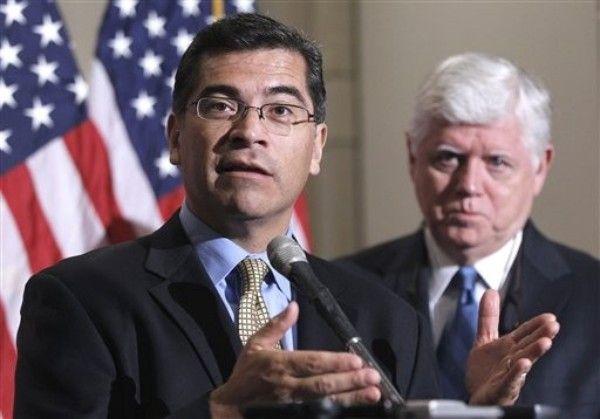
Rep. Jeb Hensarling, R-Texas, the other co-chairman of the super committee, hinted at this possibility last weekend, and other budget experts have suggested it could be a way out of the stalemate. Becerra (pictured) warmed to the concept Thursday in comments to reporters after Democrats emerged from their strategy meeting.
“If everyone would come to the table and really try to get there, I think we’d have a deal,” he said. “As long as you have really clear instructions, so long as the road map is clear, you could do any number of things together.”
He was careful to speak generally, but in response to questions Becerra toyed with more modest spending reductions now that could include entitlement programs (possibly including a higher Medicare eligibility age in the future), as long as the cuts were firmly tethered to a set of instructions to the House and Senate tax-writing committees. Those instructions would be written later into “reform” legislation that could raise revenues and/or set new tax rates.
He suggested the sequencing is less of an issue than what CBO decides meets the legal requirements, and whether there are enforcement mechanisms enacted to give lawmakers confidence that higher revenues would materialize after they embrace spending cuts.
“You could say we’re going to do X today and Y tomorrow. It makes no difference,” Becerra explained. The question would be, “Are your instructions specific enough that CBO can score them, and members of Congress can follow through on it?”
To garner enough votes, the super committee members would eventually have to overcome lawmakers’ embedded distrust prior to an election year. If they fail to present Congress with a deficit plan next week, the across-the-board spending cuts would take effect in January 2013. If they come up with a plan, Congress has until Dec. 23 to vote it up or down without amendment or filibuster.
When asked what might overcome reluctance to consider a two-step fallback, Becerra said the answer is new statutory enforcement mechanisms. “Oh, probably triggers of some sort,” he said. “If the super committee doesn’t come up with the solution -- you have automatic triggers through sequestration, so you could do triggers in any number of ways.”
Would lawmakers trust one another enough to go for that option? “That’s why the instructions, the specificity of the instructions, become so important,” the congressman replied.

A RealClear Thanksgiving: Investing in a Better Future
David DesRosiers • RealClearPolitics
Trump’s Newsom Problem: Antagonist-in-Chief
Carolina Lumetta • RealClearPolitics
America’s Free Spirit
John Maxwell Hamilton • RealClearPolitics
The GOP Majority Should Go Out in Glory
Daniel McCarthy • RealClearPolitics
Republican Majorities Could Return Sooner Than Expected
J.T. Young • RealClearPolitics
The Danger Before the Attack
Leslie J. Sullivan • RealClearPolitics
RCP Today
Top stories on RealClearPolitics
The Takeaway
Polling intelligence and analysis delivered to your inbox
World News
Featuring the latest world news
Policy
Featuring the latest policy news
Support Our Mission
As part of RealClearPolitics, authors aim to provide balanced, non-partisan analysis by presenting top reporting and commentary from all sides of the political spectrum.
Trusted by policymakers and citizens alike since 2000