Distrust, Anxiety Rise as Super Committee Clock Ticks Down
Published Nov. 16, 2011 • Read time: 7m
Join the Conversation
0The political clash on Capitol Hill about the role and scope of government will continue no matter what the deficit-cutting congressional super committee does or fails to do by next week.
President Obama, now out of the country, will return to Washington next week before the committee’s Nov. 23 deadline and decide how he will proceed if an ideologically divided Congress remains at loggerheads, unwilling to trust him or one another.
In a coordinated refrain, congressional Republicans and their aides beckoned the president Tuesday to become more involved in crafting a deal. Sen. John Thune, R-S.D., a member of the Senate leadership, said the super committee of 12 House and Senate members is “hopefully winding up their work, and with very little input from the White House on this. It would appear at least that the president is not particularly interested in seeing a result. We certainly are. We think it's the right thing for the American people.”
Thune’s theme was echoed by other Republicans Tuesday and was seen as an effort to shift blame when or if the super committee fails to reach an agreement to blend revenue-raisers and spending cuts to achieve $1.2 trillion in deficit reduction over 10 years. Also awaiting a congressional accord are extensions of the current payroll tax break for employees, and unemployment insurance, both of which are set to expire.
Congressional Republicans privately complained of chronic distrust between the two parties as the super committee deadline loomed. Conservatives taunted Obama to dive in with the budget specifics he is willing to sign, even as they complained he’s less interested in helping the economy than in bludgeoning Congress as a way to lift his flagging job approval numbers.
Gavin Newsom's Misguided Redistricting Initiative
A Warning Against the Overuse of Sanctions
Open The Books on the California State Checkbook
Senate Passes Bill Addressing Heroin, Opioid Crisis
“If the president, who is now at 43 percent in the polls, thinks he can win next year by running against Congress while making the economy worse, someone is smoking crack,” said one GOP aide.
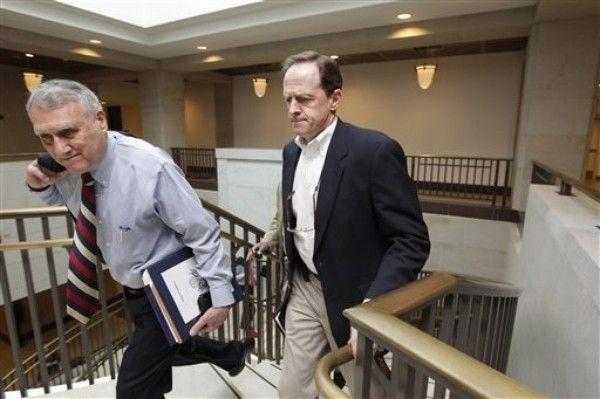
Republicans asked for more fanfare from Democrats and the media for offering to raise revenues last week as part of the deficit negotiations. Conservatives have tentatively blessed a $1.2 trillion plan designed by Sen. Pat Toomey (pictured), R-Pa., that envisioned $700 billion in spending cuts and $500 billion in new revenues over 10 years, including $250 billion in tax “reform.” The offer to close loopholes and raise taxes was conceived as a GOP shield against criticism that the party was more interested in protecting special interests and the wealthy than the struggling middle class. Republicans complained that as soon as Toomey put his ideas on the negotiating table, Democrats leaped to give the details to reporters as evidence of weakening inside the GOP ranks.
“Republicans have put revenues on the table,” Sen. Lamar Alexander, R-Tenn., told reporters Tuesday. “Anyone who knows and understands the Republican Party knows that the proposal that was made last week by the Republican members of the super committee represents a substantial departure from what we'd normally be comfortable voting for. And the only reason we're doing that,” he added, “is because the government is borrowing 40 cents out of every dollar it spends, and that's got to stop. And in exchange for real entitlement reform, we're ready to do some things we normally would not do.”
Republican lawmakers said they want to see a counter-offer from Democrats that would include concessions on entitlements.
The Democrats on the joint committee last week put forward a $2.3 trillion deficit-cutting plan that included $400 billion in entitlement reforms and $1 trillion in new revenues.
Democratic lawmakers and their aides continued to argue that Republicans are not negotiating in earnest and simply hope to lash Obama to the mast as the congressional negotiations founder. They predicted that the president will continue to encourage Congress to do its work right up to the deadline, and leave it to House and Senate leaders to step in as mediators for any sort of deal or fallback plan.
Democrats said Obama will avoid doing what he did last summer during the debt ceiling cliffhanger, when he led White House discussions with congressional leaders that eventually failed to produce a “big deficit deal.” In the summer, Obama and House Speaker John Boehner were unable to work out a $4 trillion deficit-cutting pact each side could swallow, and Congress eventually enacted $1 trillion in savings and created the super committee structure to come up with more. Obama’s poll numbers plummeted, and the public’s approval of Congress sunk to an all-time low.
On Tuesday, Senate Majority Leader Harry Reid met with Boehner to discuss the status of legislation that needs to move before the congressional session ends for the year, but it was unclear what they might have agreed on, other than a shared aversion to failure. Lawmakers who sit on the joint deficit panel, including Sen. John Kerry, D-Mass., told reporters that lawmakers on the committee continue to meet and work productively, but he offered no evidence of any breakthroughs.
Boehner told reporters that if the joint panel can reach an accord, he is “convinced” it can pass. And he blessed the Toomey offer that would raise revenues. “I think the offer that the Republicans put on the table is a fair offer,” he said, adding, “Toomey, something like [the Toomey plan]. It's important for us to, in my opinion, reform the tax code.”
Meanwhile, anxieties about potential across-the-board spending cuts -- the intended penalty for failing to reach a bipartisan accord -- were evident on Capitol Hill. Both parties are resisting the idea of deep defense cuts that could kick in after the election if Congress fails to adopt surgically crafted reforms. While lawmakers spoke with reporters Tuesday, the Pentagon continued to dispatch some of its most prominent advocates to lobby lawmakers for continued defense support.
Gen. Raymond Odierno, the new Army chief of staff and an imposing figure who commanded multinational forces in Iraq, moved between the House and Senate with his uniformed entourage, meeting with key lawmakers Tuesday. By afternoon, he was seen marching into the Capitol’s ornate Senate Appropriations Committee office behind ranking member Thad Cochran of Mississippi.
Obama last week phoned the co-chairs of the deficit panel as he departed the country for a nine-day trip to Australia and Indonesia. Last weekend at the Asia Pacific Economic forum hosted by the United States in Hawaii, the president said he would oppose any effort to legislate a slip knot around the sequestration consequences built into the debt ceiling pact. Reid vowed Tuesday he would “not vote to undo the sequester.”
The president, during a palm-draped news conference Sunday, urged Congress to find a negotiated solution as the Budget Control Act legal deadlines arrive. He warned lawmakers there is no magical means to change the deficit math or to conjure painless remedies. “I'm prepared to sign legislation that is balanced, that solves this problem,” he repeated.
The country’s economic situation in the near term remains precarious even if Congress does what the law says it must -- reduce deficits over 10 years by at least $1.2 trillion. And it would worsen if the super committee fails to reach agreement next week. If that happens, the political stalemate would sink market confidence, potentially weaken ratings of U.S. debt, and further rattle public confidence in government.
Economists have warned that Europe’s sovereign debt problems threaten to drive U.S. trading partners into recession, which would hurt the stalled U.S. recovery during an election year. The Federal Reserve Bank of San Francisco on Monday said the risk of debt default in Europe now raises to 50/50 the prospects of another recession in the U.S.

A RealClear Thanksgiving: Investing in a Better Future
David DesRosiers • RealClearPolitics
Trump’s Newsom Problem: Antagonist-in-Chief
Carolina Lumetta • RealClearPolitics
America’s Free Spirit
John Maxwell Hamilton • RealClearPolitics
The GOP Majority Should Go Out in Glory
Daniel McCarthy • RealClearPolitics
Republican Majorities Could Return Sooner Than Expected
J.T. Young • RealClearPolitics
The Danger Before the Attack
Leslie J. Sullivan • RealClearPolitics
RCP Today
Top stories on RealClearPolitics
The Takeaway
Polling intelligence and analysis delivered to your inbox
World News
Featuring the latest world news
Policy
Featuring the latest policy news
Support Our Mission
As part of RealClearPolitics, authors aim to provide balanced, non-partisan analysis by presenting top reporting and commentary from all sides of the political spectrum.
Trusted by policymakers and citizens alike since 2000