
Feeling Legislative Chill, Obama Flexes Executive Muscles
Published Sept. 26, 2011 • Read time: 6m
Join the Conversation
0When you can't legislate, act.
Seeking to overhaul a major education accountability law enacted by his predecessor, President Obama said last week he will give interested states some relief from the law on his own say-so because lawmakers in Washington have dragged their feet.
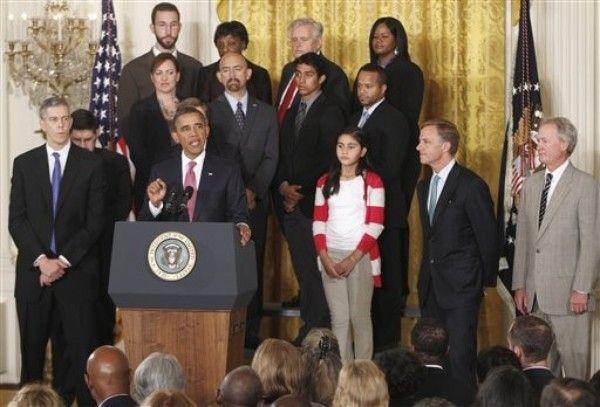
The president, flexing his executive muscles, announced Friday in the White House East Room that he is interceding because Congress has resisted legislative fixes that he said would improve and update President George W. Bush’s signature 2002 law, the No Child Left Behind Act.
“I’ve urged Congress for a while now, let’s get a bipartisan effort, let’s fix this,” Obama said, with Education Secretary Arne Duncan by his side. “Congress hasn’t been able to do it. So I will. . . . Given that Congress cannot act, I am acting. ”
Obama said his own public education initiative, known as “Race to the Top,” offers a flexibility to states that includes accountability requirements but with a focus on improvements in individual schools and among students. No Child Left Behind is “hurting our children instead of helping them,” the president asserted. “Teachers too often are being forced to teach to the test. Subjects like history and science have been squeezed out. And in order to avoid having their schools labeled as failures, some states, perversely, have actually had to lower their standards in a race to the bottom instead of a Race to the Top.”
With support from governors in both parties, and playing off a Republican argument that Washington should leave public education to the states, the president is tapping a provision in the law to act without securing congressional assent. By acting under his own steam in a fractious environment in which Congress is battling the administration on multiple fronts, the president used his executive powers under the Constitution to showcase both his heft and his leadership.
The FBI Gained Access; We'd Already Lost Our Privacy
Is Trump Right About NATO?
Arizona's Voting Rights Fire Bell
U.S. Officials Say 2 Americans Died in Brussels Attack
While the public frets that Washington cannot seem to resolve public policy problems, Obama’s rejoinder is that a president trumps Congress. His unilateral move offers a glimpse at a well-worn White House playbook.
“He is showing he can get something done,” said Towson University presidency scholar Martha Joynt Kumar, a close observer of the modern presidency since Gerald Ford.
“There are a lot of tools in a president’s policymaking kit,” she explained. “He starts out presenting his initiatives to Congress to get their approval, and when he hits heavy weather -- congressional disapproval of many initiatives and slowdowns of others -- then he turns to alternative tools, and one of those is his executive authority.”
A president can set rules for federal agencies and departments as models of policies he favors. He can write and rewrite federal regulations that interpret laws passed by Congress. He can appoint special bodies and councils, and organize a White House staff as he wishes. A commander-in-chief sends troops into battle and sets U.S. interests abroad. And when a president disagrees with Congress, he has the power to veto measures the legislative branch may send him.
“Often rules, regulations and orders are tools a president uses later in his term when he’s sparring with Congress,” Kumar added. “This gives a president a way to accomplish his ends.”
Initially after an election, a president is thinking about pushing an ambitious legislative agenda through Congress and worrying about forging relationships on Capitol Hill. Much later -- and especially when an opposing party controls one or both chambers of Congress -- a president begins to think about building strong links within his executive branch, to move the levers he can command.
President Clinton learned this after the 1994 midterms. That's when Republicans gained control of the House and challenged his policies and leadership as he lurched toward a re-election campaign the following year and then governed in his second term. Clinton had never vetoed a bill before 1995, because he was working with Democratic majorities. But from 1995 to 2000, he issued hundreds of veto threats as a way to pressure conservatives and argue for his policy preferences, and he used his veto pen 35 times in his second term. As evidence that overriding a president’s wished can be a challenge for the legislative branch, Congress tried to override Clinton’s veto 11 times and succeeded just once.
Obama is trying to showcase his heft, especially among voters who have been telling pollsters in the last few months that he is accommodative with Congress but weak as a leader. In 2009 and 2010, Obama pocket-vetoed two measures while working with Democratic majorities in both chambers. But since last fall’s midterm elections, he has issued dozens of veto threats aimed at the policies espoused by House conservatives. He recently put his presidential power to say no on more prominent display. He warned Republicans in a Rose Garden speech last week that if they send him a 10-year plan to reduce deficits by trimming benefits to Medicare recipients, he will protect senior citizens with a veto.
The president recently instructed the government to speed up federal contracts, especially contracts with small businesses, as a way to more swiftly inject federal dollars into a limping economy. Obama ordered the Environmental Protection Agency earlier this month to postpone further regulatory action on a pending and expensive smog rule, a decision meant as a gesture of economic relief to industry.
As commander-in-chief, the president committed U.S. forces and military advisers to a successful NATO effort to drive Moammar Gaddafi from power in Libya. He advised an increasingly skeptical Congress this summer that he did not need lawmakers’ consent to act in Libya. Similarly, in May he ordered a secret U.S. military raid to capture and kill Osama bin Laden in Pakistan -- and advised Congress after the fact.
While Obama believes comprehensive immigration reform cannot be accomplished without legislation, he last month ordered the government to relax its deportation policy. His action was a direct appeal to Hispanic voters who are angry that the president did not successfully lead the immigration charge in Congress soon after his election, as he had campaigned to do. The administration promised to allow undocumented immigrants without criminal records to stay indefinitely in the United States on a case-by-case basis while seeking work permits.
At the White House Friday, the president praised President Bush and the lawmakers who voted for the No Child Left Behind law nine years ago. But he said there was such an urgent need to overhaul the law that if lawmakers could not agree, he was compelled to step in.
“We can't be tied up with ideology,” Obama said, surrounded by students, governors, school officials and lawmakers. “We can't be worrying about partisanship. We just have to make sure that we figure out what works, and we hold ourselves to those high standards. Because now is the time to give our children the skills that they need to compete in this global economy. . . . Given that Congress cannot act, I am acting.”

Jon Finer’s Old and Dangerous ‘New Approach’ to Israel
Peter Berkowitz • RealClearPolitics
The President Deserves Better
John Ullyot • RealClearPolitics
Congress Doesn’t Need Another Blame Game. It Needs To Find What’s Broken
Jarrod Bernstein • RealClearPolitics
Democrats Won the Midterms. Common Sense Won, Too
Jordanne Kemper • RealClearPolitics
The 120th Congress Shapes Up
Carolina Lumetta • RealClearPolitics
Flooding GOP Primaries With Democrats
Robert Natelson • RealClearPolitics
RCP Today
Top stories on RealClearPolitics
The Takeaway
Polling intelligence and analysis delivered to your inbox
World News
Featuring the latest world news
Policy
Featuring the latest policy news
Support Our Mission
As part of RealClearPolitics, authors aim to provide balanced, non-partisan analysis by presenting top reporting and commentary from all sides of the political spectrum.
Trusted by policymakers and citizens alike since 2000