
Support for Nation-Building Fades in GOP
Published June 21, 2011 • Read time: 6m
As the Republican Party grapples with a broadening schism over the role of the U.S. military in the world, several of the GOP presidential contenders appear to be veering further away from the neo-conservative, nation-building wing of the party -- a trend that could deepen as more candidates enter the race.
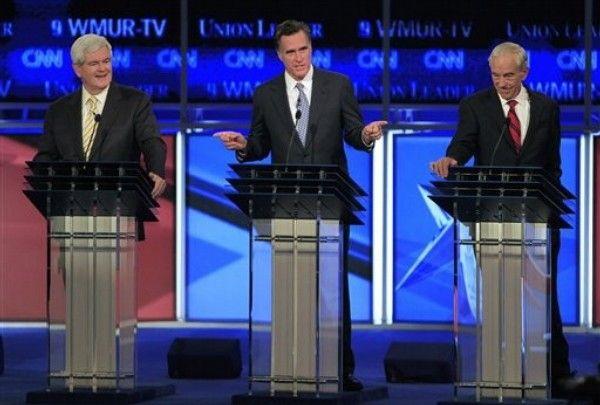
At last week's debate in New Hampshire, former Massachusetts Gov. Mitt Romney best exemplified the extent to which party orthodoxy has evolved from the interventionist foreign policy notions that predominated in Bush's post-9/11 presidency: The front-runner for the 2012 GOP nomination called for the withdrawal of U.S. troops from Afghanistan "as soon as possible" and said of the current state of the nearly decade-long war there, "Our troops shouldn't go off and try to fight a war of independence for another nation."
Romney's comments drew sharp condemnation over the weekend from two of the most prominent and vocal GOP advocates of an interventionist foreign policy -- Arizona Sen. John McCain and South Carolina Sen. Lindsey Graham. But there is ample reason to believe that town-hall attendees and rally-goers in Iowa, New Hampshire and South Carolina will, over the next few months, hear stump speeches on foreign policy that sound less like George W. Bush's democracy-promoting second inaugural and more like the George W. Bush of 2000 that opposed nation-building and called for a "humble" application of U.S. military power.
"If you believe that politics is a marketplace of ideas, there was an under-served market of people wanting to get out of Afghanistan and not enough people selling that," Chris Preble, the director of foreign policy studies at the Cato Institute, told RCP. "When you ask the American people, 'Do you want to be the world's policeman?' they say no. Rank-and-file Republicans hate nation-building."
Lies, Assault and Cover-ups Don't Stop Donald Trump
Trump Stands by His Man; Obama on a Health Scourge; Hayden Interview; Reagan's Courage
Analysis: For Trump, Few Limits to Win-At-Any-Cost Approach
What If Clinton Isn't Indicted?
Though Preble's views have to be considered with the understanding that he is a leading noninterventionist thinker, a growing pool of data appears to back up his conclusion that the Republican base has indeed shifted substantially on foreign policy from where it initially stood in the post-9/11 world.
According to a Pew survey released last month, the percentage of conservative Republicans who said that the U.S. "should pay less attention to problems overseas and concentrate on problems here at home" increased from 36 percent in 2004 to 55 percent in 2011.
And in a Gallup poll released last month, an equivalent number of Republicans who said that the U.S. still has work to do in Afghanistan (47 percent) said that the mission there has now been fulfilled and that the U.S. should bring its troops home.
But even as President Obama prepares to announce an updated plan for the withdrawal of American troops from Afghanistan, it is the NATO-led military operation in Libya that is taking an increasingly prominent role in the GOP debate. Minnesota Rep. Michele Bachmann, who last week announced that she filed papers to run for president, has been particularly emphatic in leading this charge.
At last Monday's candidate debate, Bachmann said of the situation in Libya: "We were not attacked. We were not threatened with attack. There was no vital national interest." The Minnesota congresswoman amplified on this sentiment in her speech over the weekend at the Republican Leadership Conference in New Orleans.
In a telling case study of how far some conservatives have moved away from an interventionist use of the U.S. military, Bachmann recently voted in favor of a bill presented by Ohio Rep. Dennis Kucinich, one of the most liberal members of Congress, which called for the end of U.S. military involvement in Libya within 15 days.
Former Utah Gov. Jon Huntsman who is slated to enter the race today has expressed concerns the U.S. military is spread too thin. "The deployments are mighty expensive," he told George Stephanopoulos last month. "We've got to ensure that going forward into our new world that we have a foreign policy that is an extension of our core national interests. And does that mean that we're going to have to look at the map at some point and reset our level of engagement and our deployments in some corners of the world? Absolutely it does."
Though the Republican candidates' increasing eagerness to speak in this manner is widely assumed to be, at least in part, a politically expedient way to chastise a Democratic president's foreign policy record, concerns about the growing national debt and the high cost of foreign intervention -- which remain particularly salient among Republican primary voters -- also fit neatly into a more circumspect use of the U.S. force.
"We cannot afford to be engaged in any of these military interventions unless America's interests are being challenged," former Alaska Gov. Sarah Palin, who has sounded increasingly skeptical about U.S. policy in Afghanistan and Libya as she weighs a presidential bid, said on Fox News in April in comments that she has since echoed.
The buzz has continued to grow around another major potential GOP contender, Texas Gov. Rick Perry, but relatively little is known about the broader foreign policy outlook of the nation's longest-serving governor.
Still, there are some clues that Perry may not be as quick to call for troop withdrawals as some of his prospective rivals have been. In his 2010 book, "Fed Up," Perry, a former Air Force pilot, penned a passage on defense policy that sounded at times as if it might have been written by his predecessor in the governor's mansion -- George W. Bush.
"We currently have tens of thousands of courageous servicemen and women in Iraq and Afghanistan," Perry wrote. "Their mission in these countries and others is critical to our safety here at home, and it must be the absolute priority of our national government to ensure their success."
Jim Henson, who serves as the director of the Texas Politics Project, which offers neutral political analysis, said that while Perry has made relatively few public comments on foreign affairs to date, his personal background and political persona make it unlikely that he would call for large-scale drawbacks on the international stage.
"I wouldn't want to call him an interventionist, but he's a national security guy," Henson said. "My sense is that he will be much more likely to shade away from this kind of so-called isolationist position."
Henson and other observers of Texas politics noted that Perry's political instincts would also serve to motivate him to criticize Obama more forcefully over the judiciousness of the decisions he has made on the international scene. But unlike the condemnations that were leveled against previous Democratic presidents, the charge of timidity on military force is not likely to be at the forefront of the anti-Obama foreign policy critiques that the Republican presidential candidates will issue in the coming months.

The Danger Before the Attack
Leslie J. Sullivan • RealClearPolitics
Jon Finer’s Old and Dangerous ‘New Approach’ to Israel
Peter Berkowitz • RealClearPolitics
The President Deserves Better
John Ullyot • RealClearPolitics
Congress Doesn’t Need Another Blame Game. It Needs To Find What’s Broken
Jarrod Bernstein • RealClearPolitics
Democrats Won the Midterms. Common Sense Won, Too
Jordanne Kemper • RealClearPolitics
The 120th Congress Shapes Up
Carolina Lumetta • RealClearPolitics
RCP Today
Top stories on RealClearPolitics
The Takeaway
Polling intelligence and analysis delivered to your inbox
World News
Featuring the latest world news
Policy
Featuring the latest policy news
Support Our Mission
As part of RealClearPolitics, authors aim to provide balanced, non-partisan analysis by presenting top reporting and commentary from all sides of the political spectrum.
Trusted by policymakers and citizens alike since 2000