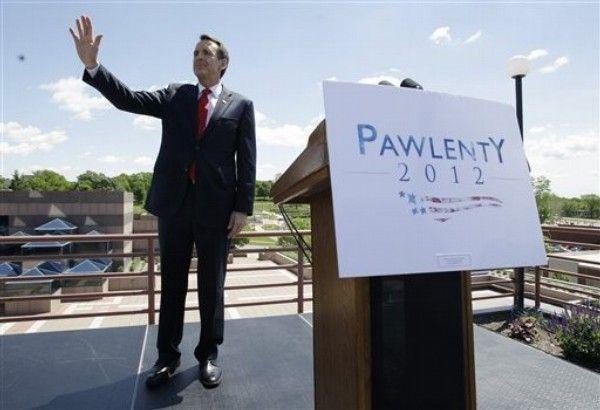
Stadium Deal Could Test Pawlenty's Fiscal Purity
Published June 16, 2011 • Read time: 5m
As the Minnesota Twins prepared to square off against the Seattle Mariners on May 27, 2006, Gov. Tim Pawlenty donned a Twins jersey with his last name plastered across the back and strutted out onto the artificial turf of the Metrodome where he "delivered a speech like an athlete who'd just won his first championship," according to the Star Tribune.
In the presence of team owner Carl Pohlad and former Twins greats such as Harmon Killebrew and Kent Hrbek, Pawlenty took a seat at an infield table and signed into law a bill authorizing construction of a $522 million outdoor stadium in downtown Minneapolis. The new law would guarantee that the team would remain in the Twin Cities after some ominous talk of relocation -- and even contraction -- had for years caused consternation among Minnesota's baseball fans and business leaders with interests tied to the team.
More than a decade in the making, the stadium deal moved the Twins out of the stale, football-centric Metrodome, built in 1982, and into the more aesthetically pleasing and baseball-friendly Target Field, which opened to rave reviews in 2010.
Though the Twins agreed to pay approximately one-third of the cost, the rest of the bill was to be footed by a 0.15 percent sales tax hike in Hennepin County -- a relatively small encumbrance on the state's largest county, but an increased tax burden nonetheless. The bill was controversial, since the state legislature and Pawlenty took advantage of a 1997 law to grant the county board permission to enact the new tax without a voter referendum.
Kids' Lives Matter Too
In a Corner of Ohio, Lessons of 2016
2016 Presidential Election Could Decide State Legislative Races
McCaskill Says No to Run for Missouri Governor
On the 2012 presidential campaign trail, Pawlenty has frequently touted his "A" grade from the libertarian-leaning Cato Institute and record of vetoing tax-hike packages, but the stadium deal could serve as an opportunity for his GOP rivals to make the case that Pawlenty's fiscally conservative record is far from unblemished.
"Opponents can use this against him in a couple of ways," Minnesota political analyst and Hamline University Professor David Schultz said. "How do we know that you're not going to do the same thing as president of the United States and push unfunded mandates down to the states? And then secondly, you actually in the process wound up creating greater tax burdens on local governments."
Even as Pawlenty wielded his veto pen to keep statewide taxes down during his eight years in office, critics frequently highlight his 75-cents-a-pack "health impact fee" on cigarettes and the massive projected deficit that he left his successor as proof that his record on fiscal issues was not as stellar as he has claimed.
The Twins stadium deal has thus far received scant attention in the national context, but the details of it could open Pawlenty up to further scrutiny over his peripheral role in seeing local taxes rise during his tenure.
As a state representative in 1997, Pawlenty opposed public funding for a new stadium. According to the Star Tribune, he said at the time that Minnesotans "do not want the state to use their money to subsidize billionaire team owners, millionaire athletes and the privileged elite who attend games in opulent luxury boxes." Pawlenty then cast contradictory votes on stadium proposals in 2001 and 2002 before finally settling on supporting public funding for the project.
The former Minnesota governor's allies now downplay Pawlenty's role in the deal, but even they concede that it was his ultimate decision to allow Hennepin County to bypass a voter referendum in raising its sales tax.
Pawlenty spokesman Alex Conant emphasized that all of the funding for the stadium project came from the county, not the state, and that local officials could have made the decision to put the tax hike to a vote before the governor got involved.
"He didn't approve the sales tax," Conant said of Pawlenty. "He simply let the local government -- Hennepin County -- decide how to proceed on its own."
Dan McElroy, a former Pawlenty administration official, noted that the "very small tax increase" used to build the stadium has raised additional revenue that has gone toward funding popular youth athletic fields and county libraries and that Target Field has proven both popular with fans and a financial success.
"It was a Hennepin County initiative that we signed, and we said that we would support it, but we were not terribly active in getting votes for it," McElroy said.
According to McElroy, Pawlenty's decision to allow the county to bypass the local referendum was largely a matter of timing and trust in the county board's judgment. "There will be people who raise all sorts of issues," he said. "I remember the governor and I having a conversation, and he said that anything we do, someone will criticize us for it, so let's just do the right thing. He believes this was the right thing, and I think history will support that."
University of Minnesota political scientist Larry Jacobs concurred that Pawlenty was not a driving force behind the stadium deal, despite the public theatrics that the governor engaged in during the 2006 bill-signing ceremony.
"The public story was that it was the county pushing for it, and he was kind of stepping out of the way to let the county handle it," Jacobs said. "Now there are certainly conservatives who had questions."
In a Republican primary environment in which a premium is placed on small-government orthodoxy, it is exactly those questions that could challenge the veracity of Pawlenty's repeated avowal that he has fought tax hikes at every turn.
The GOP Majority Should Go Out in Glory
Daniel McCarthy • RealClearPolitics
Republican Majorities Could Return Sooner Than Expected
J.T. Young • RealClearPolitics
The Danger Before the Attack
Leslie J. Sullivan • RealClearPolitics
Jon Finer’s Old and Dangerous ‘New Approach’ to Israel
Peter Berkowitz • RealClearPolitics
The President Deserves Better
John Ullyot • RealClearPolitics
Congress Doesn’t Need Another Blame Game. It Needs To Find What’s Broken
Jarrod Bernstein • RealClearPolitics
RCP Today
Top stories on RealClearPolitics
The Takeaway
Polling intelligence and analysis delivered to your inbox
World News
Featuring the latest world news
Policy
Featuring the latest policy news
Support Our Mission
As part of RealClearPolitics, authors aim to provide balanced, non-partisan analysis by presenting top reporting and commentary from all sides of the political spectrum.
Trusted by policymakers and citizens alike since 2000