Obama Releases Plan to Cut Business Regulatory Costs
Published May 26, 2011 • Read time: 5m
Join the Conversation
0Acting to fulfill one of President Obama's State of the Union pledges, the administration on Thursday released preliminary plans by at least 30 executive departments and agencies to cut "hundreds of millions of dollars" from regulatory compliance costs imposed on businesses this year, with "billions" in cumulative savings projected in years to come.
The White House in January launched the project to survey existing federal rules as part of the president's State of the Union agenda. Obama touted the re-examination of thousands of rules that impact the private sector -- particularly small businesses -- soon after Republicans won control of the House last November. The effort is in part intended to offset criticism that the administration remains unfriendly to employers and entrepreneurs.
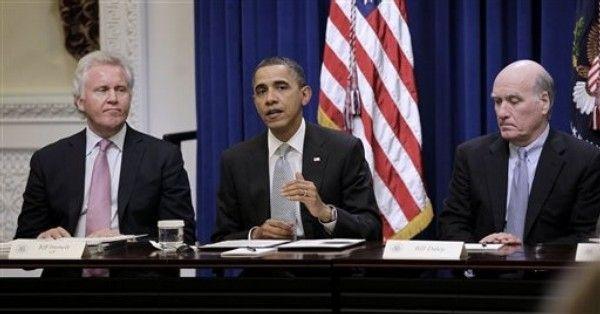
The president's outreach to the business community, including visits this year to select companies located in battleground states, will continue June 13 when Obama will travel to North Carolina for a meeting of his newly reconstituted Council on Jobs and Competitiveness. That advisory body is chaired by General Electric CEO Jeffrey Immelt.
"This is the beginning of what will become a new way of doing business," Cass Sunstein, the head of the Office of Information and Regulatory Affairs in the Office of Management and Budget, announced Thursday. He unveiled the preliminary results of the regulatory inventory in a speech delivered at the American Enterprise Institute. With the regulatory spring cleaning, he told reporters afterward, the president continues to "change the culture of Washington."
Obama's Foolish Gitmo Fixation
Choices Loom For Obama on Climate Change
Obama's Cloud-Based Transparency
Obama Signs Executive Order on Gov't Waste
So, just what regulatory deadwood will be cleared immediately? Dairy interests will see relief from oil spill rules imposed by the Environmental Protection Agency, for $140 million in savings this year and more than $1 billion over a decade. The Occupational Safety and Health Administration, part of the Labor Department, erased various reporting requirements, for a savings of $45 million annually. Harmonizing hazard labeling with other nations will also save more than $500 million each year, and the Transportation Department will selectively require new equipment on some -- rather than all -- trains, for an estimated savings of more than $1 billion over two decades, Sunstein said.
Washington's tug-of-war over regulatory policy is not new. Before Obama tackled the debate this year, Presidents Reagan and Clinton used their executive authority to establish special regimes to review the costs and benefits of proposed new rules. And President George H.W. Bush put Vice President Dan Quayle in charge of a "competitiveness council" that for a time battled the president's own EPA, which was deemed overzealous and unfriendly to business.
As with the capital's recurring skirmishes over taxes, the partisan debate about regulatory burdens vs. safeguarding the public remains lively, especially during a snail's-pace economic recovery while a Democrat occupies the White House and Republicans hold the House.
Representatives of the business community responded Thursday that the administration's efforts appeared to signal "progress" -- but progress that could gain momentum if Congress and the courts get more involved.
"What we need is a plan to make our flawed regulatory system smarter, less intrusive and more accountable," said Bill Kovacs, the U.S. Chamber of Commerce's senior vice president of environmental and regulatory policy. "Any such plan must require greater congressional oversight of rules that have a major economic impact; cost-benefit analyses and science reviews conducted entirely by independent third parties to ensure quality data and to remove politics from the equation; and greater judicial access for stakeholders, so they can enforce transparency, check bureaucratic power, and hold governmental decision makers accountable," he said in a statement.
Members of the business community are especially interested in the agency rules to come, including those for implementing the health care reform and financial reform laws. Sunstein said the president wants the same basic principles of effective and smart regulation to be applied to the rules of the future as well as to the stockpile already in effect. Independent agencies, consistent with practice since the Reagan era, are not covered by the review requirements.
Public-interest advocates said they are pleased that the departments and agencies appeared to have controlled the retrospective review process, rather than the West Wing. "If this plays out, this is an opportunity for building strong, better public protections," OMB Watch founder and Executive Director Gary Bass said in an interview.
Bass said he is dubious that Obama's initiative can appease business-sector critics. "Special interests are always searching for this pot of gold to slow down or kill regulations," he said. "I think Obama needs to understand that there's nothing he can do to satisfy them."
Public Citizen's Coalition for Sensible Safeguards, a collection of labor/consumer/science/environmental/health organizations, said in a statement that worries by business interests about costs and regulatory burdens can be -- and should be -- countered with recent examples of the costs to the public when the government has failed in its responsibilities to regulate and enforce federal requirements.
"Recent events like the Upper Big Branch mine explosion and the BP Deepwater Horizon oil spill disaster cost workers their lives," the organization stated. "The twin failures of business and government to look out for hardworking Americans cost the U.S. trillions of dollars, and more than eight million jobs."
The administration's "look-back" at existing regulations is posted on the White House website with invitations to companies and the public for feedback. The project, now in its first phase, followed a presidential executive order signed in January mandating that agencies "consider how best to promote retrospective analysis of rules that may be outmoded, ineffective, insufficient, or excessively burdensome, and to modify, streamline, expand, or repeal them in accordance with what has been learned. Such retrospective analyses, including supporting data, should be released online whenever possible."

Newsom Defies Voters, Juries and Lawmakers To Spare Murderers While Defending Abortion
Curtis Hill • RealClearPolitics
The Algorithmic Tilt
Frank Filingeri • RealClearPolitics
A RealClear Thanksgiving: Investing in a Better Future
David DesRosiers • RealClearPolitics
Trump’s Newsom Problem: Antagonist-in-Chief
Carolina Lumetta • RealClearPolitics
America’s Free Spirit
John Maxwell Hamilton • RealClearPolitics
The GOP Majority Should Go Out in Glory
Daniel McCarthy • RealClearPolitics
RCP Today
Top stories on RealClearPolitics
The Takeaway
Polling intelligence and analysis delivered to your inbox
World News
Featuring the latest world news
Policy
Featuring the latest policy news
Support Our Mission
As part of RealClearPolitics, authors aim to provide balanced, non-partisan analysis by presenting top reporting and commentary from all sides of the political spectrum.
Trusted by policymakers and citizens alike since 2000