Barry O'Bama and American Exceptionalism
Published May 24, 2011 • Read time: 7m
Join the Conversation
0On the 40th anniversary of John F. Kennedy's historic visit to Ireland, Washington journalist James R. Carroll penned a detailed account of that trip in a delightful book, "One of Ourselves."
JFK's 1963 trip to his ancestral homeland affirmed for the Irish that after centuries of struggling to forge a separate political identity, Ireland had truly emerged on the world stage. One of its grandsons had become president of the United States of America, and now walked easily among them.
"We came to regard the president as one of ourselves, though always aware that he was head of the greatest nation in the world today," Irish President Eamon de Valera would say later. "We were proud of him as being one of our race."
Technically, the Irish aren't a race, of course, and only the day before his visit, the American president had made very nearly the opposite point by declaring himself a West German. John Kennedy's Ich bin ein Berliner speech was an electric moment at the time, and still constitutes a watershed moment in Cold War history.
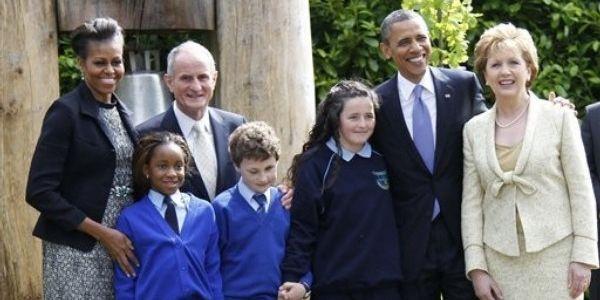
Yet it is Kennedy's nostalgic tour of the Emerald Isle that his successors have emulated. Richard Nixon, Ronald Reagan, Bill Clinton, and George W. Bush followed his path to Ireland. And now, our first African American president has done likewise, celebrating his obscure and recently unearthed Irish roots -- on his mother's side, naturally -- in the out-of-way village of Moneygall in County Offaly. And while on that road, the man who grew up answering to the name of "Barry Obama" stopped just long enough to expose the antiquated fallacy of racial and identity politics.
Lies, Assault and Cover-ups Don't Stop Donald Trump
Trump Stands by His Man; Obama on a Health Scourge; Hayden Interview; Reagan's Courage
Analysis: For Trump, Few Limits to Win-At-Any-Cost Approach
What If Clinton Isn't Indicted?
"Hello, Dublin! Hello, Ireland!" the president told a huge and adoring crowd gathered at College Green in the Irish capital on Monday. "My name is Barack Obama -- of the Moneygall Obamas. And I've come home to find the apostrophe that we lost somewhere along the way."
"I got it here!" quipped someone in crowd. "Go, Bulls!" yelled another Dubliner in honor of the American president's favorite pro basketball team. And then, in what was planned as little more than a feel-good moment designed to earn him the votes of a few Reagan Democrats (or Catholic Republicans), Barack Hussein Obama gave as concise and evocative a tutorial on "American Exceptionalism" as you'll ever hear.
It couldn't have come at a better time for him -- or us.
"Earlier today Michelle and I visited Moneygall, where we saw my ancestral home and dropped by the local pub," the president began. "And we received a very warm welcome from all the people there, including my long-lost eighth cousin, Henry. ... And it was remarkable to see the small town where a young shoemaker named Falmouth Kearney, my great-great-great grandfather, my grandfather's grandfather, lived his early life."
Like so many Irish emigrants, Falmouth Kearney left Ireland during the great famine, Obama continued, crossing the sea to New York, settling in the Midwest, marrying an American girl from Ohio, starting a family.
"It's a familiar story because it's one lived and cherished by Americans of all backgrounds," Obama said simply. "It's integral to our national identity. It's who we are, a nation of immigrants from all around the world."
In Obama's case, one of those seekers came from Kenya -- Barack H. Obama Sr. -- and he, too, married a girl from the Midwest. It's a story known around the world, in Africa and Ireland, Indonesia and Hawaii. It's a culmination of sorts, and a form of redemption, one made all the more poignant by the knowledge that the first African American president had maternal ancestors who owned slaves.
On the fringes of American politics, in both the Democratic and Republican parties, there are cynics who prefer the festering sores of an untreated affliction to the gratification that comes with healing deep wounds.
Last week, an African American college professor named Cornel West, apparently miffed because he didn't score enough inauguration tickets or because our wartime commander in chief won't always return his phone calls, employed race-baiting to register his displeasure with Obama. West, a tenured professor at Princeton, asserted that his "dear brother" was "a black mascot" more comfortable in the company of "upper middle-class white and Jewish men.''
The verdict in most quarters was that Cornel West was still the same blowhard he'd been a decade ago when Lawrence H. Summers eased him out at Harvard (and West responded that Summers had messed with the "wrong Negro").
But here's the real rub: Today's young Americans -- the people who actually attend Princeton -- are not only idealistic, but post-racial in their political outlook. Voters under the age of 30 went for Barack Obama in 2008 by a stunning 2-to-1 margin. These "millennials" are proud of Obama for the same reason cited by the Irish and citizens all over this planet. He's a biracial president, born too young to have either served in Vietnam or protested against it, with a single white mother from Kansas and a black father from Kenya; he exemplifies the very idea of American possibility.
Paradoxically, a Gallup Poll showed recently that Barack Obama scores much lower than previous presidents when voters are asked whether they think he believes in American Exceptionalism. This is not a good sign for president, and Obama and his political advisers have done what they can to address it. It stems, in some measure, from Obama's own propensity to apologize -- on foreign soil, no less -- for America's past sins, real or imagined. Also, he seems to shy away from speaking in triumphal terms about America's place in the world.
And when asked specifically by a British journalist in 2009 whether he believes in American Exceptionalism, Obama replied thusly: "I believe in American Exceptionalism, just as I suspect that the Brits believe in British exceptionalism and the Greeks believe in Greek exceptionalism."
This response sent Sarah Palin, for one, into orbit. Palin registered her objections in her recent book in a chapter titled "America the Exceptional." She is not alone. Many Republicans, particularly those who would like to unseat Obama in November of 2012, are quick to make hay on this issue.
"I don't apologize for America because I believe in America!" Mitt Romney told a conservative audience earlier this year. "The Obama administration fundamentally does not believe in the ‘American Experiment,' " Romney added in a recent speech on heath care.
"His worldview is dramatically different from any president, Republican or Democrat, we've had," chimed in Mike Huckabee. "To deny American Exceptionalism is in essence to deny the heart and soul of this nation."
But there is something discordant about this critique, just as there is about a black scholar using the lingo of the 1960s to attack the first black president of the United States. It's actually a classic form of cognitive dissonance, a point underscored this week by the thousands of adoring Irish citizens who came to see the U.S. president. In other words, whatever Obama says or does not say about American Exceptionalism, he is its living embodiment.
"Standing there in Moneygall, I couldn't help but think how heartbreaking it must have been for that great-great-great grandfather of mine, and so many others, to part -- to watch [the] Donegal coasts and Dingle cliffs recede, to leave behind all they knew in hopes that something better lay over the horizon," he said Monday.
"When people like Falmouth boarded those ships, they often did so with no family, no friends, no money, nothing to sustain their journey but faith -- faith in the Almighty; faith in the idea of America; faith that it was a place where you could be prosperous, you could be free, you could think and talk and worship as you pleased, a place where you could make it if you tried," Obama added.
"And as they worked and struggled and sacrificed and sometimes experienced great discrimination, to build that better life for the next generation, they passed on that faith to their children and to their children's children -- an inheritance that their great-great-great grandchildren like me still carry with them. We call it the America dream."

Newsom Defies Voters, Juries and Lawmakers To Spare Murderers While Defending Abortion
Curtis Hill • RealClearPolitics
The Algorithmic Tilt
Frank Filingeri • RealClearPolitics
A RealClear Thanksgiving: Investing in a Better Future
David DesRosiers • RealClearPolitics
Trump’s Newsom Problem: Antagonist-in-Chief
Carolina Lumetta • RealClearPolitics
America’s Free Spirit
John Maxwell Hamilton • RealClearPolitics
The GOP Majority Should Go Out in Glory
Daniel McCarthy • RealClearPolitics
RCP Today
Top stories on RealClearPolitics
The Takeaway
Polling intelligence and analysis delivered to your inbox
World News
Featuring the latest world news
Policy
Featuring the latest policy news
Support Our Mission
As part of RealClearPolitics, authors aim to provide balanced, non-partisan analysis by presenting top reporting and commentary from all sides of the political spectrum.
Trusted by policymakers and citizens alike since 2000