
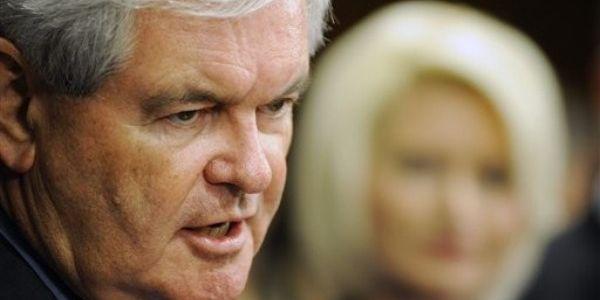
Gingrich's Short, Strange Rollout
Published March 4, 2011 • Read time: 4m
For months, former House Speaker Newt Gingrich had publicly targeted early March as his deadline for making a decision on whether to run for president.
When word leaked out last week that he was planning to announce the formation of an exploratory committee on Thursday, the plan seemed to be falling into place and on schedule for Gingrich to become the first major Republican candidate to take an official step toward mounting a campaign.
But last Tuesday night, Gingrich's spokesman Rick Tyler released what he called a "clarification" to media outlets that had been widely reporting the news.
"Gingrich is not travelling to Georgia to announce that he will form ‘an exploratory committee' as stated in the Des Moines Register," Tyler wrote in his press release. "To be clear, while Speaker Gingrich is in Georgia on Thursday, he will NOT announce the formation of an exploratory committee."
Tyler's statement directly contradicted an on-the-record comment printed in the Des Moines Register, which was attributed to Gingrich's longtime political adviser, Joe Gaylord, who had said that Gingrich was indeed set to announce the formation of an exploratory committee.
The confusion amounted to a matter of semantics, as Gingrich did announce on Thursday that he was exploring a presidential run but did not file paperwork with the Federal Election Commission, as he works to tie together loose ends among his various business interests before doing so.
But events only turned more curious on Thursday, leaving questions about how well planned Gingrich's rollout had been.
Gingrich's appearance at the Georgia state Capitol along with his wife Callista was billed as a "media availability," in which reporters are typically permitted to ask multiple questions.
The former speaker initially indicated he would stay for a while but told reporters on hand that he was most interested in taking questions related to his belief that federal regulations were hampering states' economic growth -- a topic he called the "specific purpose of today" and one that he had discussed in private with Gov. Nathan Deal (R-Ga.).
Despite the obvious reasons why so many reporters and television cameras were in the room, Gingrich said that only after talking about states' rights issues would he then get to the presidential question.
"I am glad to take any questions you have on the 10th Amendment before we get to the other topic," Gingrich said, according to a transcript provided by an aide.
When a reporter then asked if Gingrich could instead get to "the other topic" immediately, Gingrich replied that he had done his best to "get a substantive, policy-oriented moment here.
When the reporter asked if he would be running for president in 2012, Gingrich summarized the reasons why he was considering a White House run, including a desire to restore American exceptionalism, shrink government, reduce unemployment from 9 percent to 4 percent, and strengthen national security.
"We are today establishing a website: NewtExplore2012.com," Gingrich said, at last. "We will look at this very seriously, very methodically lay out the framework of what we will do next. We think the key is to have citizens who understand that this is going to take a lot of us for a long time working together. That is why we felt with the 10th Amendment to get power back home."
With that, Gingrich abruptly called short the press conference and was on his way.
According to the New York Times, Gingrich's appearance in front of reporters lasted a mere nine minutes.
With the first scheduled presidential debate less than two months away and other contenders expected to declare their own intentions in the coming weeks, Gingrich's every move will now fall under closer scrutiny, and the logistical hiccups of the past week have led Republicans and independent political watchers to wonder about the level of cohesion within his organization in the very early going.
Still, Iowa Republican Party Chairman Matt Strawn indicated to reporters earlier on Thursday that Gingrich had positioned himself to play a major role in the nation's first voting state.
"Mr. Gingrich was one of the more frequent visitors to Iowa over the last year-and-a-half and was helpful to Republicans at all levels," Strawn said. "So he was one of the more active Republicans in Iowa helping us in 2010."

RCP Today
Top stories on RealClearPolitics
The Takeaway
Polling intelligence and analysis delivered to your inbox
World News
Featuring the latest world news
Policy
Featuring the latest policy news
Support Our Mission
As part of RealClearPolitics, authors aim to provide balanced, non-partisan analysis by presenting top reporting and commentary from all sides of the political spectrum.
Trusted by policymakers and citizens alike since 2000